
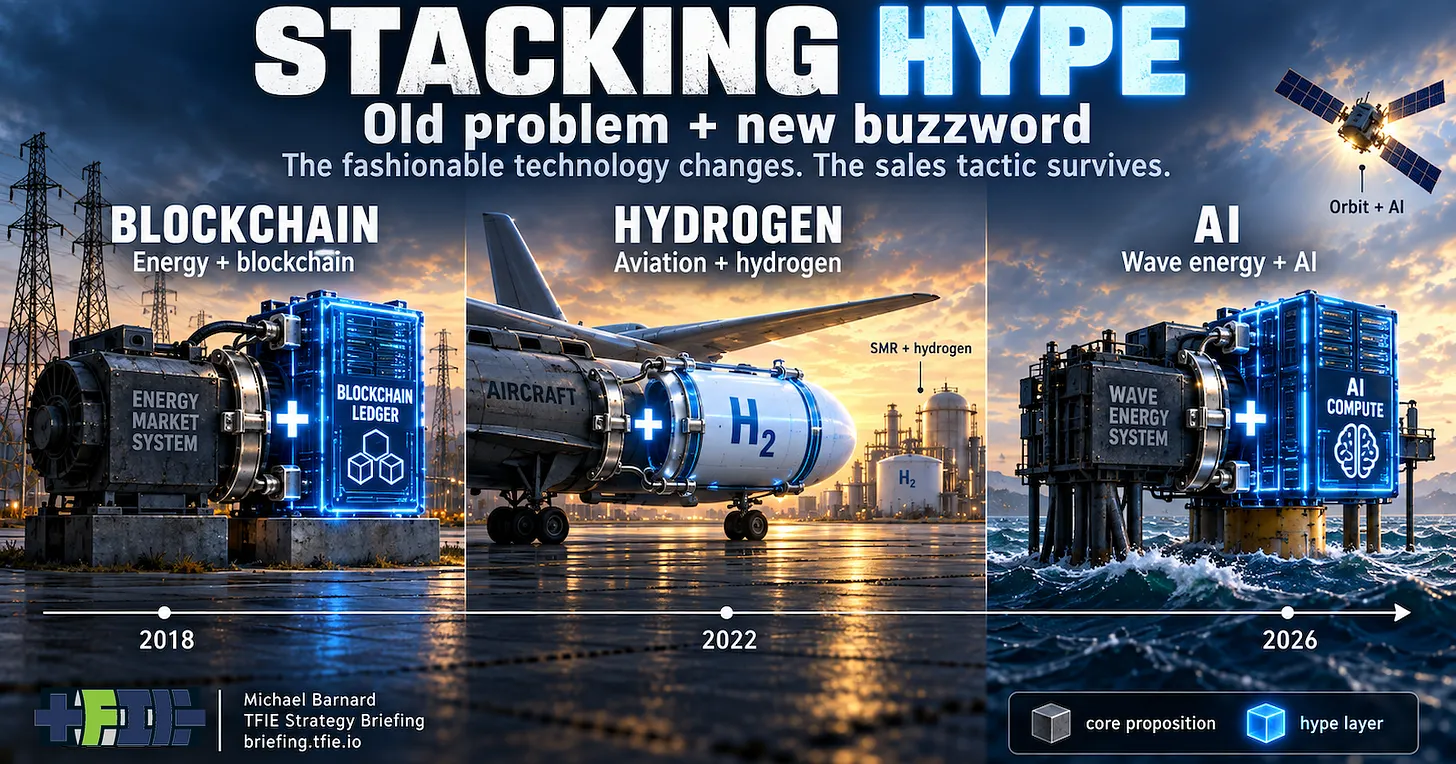
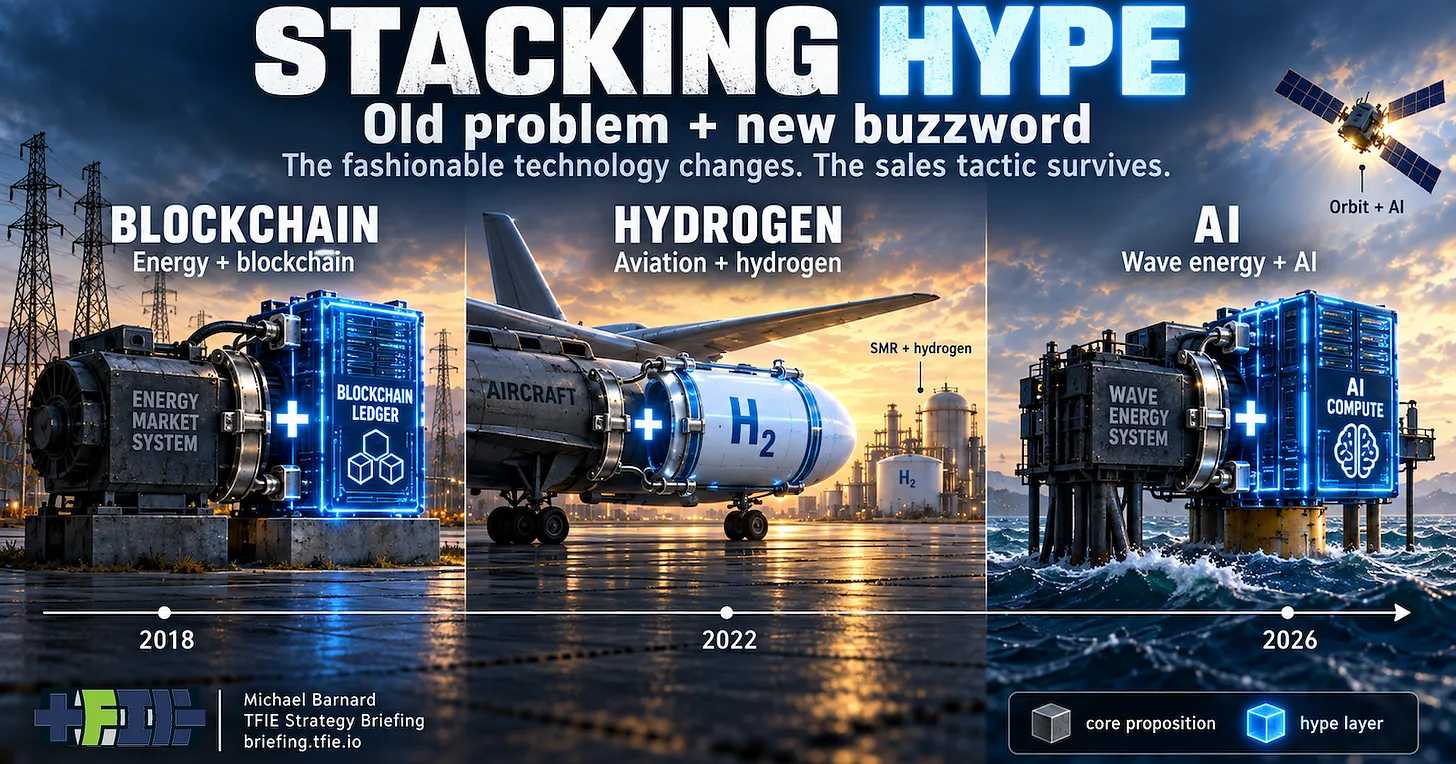
The evolution of venture capital and industrial innovation has long followed a predictable, if repetitive, cycle. From the initial fervor surrounding blockchain and the subsequent pivot toward hydrogen energy, the current investment landscape has been dominated by artificial intelligence. However, beneath the veneer of technological progress lies a consistent commercialization tactic: developers and startups are increasingly attaching high-profile, "trendy" narratives to unresolved engineering propositions before the underlying systems have achieved economic viability or proven their scalability. By layering a buzzy new technology onto an existing, struggling concept, companies often secure fresh capital, even as the core operational constraints remain unaddressed.
The Anatomy of Narrative Layering
This pattern of "hype layering" involves taking a fundamentally difficult engineering task—such as wave energy generation or specialized automotive manufacturing—and pairing it with an immature or high-growth technology. The intent is often to pivot the investor focus away from the difficult, long-term operational challenges toward a more immediate, speculative opportunity.
A prime example is the rise of autonomous ocean platforms designed for AI inference. Earlier this year, Panthalassa secured $140 million in funding to develop ocean-based platforms that generate electricity from waves to power onboard AI computing. The narrative logic is clear: by eliminating the need for subsea cables to transmit power to the shore, the company theoretically circumvents the logistical nightmare of grid connection. However, this approach merely trades one set of difficulties for another. The primary hurdles of wave energy—surviving corrosive saltwater environments, structural fatigue, extreme storms, and high maintenance costs—remain entirely unsolved. Adding high-value AI server racks, delicate power conditioning equipment, and complex communications arrays to a turbulent, offshore environment does not simplify the system; it introduces a new layer of mission-critical dependencies that are inherently vulnerable to the very environment the platform is trying to exploit.
Chronology of Commercial Shifts
The trend of appending "AI" to existing climate-tech challenges follows a well-documented timeline of failed or stalled sectoral pivots.
In 2023, the focus was heavily weighted toward the integration of hydrogen into various modes of transport. Startups promised hydrogen-powered supersonic aircraft, hydrogen-electric vertical take-off and landing (eVTOL) vehicles, and complex hydrogen-based storage solutions for mine shafts. By 2025, many of these entities were forced to confront the harsh reality of "stacking dependencies." A hydrogen-supersonic aircraft, for instance, required solving the challenges of cryogenic fuel storage, propulsion, and specialized fuel infrastructure, all while navigating the already rigorous certification processes of the aerospace industry.
The case of Destinus serves as a pivotal inflection point. Initially marketed as a hydrogen-supersonic aviation firm, the company shifted its strategic focus toward defense and missile systems by early 2026. This transition did not validate the feasibility of hydrogen-powered passenger flight; rather, it demonstrated that underlying capabilities—such as high-speed propulsion and autonomous navigation—could only find a paying market when detached from the impossible stack of dependencies required for commercial aviation.
Similarly, the trajectory of Gravitricity offers a cautionary tale. Initially focused on gravity-based energy storage using mine shafts, the company attempted to diversify into hydrogen storage (H2-FlexiStore) as the hydrogen hype cycle reached its peak. The firm entered voluntary liquidation in October 2025. While the hydrogen integration was not the sole cause of the failure, it diverted finite management attention and capital toward a second, equally unproven development program, effectively diluting the company’s ability to solve its core engineering problems.
The Aptera Case: A Study in Persistent Hype
Perhaps the most enduring example of this narrative layering is Aptera, which has maintained a presence in the automotive sector for two decades without bringing a production vehicle to market. Aptera’s marketing has consistently relied on the promise of body-integrated solar cells, a technology that works in specific, high-sunlight scenarios—such as an open driveway in Arizona—but fails to address the fundamental automotive challenges of mass production, safety certification, and broad consumer utility.
Despite repeated failures, the company has successfully utilized secondary narratives to sustain interest. These have included the promotion of in-wheel motors, generative design, and advanced driver assistance systems. Each new layer of "tech-speak" has served to keep the company in the news cycle, attracting equity investment and reservation deposits. As of recent filings, the company estimates it requires up to $160 million to scale its manufacturing to 20,000 units per year.
This suggests that the "solar" narrative serves more as a branding hook than a technical differentiator. While the company has accumulated roughly 50,000 reservations, these represent a minor fraction of the capital needed to reach true industrial scale. The persistence of such firms in the media, despite a lack of tangible delivery, highlights how narrative can outpace reality in the current venture capital environment.
The Diligence Framework: Constraint vs. Dependency
To distinguish between genuine innovation and hype, analysts and investors must distinguish between "system integration" and "dependency stacking."

In a functional system, such as a heat pump paired with thermal storage or an electric vehicle integrated with managed grid charging, the addition of a technology addresses a measurable constraint. The components perform complementary, identifiable tasks that collectively improve the economics or utility of the whole.
Conversely, hype layering creates a chain of failure points. In the case of offshore AI, the system requires the marine energy to function, the transmission to be stable, the cooling for the server to be managed, and the data connection to remain active in an oceanic environment. If any one of these subsystems fails, the entire value proposition collapses. As the number of dependencies increases, the probability of the entire system functioning at scale decreases exponentially.
Broader Implications for the CleanTech Sector
The shift from blockchain to hydrogen to AI is indicative of a broader incentive structure that rewards "unusual combinations" over iterative improvement. When a startup promises an AI-powered, wave-driven data center, it captures the attention of investors looking for exposure to both renewable energy and the AI boom. However, this often postpones the "uncomfortable comparison" with established alternatives.
For example, a terrestrial data center supplied by a combination of grid-scale wind, solar, and battery storage is currently a well-understood, reliable, and economically optimized model. A proposed offshore AI platform must not only prove its own hardware but must also prove that it can provide computing services at a lower cost per watt than a terrestrial facility. By adding the complexity of offshore infrastructure, the developer often sets a bar for success that is significantly higher than the standard they are attempting to disrupt.
Conclusion: Returning to the Denominator
The essential challenge for stakeholders is to move beyond the narrative and focus on the original economic denominator: What specific constraint is the added technology removing? How much operating burden is actually disappearing? And is the final, integrated system demonstrably more competitive than the simpler, mundane alternative?
When the answers to these questions are measurable and favorable, technological integration is a powerful tool for progress. However, when the answers are ambiguous or rely on future technological breakthroughs that have yet to materialize, the new layer is likely serving as a financing tool rather than a product enhancement. As capital becomes more discerning in the coming years, firms that prioritize fundamental engineering over narrative layering are the ones most likely to transition from speculative pilots to sustainable commercial enterprises. The history of the last four years suggests that while the names of the technologies change, the laws of thermodynamics and economics remain the ultimate arbiters of success.









Leave a Reply