
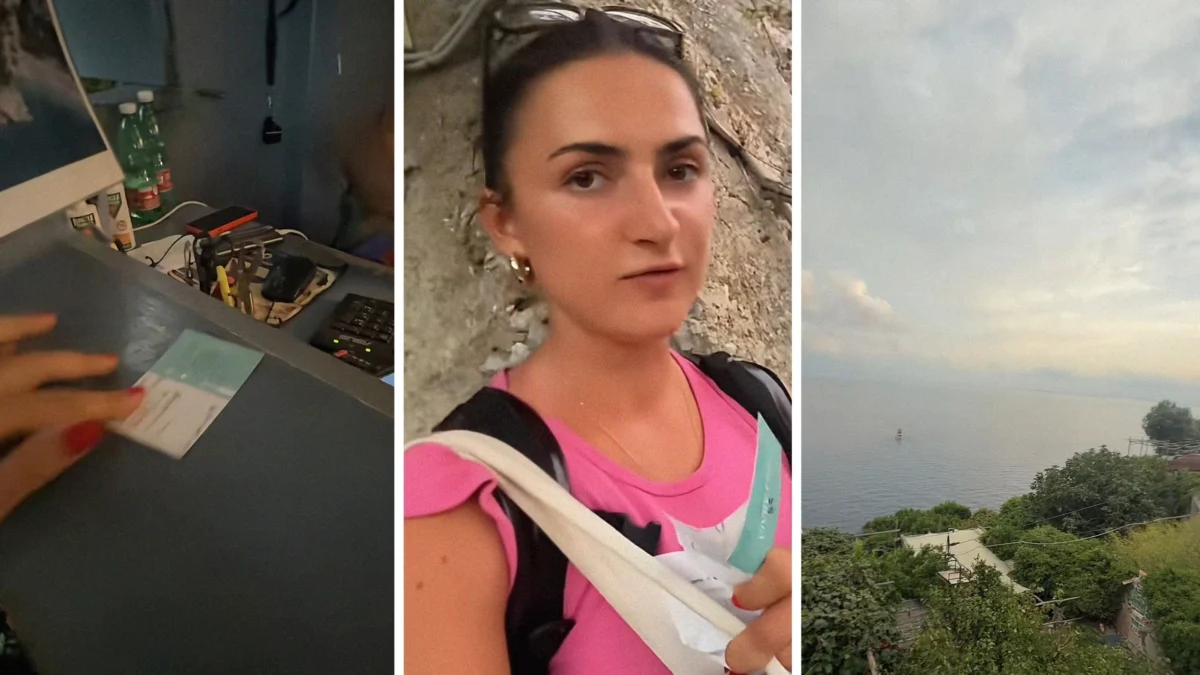
The eternal dilemma facing the modern traveler is how to maximize cultural immersion while minimizing expenditures. In high-demand European destinations like Italy’s Amalfi Coast, this challenge often borders on the impossible. Even the most modest accommodations frequently command prices comparable to luxury beachside resorts, forcing budget-conscious tourists to make difficult compromises. Recently, travel content creator Howsweethesound (@howsweethesound) documented this exact financial and physical ordeal, booking what was purportedly the least expensive accommodation available on the picturesque Italian coastline—a mountaintop tent costing $236 per night.
The resulting viral social media documentation has ignited a broader internet debate regarding modern travel ethics, the definition of value, and the stark divide between meticulous planning and spontaneous adventure.
Anatomy of a Budget Booking: The Ascent and the Expense
The journey began with the creator documenting her arrival via public transportation, burdened by a duffel bag and a backpack. Underlaid with text declaring her lodging the “cheapest accommodation on the Amalfi Coast,” the video details a grueling trek up a seemingly endless succession of steep stone staircases. The physical toll was immediately evident; the creator noted that her legs were trembling by the time she reached the summit.
Compounding the physical strain was a financial commitment that quickly escalated. Realizing the demands of the itinerary, the creator opted to extend her stay by an additional night, bringing the total expenditure for the lodging to $708—averaging $236 per night for what ultimately turned out to be a tent.
Upon completing the exhausting climb, however, the traveler was greeted by a surprisingly picturesque setting. The property featured a communal dining area and a terrace shaded by mature grapevines, offering sweeping, unobstructed views of the Tyrrhenian Sea. Upon unzipping her quarters, she revealed a surprisingly spacious, clean, and aesthetically pleasing tent that directly overlooked the water. A subsequent video tour revealed spartan yet functional shared bathroom facilities framed by fragrant lemon trees heavily laden with fruit.
Public Reaction and the Great Travel Ideology Debate
The viral documentation immediately polarized online audiences, drawing thousands of views and sparking intense discourse across TikTok and other digital platforms. Commentators quickly divided themselves into distinct camps regarding travel philosophy.
On one side were users enchanted by the rustic charm, romanticizing the prospect of sleeping under the stars, listening to live acoustic music, and waking up to the scent of Mediterranean citrus. Supporters praised the creator’s spontaneity, with user @stefanie.miss.b observing, “All it takes to be adventurous is to … go on one adventure.”
Conversely, critics questioned the financial wisdom and logistical foresight of the booking. Users expressed disbelief at paying over $200 nightly for what amounted to a campsite, questioning whether the lack of traditional hotel amenities justified the high cost. Comments such as “Did you not … plan anything?” and assertions from users who stated they would “HATE to travel” under such conditions highlighted a fundamental philosophical split in contemporary tourism: the friction between rigid itinerary planning and unstructured experiential travel.

Historical and Cultural Context of the Amalfi Coast
To understand the context of paying premium prices for minimal physical infrastructure on the Amalfi Coast, one must examine the region’s unique geography and storied history. Long celebrated as a landscape born from imagination, the Amalfi Coast features dramatic cliffs plunging directly into the Mediterranean Sea, with historic villages tucked into narrow coves. Key settlements such as Ravello, Amalfi, Praiano, and Positano have attracted elite travelers and artists for centuries.
Positano, perhaps the most internationally renowned town along the coast, boasts a lineage of tourism dating back to the Roman Empire. Long before the arrival of modern automobiles and tour buses, ancient Roman villas decorated the shoreline, vestiges of which can still be observed near local landmarks such as the Church of Santa Maria Assunta. Founded, according to local historical accounts, in the ninth century by inhabitants fleeing Saracen incursions, the town’s fortunes have fluctuated dramatically. It evolved from a medieval mountain refuge into a bustling 14th-century maritime trading hub, only to decline into a sleepy fishing village by the time of Italy’s unification in 1861.
The modern era of tourism in Positano was unlocked primarily by the construction of the SS163 highway in the early 20th century, which connected the isolated mountain communities to the broader Italian infrastructure. This engineering feat paved the way for an influx of artists, intellectuals, and celebrities drawn to the pristine shores of Spiaggia Grande and Fornillo beaches.
Economic Realities of Modern Mediterranean Tourism
The stark juxtaposition between the creator’s mountaintop tent and the opulence of the surrounding coast underscores the extreme economic stratification defining modern Mediterranean travel. While a rustic tented site commands $236 per night due to its geographical location, high-end amenities on the coast command astronomical figures. For instance, a single beach chair and umbrella rental at fashionable local establishments like La Scogliera starts at approximately €550 for a single day.
For travelers unable or unwilling to absorb such costs, the region does offer alternative, low-cost engagements. Natural attractions such as the Oasis of Vallone Porto and the mountain enclave of Montepertuso provide extensive hiking opportunities within walking distance of urban centers. Furthermore, the local culinary landscape offers accessible, high-quality traditional Italian pastries and regional fare that do not require resort-level expenditures.
Broader Implications for the Travel Industry
As digital content creators increasingly monetize raw, unvarnished travel experiences, consumer behavior shifts correspondingly. The viral success of the Amalfi Coast tent tour highlights a growing appetite among younger demographics for authenticity over standardized luxury. However, it also raises questions regarding price inflation in historically saturated tourist zones, where basic lodging provisions can command luxury-tier rates purely on the strength of a scenic view.
Industry analysts note that while spontaneous, budget-conscious travel narratives resonate powerfully on social media, they simultaneously risk normalizing hyper-inflated pricing models for substandard infrastructure. Whether paying hundreds of dollars for a mountaintop tent represents an authentic triumph of adventurous spirit or an inflated tourist trap remains entirely in the eye of the beholder.
As of press time, representatives for the platform have reached out to the creator for further commentary regarding her stay, though no official statements detailing the long-term logistical viability of such accommodations have been provided.










Leave a Reply