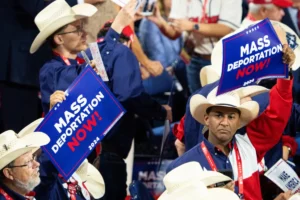
President Donald Trump’s job approval ratings have slumped to historic lows in recent weeks, a trend analysts attribute to a trifecta of economic and geopolitical headwinds: persistent inflation, surging fuel costs—with national averages now eclipsing $4 per gallon—and the political fallout from a contentious and unpopular conflict with Iran. Compounding these domestic pressures, the administration’s aggressive tariff policies have begun to ripple through the manufacturing sector, raising concerns among economists about the stability of the supply chain heading into the fall. Despite these formidable political hurdles, the mood inside the American Airlines Center in Dallas this week was one of defiance rather than despair. As the Republican Party converged for its midterm convention, the focus remained squarely on mobilizing the base and framing the upcoming November contests as a referendum on the "America First" agenda.
The gathering, dubbed by critics and supporters alike as a "Trumpapalooza," served as a litmus test for the president’s influence over the party’s rank-and-file. While some swing-district Republicans opted to distance themselves from the event to avoid being tethered to the president’s sagging numbers, the delegates in attendance were unwavering. For attendees like Pennsylvania state senator Scott Martin, the convention was a necessary tactical pivot. "I feel good about our candidates," Martin said. "Pennsylvania is not only critically important for presidential elections, but it is also critically important to where the numbers end up in the U.S. Congress."
The Strategic Calculus of the Midterm Cycle
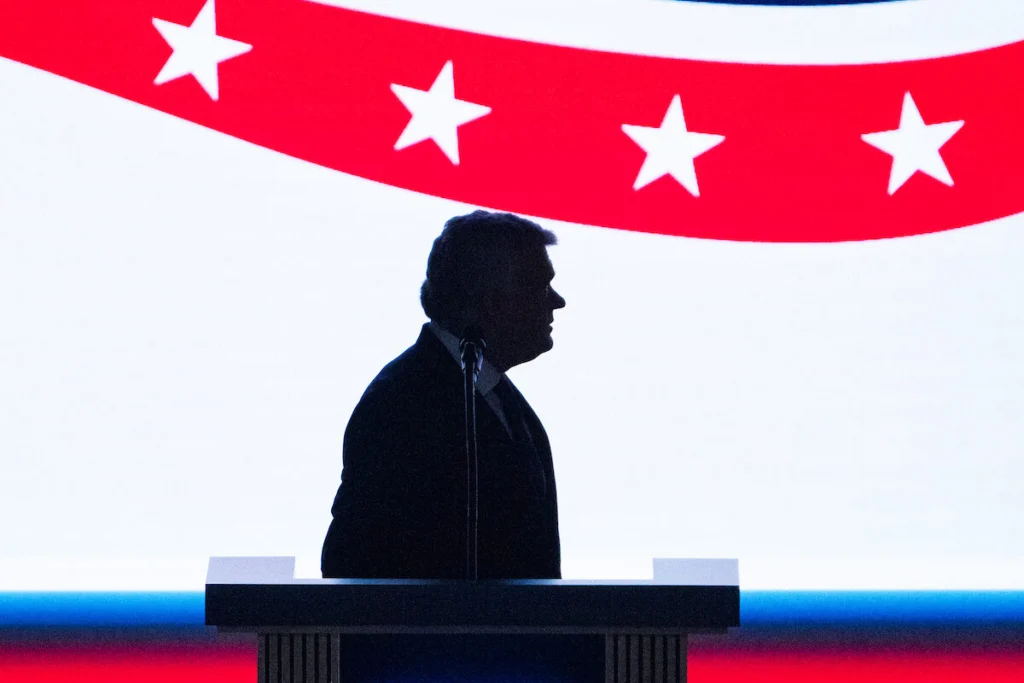
The historical reality facing the Republican Party is stark: the party in control of the White House almost invariably suffers losses during midterm elections. Recognizing this, President Trump utilized his two-hour keynote address to attempt to redefine the stakes. Eschewing traditional political rhetoric, the president employed a scattershot approach that oscillated between harsh attacks on "crazed" Democratic opponents and a bold, if controversial, economic proposal: a pledge to distribute $5,000 to every American citizen should the GOP maintain its majorities in both the House and the Senate.
The president’s core message to the faithful was a direct appeal for personal validation. "A president, Democrat or Republican, almost never wins the midterms," Trump acknowledged, framing the challenge as a struggle against institutional gravity. "We’ve got to change that because we have something going that’s so good. We can’t let that string be broken. So I’m asking you to pretend that I’m on the ballot."
The Legislative and Judicial Landscape
While the Dallas convention focused on grassroots energy, significant legal and procedural battles are unfolding in the background that could fundamentally alter the composition of the next Congress. In Missouri, the Supreme Court recently intervened to finalize the use of a 2022 congressional map for the upcoming election, effectively pausing a lower court’s order that had threatened to upend Republican-leaning districts. The decision provides a reprieve for Democratic Rep. Emanuel Cleaver II, whose district remains intact, potentially bolstering Democratic efforts to reclaim a foothold in the House.
Parallel to these electoral map battles, the Trump administration has introduced a controversial rule change regarding the 2030 census. By proposing the exclusion of undocumented and temporary immigrants from the population data used for congressional apportionment, the administration is reigniting a constitutional debate that is almost certain to reach the judiciary. Proponents argue this is a return to a strict interpretation of residency, while opponents decry it as a partisan maneuver designed to disenfranchise growing urban populations.
Continuity and Security Concerns
The political focus on midterms has not entirely eclipsed the long-term governance concerns of the legislative branch. This month marks the 25th anniversary of the September 11 terrorist attacks, a milestone that has renewed scrutiny of Capitol Hill’s continuity protocols. Despite years of deliberation, experts and advocates suggest that Congress has failed to implement robust contingency plans to ensure the continuity of government in the event of a mass-casualty catastrophe. The debate centers on whether the legislature can function remotely or through emergency session protocols—a topic that has remained stalled in committee for years.

The Changing Face of Campaign Finance and Messaging
The financial machinery of the 2026 cycle is also shifting. The pro-Trump super PAC, MAGA, Inc., has begun deploying a portion of its massive $400 million war chest into key Senate battlegrounds. A new iteration of this effort, the No Going Back PAC, has quickly emerged as a top-tier spender, reserving $49 million in airtime early this week alone. This influx of capital is intended to counter the narrative of economic dissatisfaction that has dominated recent polling.
However, the efficacy of this spending is being challenged by local dynamics. In Nebraska’s 2nd District, for instance, Republican nominee Brinker Harding has faced backlash for including investor Warren Buffett in a campaign advertisement without consent. The incident, which prompted a public rebuke from the Buffett family, highlights the perils of a campaign strategy that relies heavily on high-profile surrogates who may not support the candidate’s platform.
Voter Turnout and Mail-in Ballot Friction
A significant point of contention heading into November is the administration’s ongoing campaign against mail-in voting. According to recent Economist/YouGov data, roughly 15 percent of registered voters plan to cast their ballots by mail or via drop-box. The administration, in coordination with the U.S. Postal Service, has sought to impose new regulations that critics argue will create insurmountable logistical hurdles.
Two dozen states have filed legal objections, arguing that the timing of these changes—coming only weeks before the election—is intended to sow chaos and suppress turnout. While President Trump frequently utilizes mail-in voting himself, his rhetoric against the practice has remained a cornerstone of his campaign’s messaging. The friction is creating a bizarre electoral environment where state election officials are scrambling to send out ballots early to preempt federal interference, while voters express growing confusion over the integrity of the process.
Spotlight: The Iowa 2nd District Race
The contest for Iowa’s 2nd District, vacated by retiring GOP Senator Joni Ernst, serves as a micro-case study of the broader national struggle. Republican candidate Joe Mitchell, a housing developer and youth outreach advocate, is facing off against Democratic state Representative Lindsay James. The district, which Trump carried by 10 points in 2024, has become a focal point for Democrats who are looking to capitalize on agricultural dissatisfaction with trade tariffs and fuel prices.
Mitchell has leaned into his mentor Charlie Kirk’s "Turning Point Action" philosophy, though he has recently moderated his public-facing campaign website to reduce overt references to the president. James, conversely, has centered her platform on the "moral obligation" to address the rising cost of living, securing backing from EMILY’s List and gun-safety groups. With both candidates raising millions, the race is viewed by analysts as a barometer for how traditional GOP strongholds will react to the current administration’s economic policies.
Implications and Outlook
As the primary season draws to a close—with Delaware’s intraparty elections slated for next week and Louisiana’s jungle primary scheduled for November 3—the national political climate remains volatile. The "incrementally shifting" numbers identified by election analysts suggest that the Democrats have made modest gains in several key battlegrounds, but the Republicans remain well-positioned in deep-red districts.
The ultimate outcome of the 2026 midterms will likely depend on whether the president’s personal appeal can offset the empirical dissatisfaction with the economy. If the "Trumpapalooza" convention in Dallas proved anything, it is that the GOP remains a party defined by its connection to its leader. Whether that connection is sufficient to overcome the historical trend of midterm losses remains the most critical question facing the American political system as the nation pivots toward the final sprint of the campaign season. The intersection of economic anxiety, judicial intervention in voting rights, and a highly polarized electorate ensures that the final months of this election cycle will be among the most consequential in recent history.