President Donald Trump arrived in the Shenzhen economic zone on Wednesday, marking the beginning of a consequential trilateral summit with Russian President Vladimir Putin and Chinese leader Xi Jinping. The high-level meeting, held against the backdrop of the Pearl River, was ostensibly convened to address the urgent matter of global nuclear non-proliferation. However, the scope of the discussions has expanded rapidly to include the rapidly accelerating artificial intelligence arms race, the ongoing war in Ukraine, regional trade imbalances, and the intensifying standoff with Iran.
The summit occurs at a precarious moment for the Trump administration. Following significant losses in the November 2026 midterm elections, the president finds his political capital domestically diminished. This reality has fueled anxiety among congressional Democrats, who view the president’s personal rapport with Putin and Xi as a potential liability, fearing that his tendency toward diplomatic informality could be leveraged against U.S. national interests. Conversely, Republican allies on Capitol Hill maintain that the president’s unique approach to “dealmaking” remains the nation’s best hope for shifting the behavior of Russia and China.
Chronology of Diplomatic Maneuvering
The path to the Shenzhen summit began in earnest following the president’s recent tour of Southeast Asia. On Monday, while in Manila for the U.S.-ASEAN summit, President Trump touted a series of trade agreements with regional powers including Malaysia, Cambodia, and Indonesia, as well as longstanding allies Japan and South Korea. These agreements, which span sectors from energy to critical minerals and advanced technology, were presented by the administration as foundational to a broader strategy of regional containment.
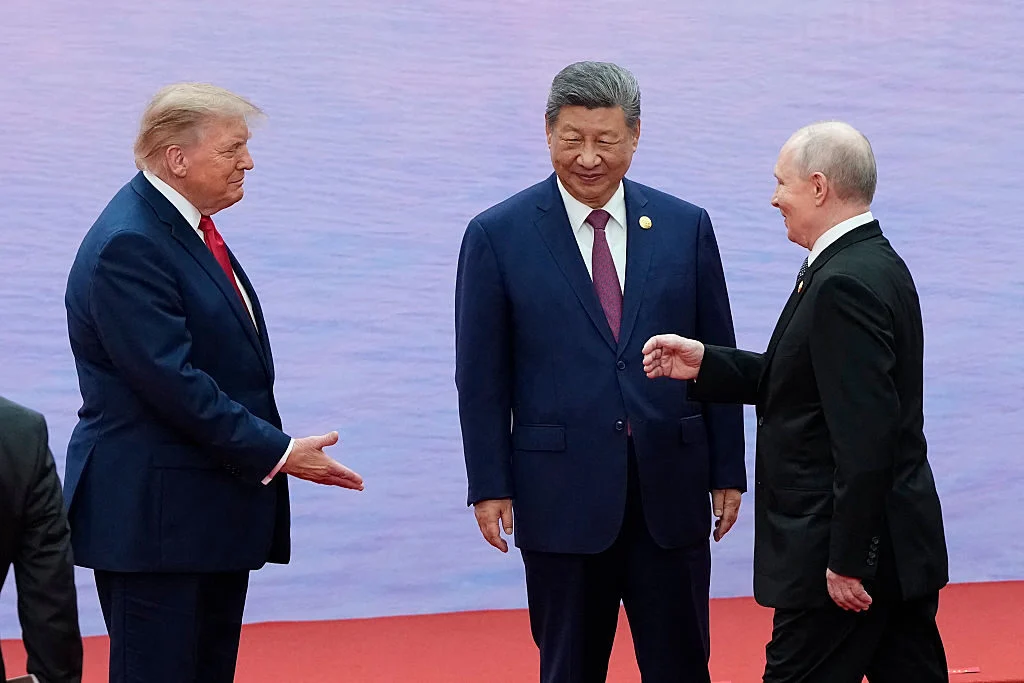
On Tuesday, as the president departed for China, he characterized the Russian leader’s recent posture in the Ukraine conflict as “backing down.” This remark, while intended to project strength, served as an immediate flashpoint in Washington. By Wednesday morning, the president had officially arrived in Shenzhen, where he was photographed in a cordial exchange with both Xi and Putin, signaling the formal commencement of the trilateral talks.
The Nuclear Non-Proliferation Dilemma
At the heart of the summit lies the question of nuclear disarmament. Despite the optimistic rhetoric from the White House, foreign policy experts warn that the challenges are immense. Heather Williams, director of the Project on Nuclear Issues at the Center for Strategic and International Studies (CSIS), noted in a recent analysis that the trilateral framework is “fraught with challenges.”
Williams argued that the diplomatic optics are particularly hazardous. “Putin could diplomatically outmaneuver the Trump administration and make any progress on nuclear issues dependent on undermining Western support to Ukraine,” she wrote. “Even the optics of Trump and Putin negotiating while the war continues and as Russia ramps up missile strikes on Ukrainian civilian targets could be interpreted as undermining U.S. values.”
Congressional Reactions and Partisan Divide
The divide on Capitol Hill reflects the broader uncertainty surrounding the summit. Senator Rick Scott (R-Fla.), a member of the Senate Armed Services and Foreign Relations committees, expressed a cautious hopefulness while acknowledging the deep-seated distrust of the foreign leaders. “As we all know, China and Russia want to destroy our way of life,” Scott stated on Tuesday. “But it would be great to reduce nuclear stockpiles and make sure we’re not going to ever get attacked.”
When pressed on whether he trusted the intentions of Xi or Putin, Scott was blunt: “Do I trust Xi or Putin? No, they’re a bunch of liars.” Despite this, he defended the president’s decision to engage in the dialogue, noting that “hope springs eternal.”
Democrats have been far more skeptical, with many voicing concerns over the lack of a clear strategy. Senator Mazie K. Hirono (D-Hawaii) expressed unease about the summit’s lack of a structured agenda, noting, “I’m not sure what’s going to pop out of [Trump’s] mouth next—especially for a meeting with two guys he clearly likes.”
Senator Tim Kaine (D-Va.) echoed these sentiments, particularly regarding the war in Ukraine. “I have some points of anxiety. I’m nervous about any discussion about Ukraine that doesn’t involve the Ukrainians,” Kaine said. “You can’t do that without Ukraine at the table. So the desire to bring about more peace and stability, that’s a good thing to talk about. But no conditions about Ukraine and ending that war without them at the table? Not so sure about that.”
The AI Race and the Nvidia Controversy
Beyond geopolitics, the summit is heavily influenced by the technology sector, specifically the global scramble for artificial intelligence dominance. President Trump has signaled his intent to question Xi regarding an alleged Chinese intelligence operative linked to the recent departure of Nvidia founder Jensen Huang. This internal crisis at Nvidia has sent shockwaves through the tech industry, prompting congressional oversight.
House Energy and Commerce Committee Chair Brett Guthrie (R-Ky.) underscored the severity of the situation in a formal letter to Commerce Secretary Howard Lutnick. Guthrie requested detailed information regarding the implementation of federal laws governing technology exports, specifically regarding semiconductor chips. The committee is concerned that current export controls are insufficient to prevent China from gaining an insurmountable edge in AI development, a sentiment shared by Senate Minority Leader Charles E. Schumer (D-N.Y.).
Schumer urged the administration to pivot away from what he described as “misplaced priorities” in Shenzhen. “Enforcement of the new rules restricting China’s access to our most sensitive AI chips should start today,” Schumer said on the Senate floor. “The president should focus more of his Asia swing on securing commitments from U.S. allies to block China from gaining an upper hand in the technology race.”
Implications for Global Stability
The implications of the Shenzhen summit extend far beyond the immediate discussions of nuclear warheads and chip exports. The meeting represents a test of the “great power competition” framework that has defined U.S. foreign policy for the better part of a decade.
If the president is successful in securing even minor concessions on nuclear arms reduction or a de-escalation in Ukraine, it could provide a much-needed boost to his administration’s standing. However, if the summit concludes without substantive outcomes, or if the president is perceived as having made concessions that undermine the sovereignty of U.S. allies, it could deepen the rift between the White House and a skeptical Congress.
Outgoing House Armed Services Vice Chair Rob Wittman (R-Va.) summarized the stakes: “They ought to be talking about how they don’t do those sorts of things, how they don’t threaten their neighbors, how they don’t try to intimidate through the assertion of force.”
As the talks continue through the week, the global community remains in a state of watchful waiting. The trilateral meeting in Shenzhen is more than just a diplomatic event; it is a critical juncture that will define the trajectory of U.S.-Russian-Chinese relations for the remainder of the president’s term. Whether the summit results in a breakthrough for global stability or serves as a reminder of the entrenched geopolitical rivalries remains to be seen. The administration’s ability to balance domestic pressure with international diplomacy will be the ultimate measure of the summit’s success.