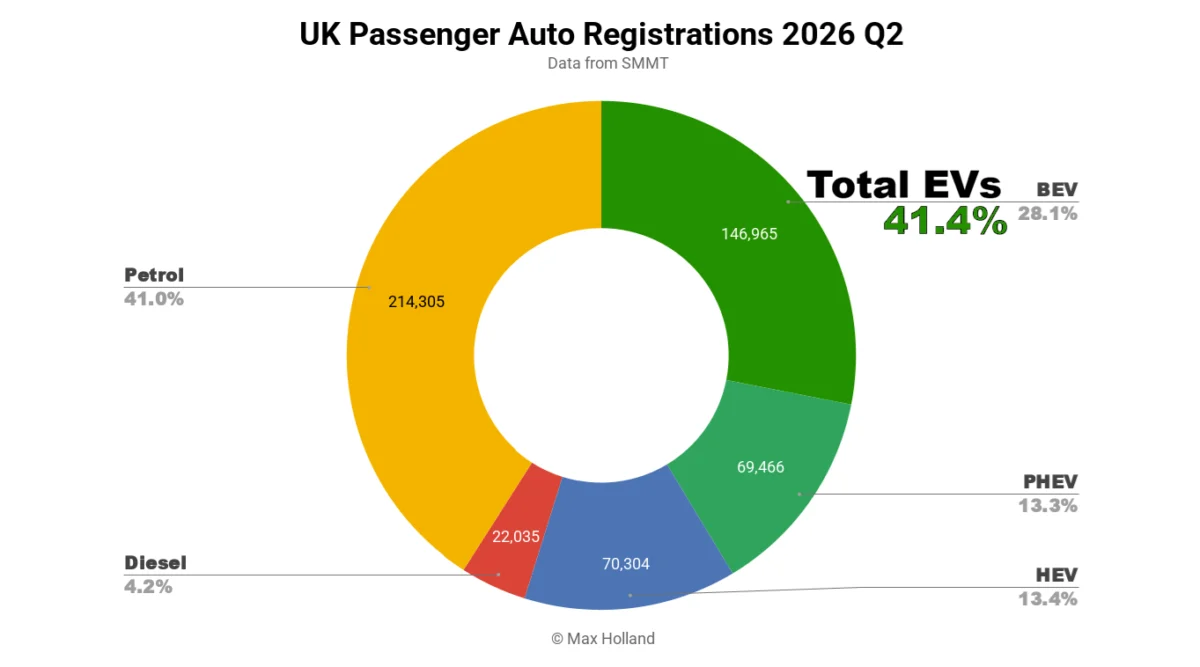
The United Kingdom’s automotive sector reached a significant milestone in the second quarter of 2026, with plugin electric vehicles (EVs) capturing a 41.4% share of the new car market. This represents a substantial increase from the 34.2% share recorded during the same period in 2025, signaling a rapid acceleration in the country’s transition toward sustainable transport. Despite broader economic headwinds and vocal opposition from legacy industry lobbyists, the data suggests that consumer demand for battery electric vehicles (BEVs) and plugin hybrid electric vehicles (PHEVs) is resilient, bolstered by shifting geopolitical realities and an evolving product landscape.
Total automotive registration volume for Q2 2026 reached 523,075 units, a 13% increase compared to the previous year. Within this growing market, BEVs emerged as the primary driver of growth, securing a 28.1% market share, up from 22.7% in Q2 2025. In terms of raw volume, BEV sales surged by 40% year-on-year, totaling 146,965 units. PHEVs also saw a modest but steady climb, reaching a 13.3% share (up from 11.6% YoY) with 69,466 units sold, representing a 30% volume increase.
The ZEV Mandate and the Lobbying Conflict
The surge in electric vehicle adoption comes at a critical juncture for the UK’s Zero Emission Vehicle (ZEV) mandate. For the 2026 calendar year, the government has set a target requiring 33% of all new car sales from manufacturers to be zero-emission. By the conclusion of the second quarter, the cumulative BEV share for the year stood at 25.0%, up from 21.6% at the same point in 2025.

This progress has become a flashpoint for political and industrial debate. The Society of Motor Manufacturers and Traders (SMMT), the primary lobby for the UK’s legacy automotive industry, has intensified its efforts to have the ZEV mandate watered down. Representatives from the SMMT have argued that the 33% target is "too hard" to meet under current market conditions, citing weak consumer confidence and the need for greater infrastructure investment.
However, a closer analysis of the registration data reveals a different narrative. While the cumulative 25% share is currently below the 33% year-end target, the trajectory is nearly identical to the 2025 cycle. In 2025, the industry was required to meet a 28% target and was similarly "behind" at the mid-year point, yet it managed to align with regulations through late-year surges. Furthermore, the momentum observed in Q2 2026 indicates a sharp upward trend. BEV volume growth, which sat at a modest 14.5% in Q1, accelerated to 40.4% in Q2. This steepening curve suggests that the market is naturally scaling toward the mandate’s requirements, casting doubt on the necessity of lowering regulatory standards.
Geopolitical Influences and Economic Pressures
The acceleration of EV adoption in the second quarter cannot be viewed in isolation from global geopolitical events. Rising fuel prices, exacerbated by the ongoing war of aggression against Iran, have significantly altered the total cost of ownership (TCO) calculations for UK motorists. Transport fuel prices rose by over 20% during the first half of the year, providing a powerful financial incentive for consumers to switch to electric alternatives.
This shift occurred despite a generally tepid UK economy. Revised figures for Q1 2026 showed GDP growth at a mere 0.9% year-on-year. While headline inflation cooled to 2.6% by the end of June—down from 3.3% in March—the persistent high cost of living remains a concern for households. Interest rates have remained stationary at 3.75% since mid-December 2025, keeping financing costs for new vehicles relatively high.
Despite these pressures, the Manufacturing Purchasing Managers’ Index (PMI) showed signs of stabilization, rising to 52 points at the end of Q2 from 51 points in Q1. This indicates a marginal expansion in the manufacturing sector, which may be benefiting from the localized production of EV components and the broader "green" industrial strategy.
Brand Performance and Market Shifts
Tesla maintained its position as the leading BEV brand in the UK during Q2 2026. The American automaker saw its market share improve from 9.8% in Q2 2025 to 11.0% in the current period. Tesla’s ability to maintain dominance in an increasingly crowded market is attributed to its robust charging network and aggressive pricing strategies that have forced legacy manufacturers to respond.
Volkswagen, once a dominant force in the UK’s electric transition, saw its BEV share slip from 9.5% to 7.2% year-on-year, landing it in second place. Kia, conversely, demonstrated strong growth, moving into third place with a 6.7% share, up from 4.7% a year ago. The success of Kia is largely attributed to the successful rollout of its diverse EV lineup, including the highly anticipated Kia EV2, which hit showrooms in Q2.
Other brands experiencing notable year-on-year growth include MG, Mini, and Toyota. The latter’s growth is particularly significant given its historical skepticism toward pure battery electric technology. Furthermore, the market is beginning to see the impact of new entrants and fresh models. Chinese-backed brands such as Leapmotor, Jaecoo, and Aion are gaining a foothold, offering competitive technology at lower price points. The debut of the Aion V and the all-electric Porsche Cayenne were among the highlights of the quarter, illustrating the broadening of the EV market from entry-level hatchbacks to luxury SUVs.

Conversely, brands such as BMW and Peugeot joined Volkswagen in losing market share during the quarter. Analysts suggest that these manufacturers may be struggling to balance their legacy internal combustion engine (ICE) portfolios with the rapid scaling required to stay competitive in the BEV space.
The Decline of the Internal Combustion Engine
As plugin vehicles rise, the dominance of the traditional internal combustion engine continues to erode. In Q2 2026, the combined share of pure combustion-only vehicles (petrol and diesel) fell to a record low of 45.2%. This is a landmark moment for the UK auto market, marking the first time that non-plugin vehicles have neared a minority status in quarterly registrations.
Industry projections suggest that if the current rate of adoption continues, the combustion-only share could drop to approximately 40% by the end of the fourth quarter. This decline is being driven not only by consumer preference but also by the strategic decisions of manufacturers to prioritize the allocation of semiconductors and production capacity to high-margin EV models to avoid ZEV mandate penalties.
Chronology of the UK’s EV Transition (2024–2026)
To understand the significance of the Q2 2026 data, it is helpful to look at the timeline of the UK’s policy and market evolution:

- January 2024: The ZEV Mandate officially begins, requiring 22% of new car sales to be zero-emission.
- Late 2024: Market share for BEVs stabilizes around 18-20% as manufacturers navigate early supply chain hurdles.
- January 2025: The ZEV target increases to 28%. SMMT begins initial lobbying for "flexibility."
- Q2 2025: Plugin EV share reaches 34.2%. Tesla remains the top seller.
- December 2025: The UK government reaffirms its commitment to the 2030 phase-out of new petrol and diesel cars, despite political pressure.
- Q1 2026: Growth slows temporarily due to economic uncertainty and high interest rates. ZEV target moves to 33%.
- Q2 2026: Geopolitical tensions lead to a spike in fuel prices. BEV sales surge by 40% YoY, bringing total plugin share to 41.4%.
Analysis of Implications
The data from Q2 2026 carries several long-term implications for the UK’s automotive landscape and climate goals. First, the resilience of EV demand in a weak economy suggests that the "early adopter" phase has successfully transitioned into the "early majority" phase. Consumers are no longer buying EVs solely for environmental reasons; they are doing so as a hedge against volatile fossil fuel prices.
Second, the disparity between the SMMT’s rhetoric and the actual registration data suggests a disconnect between industry lobbying and market reality. While some legacy manufacturers may find the ZEV mandate challenging, others are successfully pivoting. Policy makers who rely on the "it’s too hard" narrative risk stalling the very momentum that is necessary to achieve the UK’s Net Zero targets.
Third, the entry of brands like Leapmotor and Jaecoo indicates that the UK is becoming a primary battleground for global EV market share. The influx of high-tech, affordable electric vehicles from overseas will likely continue to put downward pressure on prices, benefiting consumers but challenging the profit margins of established European automakers.
Conclusion and Future Outlook
As the UK moves into the second half of 2026, the trajectory for electric vehicles remains positive. The combination of the ZEV mandate, high fuel costs, and an influx of new models is likely to keep BEV growth on a steady path. While the 33% annual target for zero-emission vehicles remains a high bar, the 40.4% volume growth seen in Q2 suggests that the goal is within reach, provided the industry maintains its current momentum.

The remaining months of the year will be a test of the UK’s charging infrastructure and the government’s resolve in the face of industry pushback. If the trend continues, 2026 will be remembered as the year the internal combustion engine lost its majority grip on the British road, paving the way for a fully electrified future. For now, the "crocodile tears" of the combustion lobby appear to be at odds with a public that is increasingly voting with its wallet for a cleaner, more cost-effective mode of transport.