The Battersea Shield stands as one of the most celebrated and enigmatic masterpieces of prehistoric European metalwork, representing the pinnacle of La Tène artistic achievement during the British Iron Age. Recovered from the murky depths of the River Thames in London during dredging operations in 1857, this remarkable artifact—officially classified as the bronze facing of a ritual or ceremonial shield—has captivated historians, archaeologists, and the public for well over a century. Crafted sometime between 350 and 50 B.C., the shield offers a rare window into the sophisticated metallurgical techniques, religious practices, and martial culture of ancient Britons centuries before the Roman conquest.
Discovery and Recovery in the River Thames
The story of the Battersea Shield begins in the mid-19th century amidst the rapid modernization and industrial expansion of London. On a spring day in 1857, workers engaged in dredging the bed of the River Thames near the site of the old Battersea Bridge uncovered an array of ancient items buried in the silt. Among the various wooden piles, weapons, and animal bones brought to the surface was a large, highly ornate sheet of beaten bronze that would eventually become known worldwide as the Battersea Shield.
At the time of its discovery, the practice of throwing valuable metalwork into rivers, bogs, and lakes was not yet fully understood by Victorian antiquarians. However, modern archaeological consensus recognizes these depositions as deliberate ritual offerings. The River Thames, a vital artery for trade, travel, and sustenance in ancient Britain, frequently served as a sacred space where communities cast high-status items to appease deities, mark significant transitions, or seal solemn oaths. The recovery of the Battersea Shield from the riverbed aligns with numerous other high-value discoveries along the Thames corridor, suggesting that the waterway held profound spiritual significance for Iron Age tribes inhabiting the region.
Chronology and Dating of the Artifact
Archaeological and art-historical analyses place the creation of the Battersea Shield broadly between the middle of the fourth century B.C. and the middle of the first century B.C., during the British Late Iron Age. This extensive timeframe reflects the ongoing academic debate regarding the precise evolution of La Tène art styles in Britain, a movement characterized by flowing, asymmetrical curvilinear patterns, stylized animal motifs, and intricate geometric designs.
While the exact year of manufacture remains elusive, typological comparisons with other Celtic metalwork found across Europe and the British Isles suggest that the shield was likely produced during the middle phase of this period, roughly around the 2nd or 1st century B.C. The advanced techniques required to cast, hammer, and rivet the bronze components indicate a society with highly specialized artisans who maintained extensive networks for raw material acquisition and artistic exchange across continental Europe.
Physical Characteristics and Craftsmanship
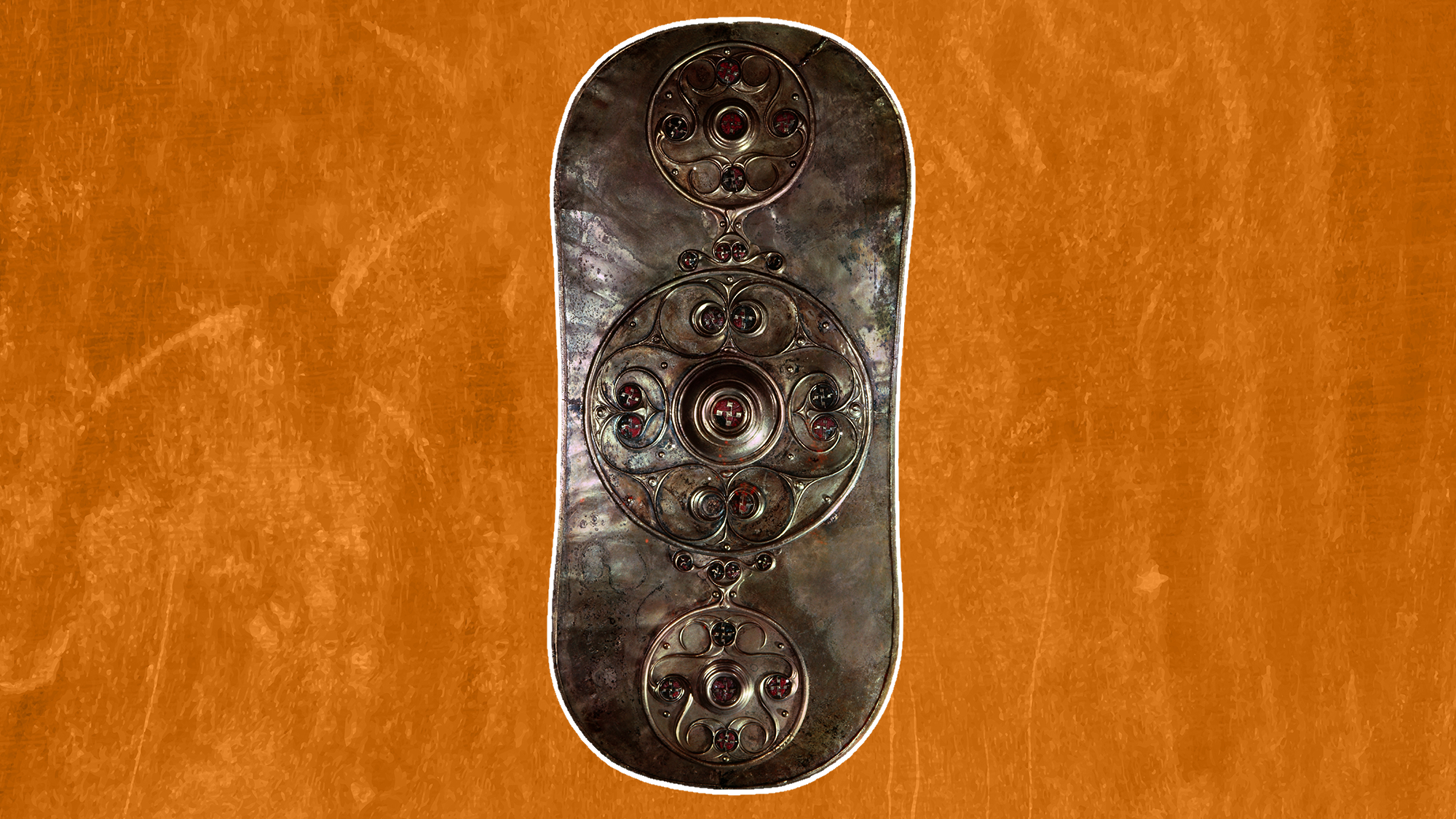
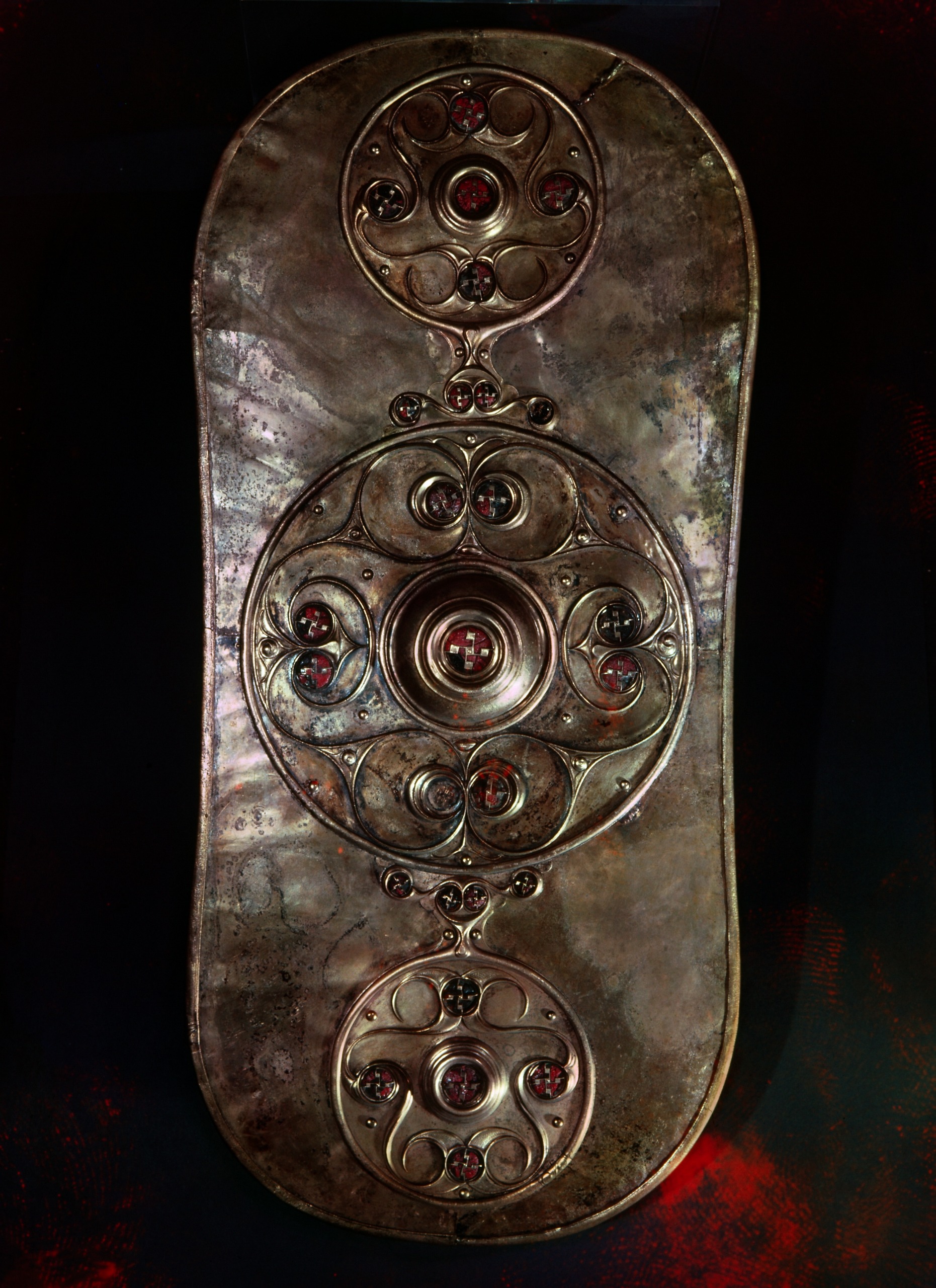
The Battersea Shield is not a complete defensive armor piece in the traditional sense, but rather the bronze facing that would have been mounted onto a wooden or leather substrate to form a functional or ceremonial shield. Measuring approximately 77.6 centimeters (30.5 inches) in length, the artifact is constructed from thin bronze sheets skillfully beaten and riveted together.
Its most striking visual features are the embossed or repoussé decorative elements. The face of the shield is divided into symmetrical panels featuring four prominent circular roundels. These red roundels were originally inlaid with vibrant red glass paste or enamel, a technique that would have created a stunning visual contrast against the polished bronze background when the shield was new. The surrounding metalwork is meticulously decorated with characteristic La Tène scrollwork, featuring swirling triskeles, lotus-bud motifs, and abstract plant-like patterns that demonstrate an exceptional mastery of metal manipulation.
Despite its intricate beauty, scholars debate whether the Battersea Shield was ever intended for actual combat. The thinness of the bronze facing and the presence of decorative inlays suggest that it may have been primarily ceremonial—designed to display the wealth, status, and divine favor of a chieftain or warrior elite during tribal gatherings, rather than to withstand the brutal impacts of sword and spear on a battlefield.
Supporting Data and Historical Context
To understand the significance of the Battersea Shield, one must examine the broader socio-political landscape of Britain during the centuries preceding the Roman invasion led by Julius Caesar in 55 and 54 B.C.
- Material Composition: Metallurgical studies of British Iron Age bronze artifacts indicate that craftsmen frequently recycled imported copper and tin, utilizing complex alloying proportions to achieve ductility for repoussé work and hardness for structural integrity.
- Geographic Distribution: Similar Iron Age river finds, such as the Witham Shield recovered from Lincolnshire and the Wandsworth Shield found further upstream on the Thames, indicate a widespread ritual tradition spanning multiple distinct tribal territories across southern and eastern Britain.
- Economic Networks: The presence of red glass inlay points to long-distance trade networks connecting Iron Age Britain with continental European centers, where glassmaking and enameling technologies were advanced.
These data points illustrate that the creators of the Battersea Shield operated within a complex, interconnected economy capable of supporting full-time master craftspeople who could dedicate weeks or months to producing a single luxury item.
Official Responses and Curation
Following its extraction from the Thames in 1857, the Battersea Shield quickly transitioned from a construction site curiosity to a treasured object of national heritage. Acquired by the British Museum, the shield became a cornerstone of the institution’s prehistoric galleries, where it continues to educate millions of visitors about the sophistication of pre-Roman British civilization.
Curators and conservators at the British Museum have undertaken numerous studies over the decades to preserve the delicate bronze structure and analyze its manufacturing techniques. Advanced imaging technologies, X-ray fluorescence, and digital 3D modeling have allowed modern researchers to peer beneath centuries of patina, revealing toolmarks and assembly methods that validate the extraordinary skill of Iron Age metalsmiths. Official museum commentary consistently emphasizes that the shield challenges outdated historical narratives that dismissed pre-Roman Britons as "uncivilized" barbarians, proving instead that they possessed a rich, vibrant artistic and technological culture.
Broader Impact and Implications
The enduring legacy of the Battersea Shield extends far beyond its physical beauty; it fundamentally shapes our understanding of identity, ritual, and power in Iron Age Britain.
By analyzing the context of its deposition in the Thames, historians gain insight into the psychological and spiritual dimensions of ancient tribal societies. Ritual wealth-destruction and votive deposition were powerful mechanisms for reinforcing social hierarchy and communal solidarity. When a community surrendered a masterpiece like the Battersea Shield to the river, they were not merely discarding an object; they were permanently removing immense economic and symbolic capital from circulation as an offering to the divine.
Furthermore, the shield serves as a vital touchstone for modern Celtic studies and public archaeology. Its iconic design has inspired generations of artists, jewelers, and designers, cementing its status as a visual shorthand for the ancient heritage of the British Isles. As ongoing archaeological discoveries continue to refine our chronology of the British Iron Age, the Battersea Shield remains an irreplaceable monument to the ingenuity, artistry, and spiritual depth of the people who shaped Britain’s ancient landscape.