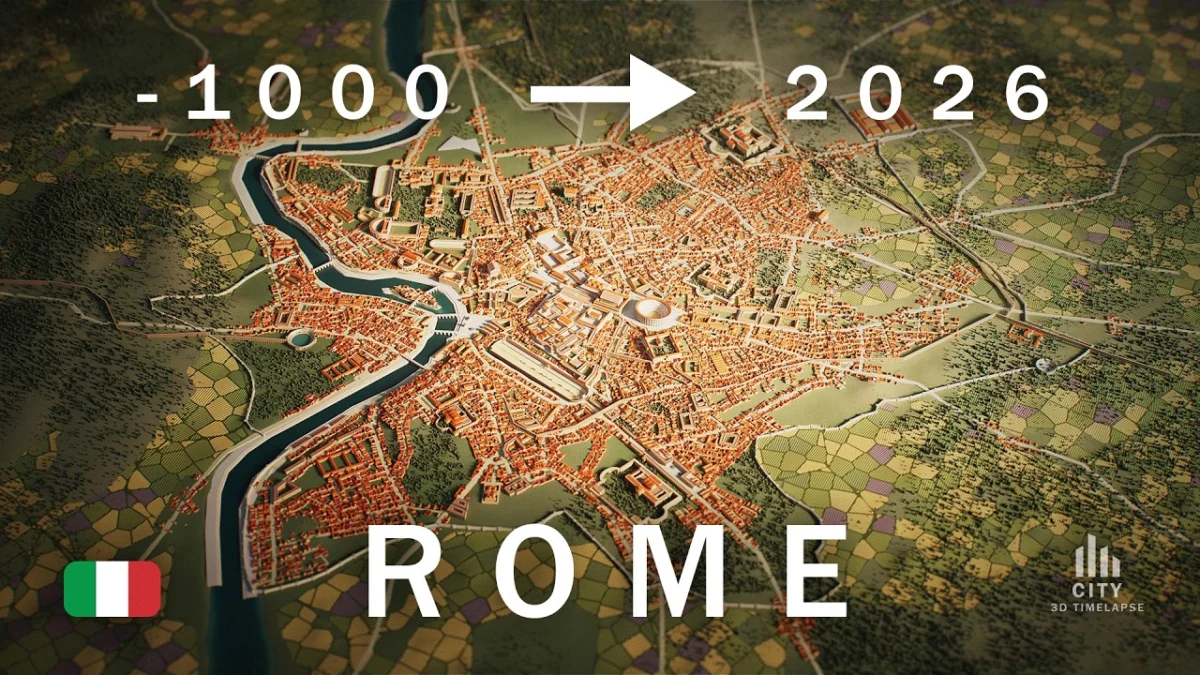
While historians and classical scholars have long debated the exact calendar year of the fall of the Roman Empire, visual evidence of its physical decline leaves little room for ambiguity. A newly released digital visualization from the media project City 3D Timelapse vividly illustrates the dramatic transformation of the Eternal City, chronicling its architectural apex, its desolate medieval trough, and its sprawling modern rebirth.
In this accelerated three-minute visual history, the critical transitional era around the turn of the sixth century AD unfolds in mere seconds. Viewers can watch as monumental structures begin to vanish at an alarming rate. Long before the conclusion of the first millennium, the once-mighty capital is shown plunged into a period of extreme urban contraction and hardship.
As the digital simulation accelerates, centuries of human history rush past. A 500-year span of medieval decay passes in just over five seconds. Within a single minute of screen time, the city’s footprint expands dynamically, pushing far beyond its ancient Aurelian walls and stretching past the margins of the aerial frame to form the sprawling, highly urbanized metropolis known to the modern world today.
The Mythological Genesis and the March of Eras
According to ancient legend, Rome was founded in 753 BC after Romulus slew his twin brother Remus during a dispute over the location of their new settlement. However, modern archaeological data indicates that the site along the Tiber River was inhabited significantly earlier. Despite this, the traditional founding date roughly coincides with the historical emergence of the Roman Kingdom.
Following the monarchical period, the city progressed through the trials of the Roman Republic and the vast territorial expansion of the Roman Empire. The trajectory then plummeted into the medieval era. During the Middle Ages, the once-formidable center of the Western world was largely left for dead, its grand public spaces reduced to pastures and ruins inhabited by a fraction of its former population.
Subsequent epochs brought dramatic shifts in architectural style and urban planning, moving through the Renaissance, the Roman Baroque period, the industrial era, and finally into contemporary globalization. To provide historical anchoring within the video, classical archaeologist and artist Giovanni Battista Piranesi appears near the 1:55 mark, representing the era when he created his highly influential etchings of Rome’s crumbling antiquities during the 18th century.
Urban Evolution: From Piranesi’s Ruins to the Modern Metropolis
The melancholic, overgrown ruins captured in Piranesi’s famous Vedute di Roma series bear little resemblance to the bustling, congested capital of the twenty-first century. While contemporary tourists can still view the Colosseum by moonlight, the sensory experience has fundamentally altered. Gone are the days when the amphitheater hosted hundreds of exotic plant species and wild overgrowth, meticulously cleared away by modern preservationists. Today, the monument is surrounded by steady streams of global tourism, year-round pedestrian traffic, and the ceaseless hum of urban transit.
Urban planners and historians frequently caution against viewing Rome strictly through the lens of its isolated ancient landmarks. For centuries, the city has been simultaneously celebrated and dismissed as an open-air museum. However, accelerated 3D timelapses challenge this static perception. By compressing millennia of urban construction, destruction, and reconstruction into the span of a short song, the simulation serves as a reminder that Rome was neither built nor rebuilt in a single day. Even in the face of formidable economic, political, and environmental difficulties across millennia, the city continually manages to innovate and adapt.
Chronology of Rome: A Millennial Overview
To understand the scale of transformation captured in the City 3D Timelapse, historians divide the city’s architectural and political evolution into several distinct phases:
- 753 BC: Traditional founding of Rome by Romulus; transition from early tribal settlements to the Roman Kingdom.
- 509 BC – 27 BC: The Roman Republic, marked by the expansion of republican governance and early monumental stone architecture.
- 27 BC – 476 AD: The Roman Empire, representing the height of classical urbanism, marble monuments, aqueducts, and imperial forums.
- 6th Century – 14th Century: The Middle Ages, characterized by population collapse, the abandonment of public infrastructure, and the ruralization of the urban landscape.
- 15th Century – 17th Century: The Renaissance and Baroque periods, which saw the resurgence of papal power, the construction of new basilicas, and the systematic mapping of antiquities.
- 19th Century – Present: The Industrial Era and Modern Globalization, transforming Rome into a major European capital with extensive suburban expansion beyond historic boundaries.
Academic and Technical Significance
Digital modeling of ancient cities has become an increasingly vital tool for both academic research and public education. Projects like City 3D Timelapse build upon decades of archaeological excavation, stratigraphical analysis, and textual scholarship. By translating complex geographic and historical data into accessible 3D environments, researchers can bridge the gap between dry academic texts and public engagement.
Institutions worldwide have embraced similar digital initiatives. Sapienza University of Rome, for instance, offers specialized online curricula exploring the changing landscape of the ancient capital, while digital heritage projects routinely release virtual tours recreating the Forum and the Colosseum as they appeared at their architectural zenith around 320 CE. These digital reconstructions allow students and enthusiasts to explore historical layers that are otherwise invisible to the modern eye.
Broader Implications and Legacy
The rapid digitization of historical geography offers profound implications for how society understands urban resilience. Cities are rarely permanent monuments frozen in amber; they are organic, evolving ecosystems subject to cycles of growth, decay, and reinvention.
Rome’s ability to survive the catastrophic collapse of centralized imperial authority, centuries of depopulation, foreign invasions, and the pressures of modern industrialization underscores a remarkable capacity for renewal. As urban centers globally face contemporary challenges related to climate change, population shifts, and economic restructuring, historical timelapses of ancient capitals provide a humbling perspective on the long-term lifecycle of human civilization. The visual record confirms that while empires rise and fall, the human drive to inhabit, rebuild, and continuously reinvent the urban landscape remains an enduring constant.