
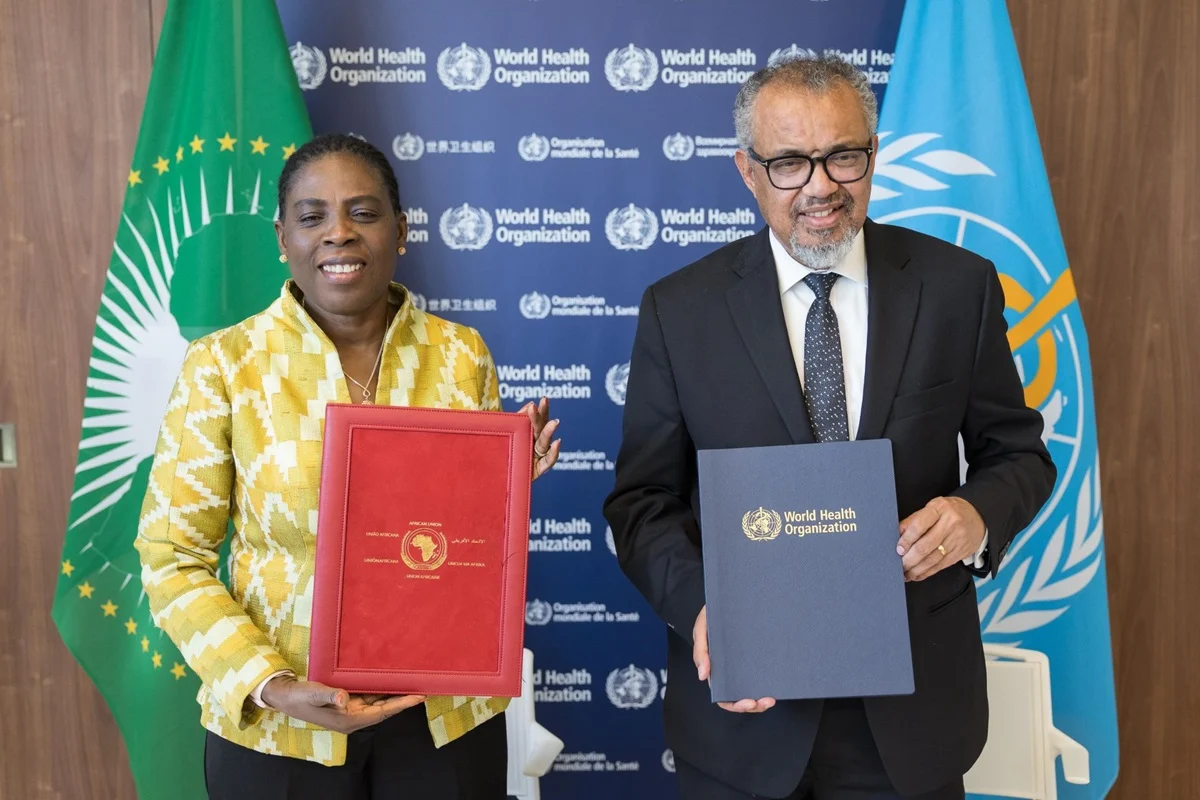
GENEVA — In a definitive move to reshape the trajectory of public health across the African continent, the World Health Organization (WHO) and the African Union (AU) Commission officially renewed their foundational strategic partnership on the sidelines of the 78th World Health Assembly. The signing ceremony, which took place in Geneva, Switzerland, introduces an updated Memorandum of Understanding (MoU) designed to fortify health security, accelerate universal health coverage (UHC), and drive sustainable development. This high-level pact arrives at a critical juncture for the international community, addressing unprecedented financial contractions in the global health ecosystem and setting a resolute course toward African-led health self-reliance.
The newly minted agreement underscores the burgeoning leadership of the African Union in fostering collective regional resilience, inclusive multilateral partnerships, and rigorous policy implementation. Central to this execution is the AU’s Department of Health, Humanitarian Affairs, and Social Development, which stands tasked with translating continental health aspirations into tangible ground-level realities.
A Defining Moment for Primary Health Care and Regional Autonomy
The formal document was executed by Her Excellency Ambassador Amma Adomaa Twum-Amoah, Commissioner for Health, Humanitarian Affairs and Social Development, speaking on behalf of His Excellency Mahmoud Ali Youssouf, Chairperson of the African Union Commission, alongside Dr. Tedros Adhanom Ghebreyesus, Director-General of the World Health Organization. This leadership alignment signals a profound shift in how multilateral organizations intend to interact with the Global South, moving away from paternalistic models of international assistance toward equitable, locally driven health governance.
During the signing event, Commissioner Twum-Amoah articulated the fundamental philosophy underpinning the renewed partnership. Emphasizing the necessity of systemic transformation, she noted that the agreement heralds an unprecedented chapter in cooperative health policy between the two institutions.
"This Agreement marks a new chapter in AU-WHO cooperation," Commissioner Twum-Amoah stated. "By working together more closely, we can better respond to the health needs of our populations and ensure that no one is left behind. The African Union values WHO’s central and leading role in global health and looks forward to deepening this strategic partnership in support of our shared goals. We need to move from budgeting for survival to planning for health sovereignty."
This call for "health sovereignty" resonates deeply within modern African policy circles. For decades, the continent’s healthcare infrastructure has been disproportionately vulnerable to external macroeconomic shocks, shifting donor priorities, and erratic bilateral aid disbursements. By anchoring future planning in domestic institutional capacity and streamlined multilateral cooperation, the AU aims to insulate its member states from the volatility of international financing.
Chronology and Evolution of the AU-WHO Partnership
To fully understand the gravity of the newly signed MoU, it is instructive to examine the chronological progression of institutional collaboration between the WHO and the African Union:
- Pre-2019 Foundations: Decades of ad-hoc technical cooperation, primarily driven by regional outbreaks such as the 2014–2016 West African Ebola crisis, which exposed severe structural gaps in continental health security and multilateral coordination.
- The 2019 Memorandum of Understanding: The signing of a comprehensive framework agreement that sought to harmonize WHO technical guidance with AU political mandates, establishing joint mechanisms for epidemic preparedness and health systems strengthening.
- The COVID-19 Pandemic (2020–2023): A profound stress test for global health architecture. The pandemic exposed stark inequities in vaccine distribution, prompting the AU to establish the Africa Centres for Disease Control and Prevention (Africa CDC) as an autonomous specialized institution and pushing for local vaccine manufacturing capabilities.
- The G20 Integration (2023): The African Union officially secured permanent membership in the G20, elevating the continent’s geopolitical leverage and ensuring direct representation in global economic and health governance discussions.
- The 78th World Health Assembly (Geneva, 2025): The formal updating, streamlining, and signing of the current MoU, designed explicitly to combat bilateral aid cuts and institutionalize the transition from aid dependency to sustainable self-reliance.
Navigating Global Financial Headwinds and Aid Reductions
The timing of the updated MoU is far from coincidental. The global health landscape is currently experiencing a severe liquidity crisis. Traditional donor nations across North America and Europe are facing domestic fiscal pressures, leading to profound contractions in official development assistance (ODA). Bilateral health aid—long a lifeline for HIV/AIDS, malaria, and tuberculosis programs across sub-Saharan Africa—has seen dramatic reductions.
Dr. Tedros Adhanom Ghebreyesus did not mince words regarding these financial pressures when addressing delegates and press representatives in Geneva.
"This renewed agreement comes at a critical time, as cuts to bilateral aid imperil the health of millions in Africa," Dr. Tedros warned. "It reflects our determination to translate our partnership into tangible results for the people of Africa, and support countries to leave behind the era of aid dependency and transition to sustainable self-reliance. We are proud to stand with the African Union in driving forward the health priorities of the continent."
The pragmatic implications of these aid cuts are severe. Millions of patients dependent on subsidized therapeutics, diagnostic campaigns, and maternal-child health initiatives face immediate service disruptions unless domestic resource mobilization can fill the financing void. The WHO-AU partnership specifically aims to mitigate these vulnerabilities by optimizing resource allocation, reducing administrative redundancies, and bolstering domestic tax-base investments in public health infrastructure.
Strategic Pillars of the Updated Framework
Building upon the structural foundation established by the 2019 agreement, the updated Memorandum of Understanding introduces a streamlined, highly focused architecture. While the foundational text spans multiple administrative domains, the collaborative framework concentrates on core operational imperatives:
- Advancing Universal Health Coverage (UHC): Strengthening primary health care (PHC) systems to ensure equitable access to essential medical services at the community level, thereby reducing catastrophic out-of-pocket health expenditures for vulnerable households.
- Bolstering Health Security and Emergency Preparedness: Enhancing early-warning surveillance systems, laboratory networks, and cross-border pathogen tracking in close coordination with the Africa CDC, preventing localized outbreaks from escalating into continental or global health emergencies.
- Promoting Local Production of Pharmaceuticals and Vaccines: Addressing the historical vulnerability exposed during global supply chain freezes by championing regulatory harmonization, technology transfer, and industrial capacity building for domestic vaccine and drug manufacturing across Africa.
- Tackling Non-Communicable Diseases (NCDs) and Climate-Health Nexus: Integrating responses to the rising burden of cardiovascular diseases, diabetes, and cancers, alongside addressing the acute public health impacts of climate change, food insecurity, and extreme weather events on African populations.
- Harmonizing Normative and Technical Leadership: Aligning WHO’s global normative standards with regional political commitments, ensuring that the Sustainable Development Goals (SDGs) related to health are systematically localized and executed across all 55 AU member states.
Fact-Based Analysis of Broader Implications
The formalization of this enhanced partnership carries significant geopolitical and operational implications for international public health:
- Elevated Geopolitical Agency: With its recent inclusion in the G20, the African Union is no longer merely a recipient of international health aid; it is an active co-architect of global health policy. The updated MoU reflects this shift by positioning the AU as an equal strategic partner to the WHO, rather than a passive field implementer.
- Institutional Accountability: By explicitly connecting technical cooperation to measurable outcomes in primary health care and domestic financing, the framework creates built-in accountability mechanisms. Member states are encouraged to move away from fragmented donor projects and toward integrated, national health sector strategic plans.
- Catalyzing the Private Sector and Innovation: The push for health sovereignty inherently involves engaging local academic institutions, the private biotechnology sector, and regional financial bodies (such as the African Development Bank) to create sustainable financing mechanisms, including domestic health bonds and innovative public-private partnerships.
- Mitigating Global Health Insecurity: In an interconnected world, pathogen surveillance in sub-Saharan Africa is a global public good. Strengthening African health systems directly fortifies international health security, making the entire global community more resilient against novel pandemic threats.
Looking Ahead
As the delegations conclude their engagements at the 78th World Health Assembly, the immediate task shifts from diplomatic consensus to rigorous operational execution. The success of this updated Memorandum of Understanding will ultimately be measured not by the rhetoric of its signing, but by the tangible improvements in health outcomes experienced by everyday citizens across the African continent—fewer preventable maternal deaths, more robust community clinics, reliable access to essential medicines, and enduring insulation against future health shocks.
Through this renewed pact, the World Health Organization and the African Union Commission have established a robust roadmap. By committing to structural resilience, financial sustainability, and uncompromising regional leadership, the partnership signals that Africa’s health future will be defined by self-determination, strategic foresight, and sovereign strength.
For Further Information and Media Inquiries:
- Professor Julio Rakotonirina | Director | Department of Health, Humanitarian Affairs and Social Development | African Union Commission | E-mail: [email protected]
- Ms. Stéphanie Seydoux | Director | DG Envoy for Multilateral Affairs | World Health Organization | E-mail: [email protected]
- WHO Media Team | World Health Organization
- Mr. King David Cartey | African Union Commission







Leave a Reply