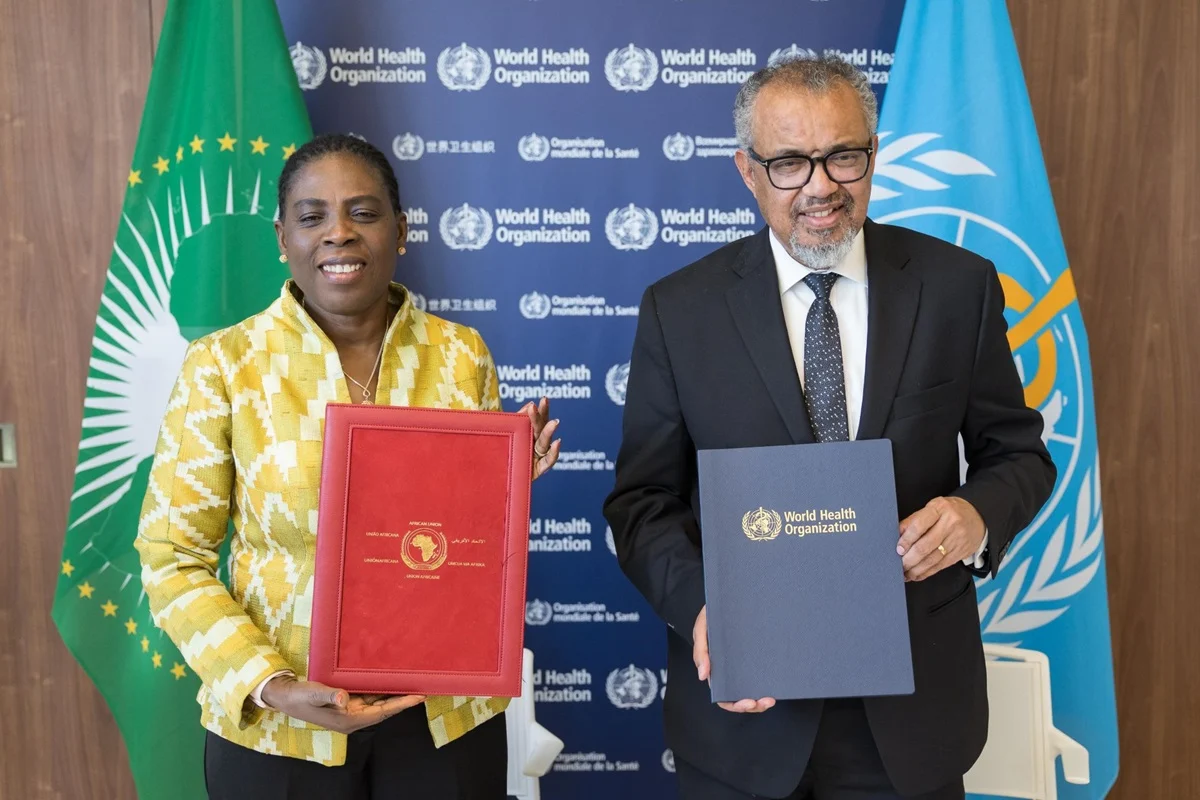
GENEVA — In a decisive move to fortify the continent’s health architecture against mounting global financial pressures, the World Health Organization (WHO) and the African Union (AU) Commission officially renewed their longstanding strategic partnership today. The signing of an updated Memorandum of Understanding (MoU) took place on the sidelines of the 78th World Health Assembly in Geneva, Switzerland, marking a critical juncture for health security, universal health coverage (UHC), and sustainable development across the African continent.
The high-stakes agreement underscores the African Union’s expanding leadership in fostering collective action, inclusive partnerships, and regional resilience. By positioning the Department of Health, Humanitarian Affairs, and Social Development of the AU Commission squarely at the center of the continent’s health policy implementation efforts, the updated pact seeks to streamline multilateral interventions and accelerate progress toward primary healthcare for millions of citizens.
The agreement was formally executed by Her Excellency Ambassador Amma Adomaa Twum-Amoah, Commissioner for Health, Humanitarian Affairs, and Social Development, acting on behalf of His Excellency Mahmoud Ali Youssouf, Chairperson of the African Union Commission, alongside Dr. Tedros Adhanom Ghebreyesus, Director-General of the World Health Organization. This landmark signing represents a foundational shift away from historical aid dependency toward a future defined by domestic resource mobilization, strategic self-reliance, and health sovereignty.
Chronology and Evolution of the AU-WHO Partnership
The path toward the current Memorandum of Understanding reflects a multi-decade evolution in international public health cooperation. Historically, health interventions in Africa were heavily driven by vertical, donor-funded programs that, while successful in eradicating specific diseases, often fragmented local health systems. Recognizing the need for a more cohesive, country-led approach, the WHO and the African Union have steadily tightened their institutional ties over the years.
A major milestone in this institutional relationship was reached in 2019, when the two organizations signed a comprehensive precursor MoU designed to align the WHO’s normative guidance with the strategic objectives of the African Union’s Agenda 2063. That agreement provided the framework for joint responses to persistent epidemics, institutional capacity building, and the strengthening of regulatory frameworks across AU member states.
Over the subsequent five-year period, the global health landscape underwent seismic shifts. The emergence of the COVID-19 pandemic exposed profound vulnerabilities in global supply chains, vaccine equity, and local manufacturing capacities within Africa. In response, the African Union and its specialized technical agency, the Africa Centres for Disease Control and Prevention (Africa CDC), assumed unprecedented operational leadership. The successful rollout of continental strategies, such as the Partnerships for African Vaccine Manufacturing (PAVM), demonstrated that regional bodies could successfully mobilize resources and coordinate public health responses on a massive scale.
The timing of the current 2024 renewal at the 78th World Health Assembly is particularly strategic. It coincides with the African Union’s recent elevation in global governance forums—most notably its historic inclusion as a permanent member of the G20. This expanded geopolitical footprint provides the AU with a powerful platform to advocate for systemic reforms in international financial architectures, debt relief, and equitable global health governance. Building directly upon the foundations laid in 2019, the newly updated MoU rationalizes cooperation across all AU entities, ensuring that WHO’s technical and normative leadership is deployed efficiently to support Africa’s self-determined health priorities.
Financial Realities and the Imperative of Health Sovereignty
The urgency driving the newly minted agreement cannot be divorced from the severe financial headwinds currently buffeting the global health sector. In recent years, traditional donor nations have faced domestic budgetary constraints, economic sluggishness, and shifting geopolitical priorities, leading to sharp reductions in bilateral health aid. For the African continent, where external financing has traditionally accounted for a significant percentage of public health expenditures, these sudden cuts pose an immediate existential threat to disease surveillance, maternal and child health programs, and the prevention and treatment of infectious diseases such as HIV/AIDS, tuberculosis, and malaria.
During the signing ceremony, Commissioner Amma Adomaa Twum-Amoah addressed this financial vulnerability with blunt realism, calling for a fundamental paradigm shift in how African nations approach healthcare financing.
"This Agreement marks a new chapter in AU-WHO cooperation. By working together more closely, we can better respond to the health needs of our populations and ensure that no one is left behind," Commissioner Twum-Amoah stated. "The African Union values WHO’s central and leading role in global health and looks forward to deepening this strategic partnership in support of our shared goals. We need to move from budgeting for survival to planning for health sovereignty."
Her sentiment was strongly echoed by WHO Director-General Dr. Tedros Adhanom Ghebreyesus, who highlighted the devastating real-world human cost of declining international assistance.
"This renewed agreement comes at a critical time, as cuts to bilateral aid imperil the health of millions in Africa," Dr. Tedros remarked. "It reflects our determination to translate our partnership into tangible results for the people of Africa, and support countries to leave behind the era of aid dependency and transition to sustainable self-reliance. We are proud to stand with the African Union in driving forward the health priorities of the continent."
By prioritizing health sovereignty, the AU and WHO aim to help member states internalize health spending as a core component of national economic security rather than a peripheral social sector dependent on the whims of foreign donors. This involves strengthening domestic tax bases, implementing innovative financing mechanisms, expanding universal health coverage schemes to reduce out-of-pocket expenditures, and fostering robust public-private partnerships within the domestic pharmaceutical and medical technology sectors.
Key Pillars of the Renewed Strategic Framework
While the overarching vision of the updated Memorandum of Understanding is the realization of universal health coverage and robust health security, the operational text outlines precise, actionable areas of collaboration designed to maximize efficiency and accountability. Although the formal document delineates five core operational pillars, the overarching strategy focuses heavily on structural transformation, normative alignment, and operational execution.
First, the partnership emphasizes the reinforcement of regulatory systems and regional manufacturing capabilities. The COVID-19 pandemic laid bare the perilous reality of a continent that imported over 99 percent of its vaccines and nearly 94 percent of its essential medicines. The renewed MoU provides a framework for the WHO to lend its rigorous technical expertise to the African Medicines Agency (AMA) and national regulatory authorities, ensuring that locally produced diagnostics, therapeutics, and vaccines meet the highest international standards of safety and efficacy.
Second, the agreement targets health emergency preparedness, prevention, and response. Learning from the lessons of recent outbreaks—including Ebola, Marburg virus, cholera, and mpox—the WHO and the AU Commission will work in lockstep to support member states in building resilient health systems capable of detecting pathogens at the community level before they escalate into cross-border crises. This includes strengthening laboratory networks, training rapid response teams, and integrating digital health surveillance systems across regional economic communities.
Third, the framework prioritizes primary health care (PHC) as the bedrock of sustainable health systems. By aligning WHO’s global normative guidance with the operational realities on the ground, the partners will assist governments in shifting resources away from top-heavy tertiary care toward community-based prevention, maternal health, and non-communicable disease management. This approach directly supports the realization of the Sustainable Development Goals (SDGs), particularly SDG 3, which aims to ensure healthy lives and promote well-being for all at all ages.
Fourth, the partnership focuses on workforce development and retention. Africa faces a well-documented shortage of healthcare professionals, exacerbated by the "brain drain" migration of skilled doctors and nurses to high-income nations. The renewed MoU provides mechanisms for collaborative capacity building, educational exchange, and the creation of an enabling environment that incentivizes health workers to remain within their home countries.
Finally, the agreement solidifies joint advocacy and multilateral diplomacy. With the African Union now occupying a permanent seat at the G20 table and commanding a stronger voice in global financial institutions like the International Monetary Fund and the World Bank, the WHO will act as a close technical ally. Together, the organizations will lobby for debt-for-health swaps, specialized drawing rights, and increased international development assistance that respects national ownership and avoids the historical pitfalls of donor conditionality.
Broader Implications and Global Significance
The cementing of this strategic alliance in Geneva carries profound implications for the broader architecture of global health governance. For decades, international health agendas were largely drafted in Geneva, Washington, and London, with African nations frequently relegated to the role of passive implementers of top-down mandates. The modern posture of the African Union, catalyzed by health emergencies and asserted through robust regional institutions like Africa CDC, signals the definitive end of that era.
By choosing to explicitly anchor the implementation of the MoU within the AU’s Department of Health, Humanitarian Affairs, and Social Development, the agreement validates the principle of regional agency. It signals to the international community that global health security cannot be successfully managed through fragmented, unilateral interventions; rather, it requires equitable partnerships that respect the sovereignty and strategic vision of regional bodies.
Furthermore, the transition from aid dependency to health sovereignty addresses a long-standing vulnerability in global economic stability. Pandemics and health crises do not respect national borders. When a continent of 1.4 billion people lacks resilient health systems and local manufacturing capacity, the entire global economy remains at risk of supply chain disruptions and prolonged contagion. By fostering a self-reliant African health sector supported by the technical prowess of the WHO, the global community gains a more stable, resilient partner in the ongoing defense against biological threats.
As implementation begins, the success of this updated Memorandum of Understanding will ultimately be measured by its tangible impact on the ground—in the rural clinics, urban hospitals, and public health laboratories across the 55 member states of the African Union. Through sustained political will, innovative domestic financing, and unyielding technical cooperation, the AU and WHO have set a formidable roadmap toward a healthier, more self-reliant African continent.
For further information and media inquiries, official representatives may be contacted directly:
- Professor Julio Rakotonirina | Director | Department of Health, Humanitarian Affairs and Social Development | African Union Commission | Email: [email protected]
- Ms. Stéphanie Seydoux | Director | DG Envoy for Multilateral Affairs | World Health Organization | Email: [email protected]
- WHO Media Team | World Health Organization
- Mr. King David Cartey | African Union Commission