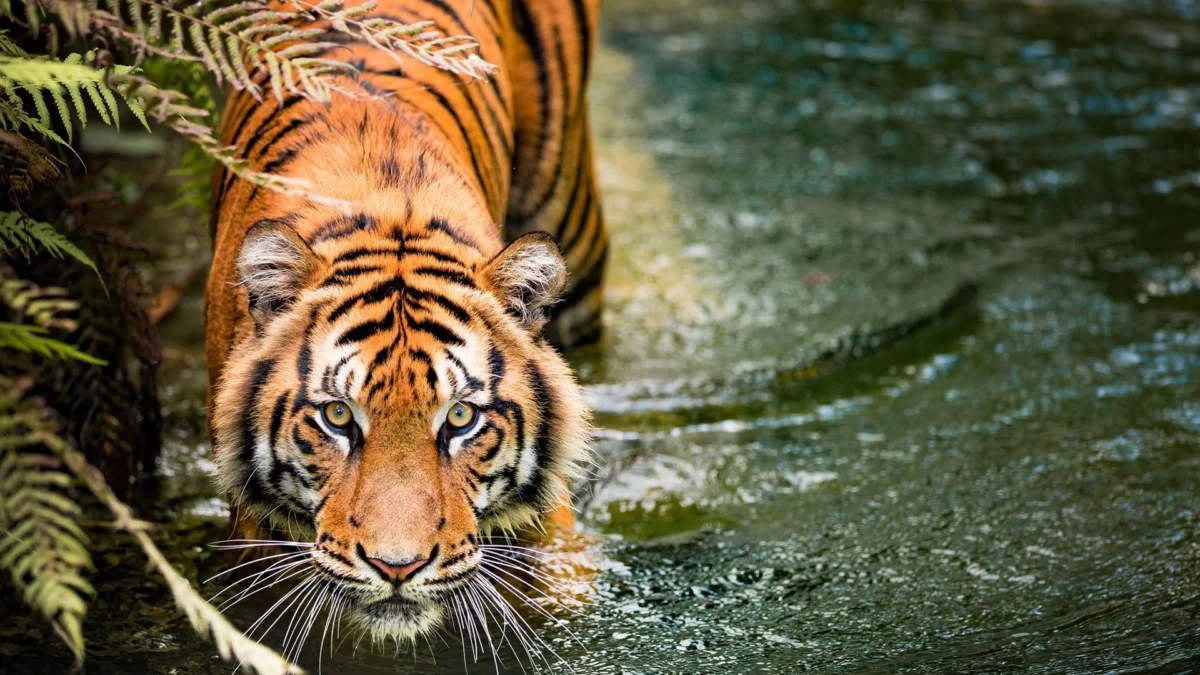
Rare and unprecedented footage captured in the rugged wilderness of Nepal has fundamentally challenged decades of established zoological understanding regarding tiger social behavior and parental roles. In a sequence broadcast as part of the PBS Nature documentary series Tiger Island, a mature male tiger is documented approaching his offspring, greeting them with a distinct head-bobbing motion while the mother rests nearby. This remarkable interaction shatters the long-held scientific dogma that male tigers play no role in the rearing of their young and typically maintain a strictly solitary existence, avoiding maternal dens to prevent infanticide.
The documentary, a comprehensive two-part production that chronicles the intricate lives of two distinct big-cat families across the diverse ecosystems of Nepal, provides researchers with a rare window into wild feline dynamics. According to wildlife biologist and filmmaker Dan O’Neill, who contributed extensively to the production of Tiger Island, this visual evidence marks the first time a complete tiger family unit has been documented coexisting and spending time together in the wild. The implications of this discovery extend far beyond a single heartwarming wildlife moment, forcing conservationists, behavioral ecologists, and field researchers to re-evaluate the social complexities of Panthera tigris.
Main Facts of the Discovery
The documented interaction centers around a male tiger approaching his dependent cubs, exhibiting a peaceful and communicative greeting characterized by a gentle head-bob. Nearby, the tigress rests without showing signs of aggression, territorial panic, or defensive posturing—behaviors that have traditionally been considered standard when a strange or territorial male enters the vicinity of vulnerable cubs.
Historically, mainstream wildlife biology textbooks and peer-reviewed literature have maintained that tiger social structures are strictly asocial. Adult tigers, particularly males, are known to roam vast, overlapping home ranges, interacting primarily for mating purposes. Once mating concludes, the female assumes total responsibility for gestation, parturition, and the arduous task of raising the cubs. For decades, standard scientific consensus dictated that mothers must fiercely guard their offspring not only from rival predators, such as leopards and dholes, but specifically from adult male tigers. Male tigers are well-documented perpetrators of infanticide, a reproductive strategy observed in many mammalian species where a male eliminates unrelated offspring to bring the female back into estrus.
The footage from Nepal complicates this simplistic narrative. It suggests that under specific environmental conditions, and perhaps with individual variations in temperament, male tigers may tolerate or even engage positively with their own offspring. This challenges the absolute nature of the solitary paradigm that has guided conservation management and behavioral studies for over a century.
Chronological Context and Field Documentation
The journey to capturing this historic footage spans years of meticulous field observation, advanced remote-sensing technology, and patient documentary filmmaking across Nepal’s protected areas. Nepal has long been a global conservation success story, particularly due to its rigorous anti-poaching measures, community forestry initiatives, and strict habitat protection policies implemented under the aegis of the Government of Nepal’s Department of National Parks and Wildlife Conservation (DNPWC).
In recent decades, Nepal’s tiger population has undergone a remarkable demographic resurgence. National tiger surveys, conducted systematically using camera-trap methodologies aligned with global standards, revealed that the country’s wild tiger population nearly tripled from an estimated 121 individuals in 2009 to 355 individuals in the 2022 national census. This dramatic increase in population density within limited geographic reserves, such as Chitwan National Park and Bardiya National Park, has inevitably led to shifts in spatial overlap and social interactions among resident tigers.
As tiger numbers rebound, the pressure on available territory intensifies. Young adults and established breeding males must navigate increasingly crowded landscapes. It was within this dynamic ecological framework that the production team behind Tiger Island deployed high-resolution cameras, thermal imaging, and long-lens tracking techniques to monitor the subtle, day-to-day interactions of these apex predators.
Months of tracking culminated in the serendipitous recording of the family dynamic. Field researchers monitoring the movements of the resident male and female noted overlapping home ranges, but direct visual confirmation of harmonious coexistence remained elusive until the specific sequence featured in the documentary was captured. The chronological timeline of the event highlights the immense difficulty of observing wild tigers, whose camouflage, nocturnal habits, and vast roaming territories make continuous behavioral studies extraordinarily challenging.
Supporting Data and Behavioral Science
To understand the magnitude of this discovery, it is essential to examine the baseline data concerning tiger social structure and parental investment. Mammalian carnivore biology traditionally categorizes felids into social species, such as lions, which live in prides, and solitary species, such as leopards, jaguars, and tigers.
Extensive field studies conducted over the past fifty years—pioneered by researchers in India’s Chitwan National Park and Russia’s Sikhote-Alin biosphere reserve—established that female tigers raise their cubs independently for a period ranging from 18 to 24 months. During this critical developmental window, mothers teach their offspring how to hunt, navigate territory, and avoid hazards. Throughout this period, the presence of an adult male near a natal den or a mother with young cubs was universally interpreted by field biologists as a mortal threat.
Statistically, infanticide by males accounts for a significant proportion of cub mortality in tiger populations where spatial competition is high. Because a tigress will not conceive while lactating and rearing cubs, the elimination of a rival’s offspring offers an evolutionary advantage to an incoming male by making the female receptive to mating within days or weeks of the event. Consequently, natural selection has favored hyper-vigilant maternal protection and avoidance behaviors in females.
The observation in Tiger Island does not invalidate the prevalence of infanticide, but it introduces the concept of behavioral plasticity. Animal behavior is rarely monolithic; while general rules define a species, individual personalities, ecological saturation, food availability, and kinship recognition can modify behavioral outputs. Biologists have increasingly recognized that solitary species possess more complex social networks than previously acknowledged, facilitated by scent-marking, vocalizations, and indirect communication that help individuals map the social landscape of their habitat.
Reactions and Expert Analysis
The release of the Tiger Island footage has prompted widespread discussion within the global conservation and academic communities. Wildlife biologists who reviewed the footage prior to its broadcast noted that while anecdotal reports of unusual male tolerance have occasionally circulated among field rangers and safari guides, verified, high-definition visual documentation has been entirely lacking until now.
Dr. Dan O’Neill, reflecting on the significance of the footage, emphasized that capturing this interaction forces a paradigm shift in how science views feline paternal engagement. "For generations, the textbook definition of a tiger’s social life has been rigid: solitary, fiercely independent, and hostile outside of direct mating contexts," O’Neill noted. "Seeing a male approach his cubs with non-aggressive, communicative body language—and observing the mother’s calm acceptance—demonstrates that we still have much to learn about the emotional and social lives of these magnificent animals."
Other conservation scientists have urged caution against over-interpreting the footage as a universal behavior. Dr. Hari Sharma, a conservation ecologist specializing in large carnivore management in South Asia, pointed out that while the event is scientifically exhilarating, it must be contextualized within Nepal’s unique conservation landscape.
"When tiger populations reach high densities, as we are witnessing in Nepal due to successful recovery programs, the traditional spatial buffers that kept solitary tigers apart begin to erode," Dr. Sharma explained. "Encounters that were once evolutionary anomalies may become more frequent as animals adapt to sharing compressed habitats. Whether this particular interaction represents an isolated paternal anomaly or a broader, under-documented facet of tiger society requires rigorous, long-term telemetry and genetic tracking."
Furthermore, animal behaviorists suggest that the head-bobbing motion observed in the male tiger is a specialized form of visual signaling. Similar subtle movements are documented in other felids as appeasement gestures or distance-reducing signals, designed to communicate non-hostile intent to conspecifics. The fact that the male utilized this specific communicative cue indicates a level of social intelligence and nuance that challenges the outdated characterization of tigers as purely reactive, instinct-driven predators.
Broader Impact and Implications for Conservation
The documentation of a multi-generational tiger family unit spending time together carries profound implications for conservation strategy, wildlife management, and public education.
First, it highlights the importance of protecting contiguous, high-quality habitats that allow for natural social dynamics to unfold. As conservation efforts succeed globally, the focus is shifting from merely increasing head counts to ensuring the ecological health and behavioral diversity of wild populations. Understanding how apex predators negotiate shared spaces, territorial boundaries, and family structures helps wildlife authorities design better protected-area networks and wildlife corridors.
Second, this discovery underscores the critical role of advanced natural history filmmaking in scientific discovery. While academic field studies rely heavily on telemetry collars, scat analysis, and camera traps—which provide quantitative data but limited behavioral context—high-end documentary crews often invest thousands of hours observing specific animal lineages. This synergy between media production and field science frequently yields behavioral insights that academic researchers, constrained by funding and time, might otherwise miss.
Finally, Tiger Island serves to reconnect the global public with the wonder of the natural world. In an era marked by biodiversity loss, habitat fragmentation, and ecological anxiety, visual proof of complex, family-oriented behavior in one of the world’s most formidable predators fosters empathy and renewed dedication to conservation causes.
As researchers continue to analyze the data surrounding Nepal’s resurgent tiger populations, the historic footage stands as a powerful reminder that nature remains infinitely complex. The solitary tiger, long viewed through a rigid scientific lens, has revealed a hidden layer of social capability, proving that even the most well-studied species still hold secrets waiting to be uncovered in the wild.