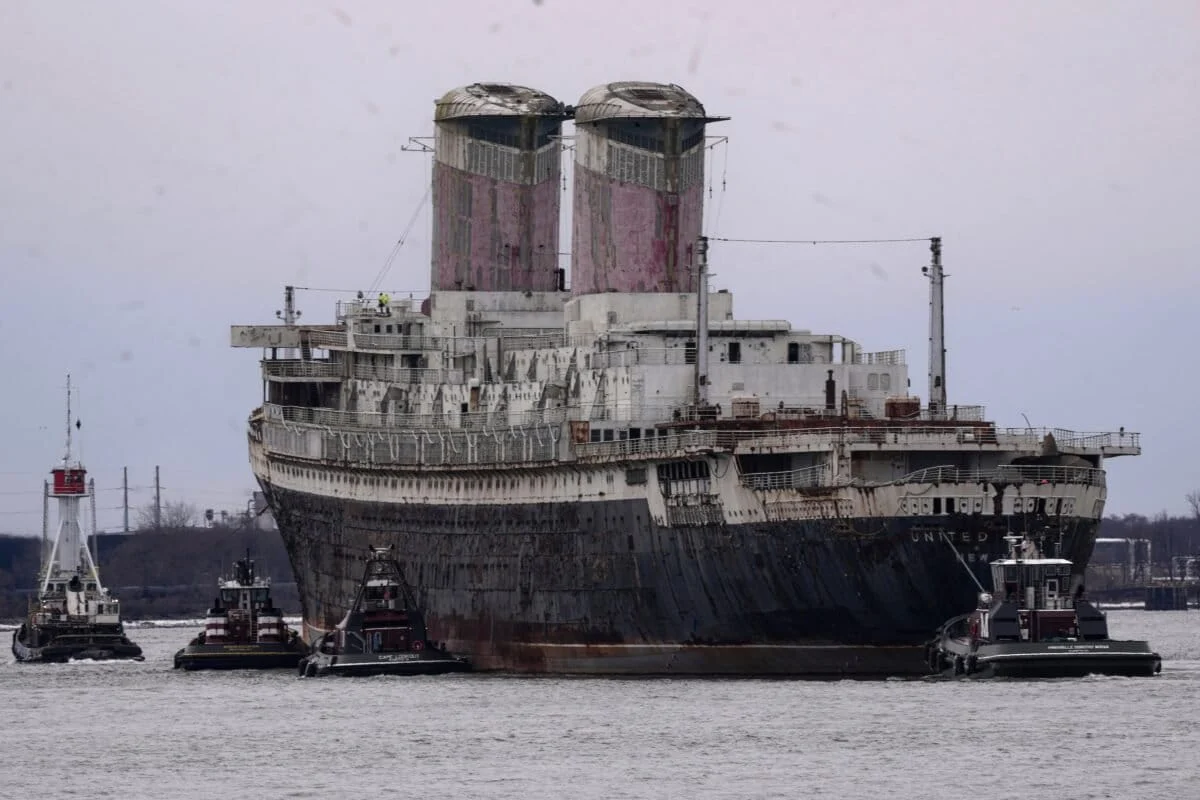
DESTIN, Fla. — In a momentous event that bridges the golden age of transatlantic maritime travel with modern marine conservation, the legendary ocean liner SS United States has been deliberately scuttled off the Florida Panhandle. Once hailed as the fastest passenger ship to ever cross the Atlantic, the historic vessel has found its final resting place on the floor of the Gulf of Mexico, approximately 25 miles southwest of Destin, situated between Panama City and Pensacola.
The multimillion-dollar sinking project, totaling an estimated $13.5 million in preparation, environmental remediation, towing, and sinking costs, successfully transforms the 990-foot behemoth into the world’s largest artificial reef. While marine historians mourn the passing of an era that the ship physically embodied, local officials, environmental scientists, and tourism boards celebrate a new chapter for the vessel. Instead of being dismantled into scrap metal, the sleek, aluminum-superstructured liner will now foster a thriving underwater ecosystem, providing a vital aquatic habitat for pelagic species such as tuna, marlin, and swordfish, while simultaneously driving a lucrative boost to regional dive tourism and recreational fishing economies.
Main Facts of the Scuttling Operation
The precise execution of the scuttling culminated years of legal battles, preservation efforts, and meticulous environmental preparation. Marine engineers, explosives experts, and state environmental protection officials coordinated the operation to ensure the vessel settled upright on the sandy seabed, maximizing its structural integrity for marine life colonization and diver safety.
Environmental compliance stood at the forefront of the $13.5 million endeavor. Prior to being towed to its destination in the Gulf of Mexico, the SS United States underwent rigorous hazardous material abatement. Workers stripped the ship of decades-old paints, wiring, oils, and any remaining synthetic or toxic substances that could potentially leach into the marine environment. What remained was the structurally sound steel and aluminum hull—a massive underwater monument tailored to replicate the complexity of natural coral reefs.
Local municipalities across Okaloosa, Walton, and Bay counties championed the project, viewing the massive hull as a transformative economic engine. Artificial reefs in the Florida Panhandle have historically proven to be powerful economic catalysts, drawing hundreds of thousands of diving tourists and sports anglers annually. By placing the world’s largest artificial reef off their coast, regional leaders anticipate millions of dollars in secondary economic activity injected into hotels, restaurants, charter boat operations, and dive shops.
A Storied Chronology: From Speed Record to Seabed
The saga of the SS United States spans more than seven decades, marked by brilliant technological achievements, periods of peak geopolitical importance, and eventual decades of neglect.
The 1950s: The Golden Age and the Blue Riband
Designed by renowned naval architect William Francis Gibbs, the SS United States was constructed by Newport News Shipbuilding and Dry Dock Company in Virginia, with substantial financial backing from the United States Navy. During the Cold War, the federal government viewed a fast, high-capacity troop transport as a strategic national security asset. Consequently, the government subsidized the ship’s construction costs, stipulating that it could be rapidly converted into a troopship capable of carrying 15,000 soldiers for 10,000 miles without refueling.
On its maiden voyage in July 1952, the SS United States astonished the maritime world. Under the command of Commodore Harry Manning, the ship shattered the transatlantic speed record in both directions, capturing the coveted Blue Riband. Traveling eastward from New York to Bishop Rock, Cornwall, the liner crossed the Atlantic in 3 days, 10 hours, and 40 minutes at an average speed of over 35.5 knots (roughly 41 mph). Its return journey westward broke the record again. This unprecedented speed milestone remains unbroken by any passenger liner to this day.
Throughout the 1950s and early 1960s, the ship served as the premier choice for international diplomats, Hollywood celebrities, and royalty. Presidents, dignitaries, and artists walked its sprawling decks, wrapped in mid-century luxury.
The 1960s–1990s: Obsolescence and Layup
The ascendancy of commercial jet aviation in the late 1950s and 1960s spelled the doom of the transatlantic ocean liner. As passengers increasingly opted for the speed of airplanes over multi-day sea voyages, the financial viability of ocean liners deteriorated rapidly. In November 1969, facing mounting operational subsidies and declining ticket sales, the SS United States was withdrawn from service and laid up in Norfolk, Virginia.
Thus began a protracted period of nomadic ownership. Over the next several decades, the ship changed hands multiple times. Various investors floated ambitious revitalization proposals—including turning it into a cruise ship, a floating hotel, or a multi-use commercial property—yet none secured the necessary capital or logistical backing to restore the deteriorating vessel. In 1996, the ship was towed from Virginia to a pier in Philadelphia, Pennsylvania, where it would remain docked along the Delaware River for nearly three decades, slowly rusting while preservationists fought desperately to save it.

The 2000s–2025: The Preservation Battle and Final Voyage
As the structural condition of the ship worsened, non-profit organizations such as the SS United States Conservancy waged tireless legal and fundraising campaigns to find a permanent home for the historical icon. Despite widespread public affection and passionate grassroots support, the immense costs associated with asbestos remediation, structural restoration, and ongoing maintenance proved insurmountable.
Facing impending eviction from its Philadelphia berth in recent years, the conservancy partnered with Okaloosa County, Florida, paving the way for the ship’s transformation into an artificial reef. In February 2025, the vessel was photographed leaving Philadelphia, towed down the Delaware River amid great public emotion. The journey marked the final chapter of its physical existence on the surface before its ultimate deployment in the Gulf of Mexico.
Supporting Data and Economic Projections
The decision to sink a historic vessel rather than scrap it or restore it is rare, but the economic and ecological metrics surrounding artificial reefs justify the approach for regional planners.
According to data compiled by the Florida Fish and Wildlife Conservation Commission, artificial reefs substantially enhance local marine biodiversity. Within months of deployment, sunken structures attract micro-algae, barnacles, and corals, which form the base of a complex food web. Smaller reef fish quickly populate the wreckage, followed swiftly by predatory pelagic species like amberjack, snapper, grouper, tuna, marlin, and sharks.
From an economic standpoint, Okaloosa County tourism studies indicate that artificial reef installations yield a return on investment manifold greater than their initial costs. Previous sinking projects in the region—such as the aircraft carrier USS Oriskany, scuttled off the coast of Pensacola in 2006—generated millions of dollars annually in regional economic impact. Because the SS United States is substantially larger and possesses unmatched historical name recognition, tourism officials project unprecedented engagement from the global diving community.
Official Responses and Stakeholder Reactions
The scuttling of the SS United States elicited a complex spectrum of emotional responses from maritime historians, preservationists, local government leaders, and environmental advocates.
Susan Gibbs, executive director of the SS United States Conservancy and granddaughter of the ship’s designer, expressed bittersweet acceptance of the outcome. While acknowledging the heartbreak of losing a physical piece of American maritime heritage, Gibbs emphasized that the project ensures the ship avoids the indignity of being cut apart for scrap metal in a foreign breaker’s yard. Instead, the vessel achieves a dignified, permanent legacy that will sustain life and inspire generations of divers and ocean explorers.
Local government officials on the Florida Panhandle lauded the collaborative effort required to bring the project to fruition. Okaloosa County commissioners highlighted the rigorous environmental standards met during the preparation phase, reassuring local residents and conservation groups that the ship was rendered entirely safe for the marine environment prior to its descent. Representatives from the recreational fishing and diving sectors also voiced enthusiasm, noting that the sheer vertical relief provided by the 990-foot hull will create a world-class destination capable of relieving fishing pressure on natural reefs.
Broader Impact and Implications
The final voyage of the SS United States underscores a broader reality within modern historic preservation and marine management: the limits of nostalgia when confronted with the realities of industrial decay and capital scarcity.
While preservationists fought valiantly for decades to keep the grand liner intact above water, the millions of dollars required for dry-docking and historical restoration were simply unattainable in a modern economic climate where historic ships rarely generate operational revenue. By pivoting toward artificial reef creation, stakeholders have pioneered a pragmatic model for monumental maritime preservation.
The ship will no longer slice through the waves at 35 knots, nor will passengers waltz across its grand ballrooms. However, as the SS United States rests quietly on the floor of the Gulf of Mexico, it initiates a vital second life. Enveloped by the blue waters of Florida, the historic liner transitions from a static artifact of human speed into a dynamic, living ecosystem—ensuring that the name and silhouette of the fastest ocean liner in history will endure for centuries to come.