Drones capable of spraying water and fire retardants have been practicing how to snuff out wildfires early in California and Alaska this summer, demonstrating a possible rapid-response tool for firefighting as climate change transforms wildfire season into a nearly year-round risk for much of the United States and globally. These recent trials signal a significant pivot in wildfire management strategies, moving towards integrating advanced autonomous technologies to augment traditional firefighting efforts, particularly in the crucial initial attack phase.
The Escalating Wildfire Crisis and the Imperative for Innovation
The urgency for innovative firefighting solutions has never been greater. Wildfires, once largely seasonal events, are now characterized by increased frequency, intensity, and duration across the globe. In the United States alone, the National Interagency Fire Center (NIFC) reports that an average of 60,000 wildfires burn over 7 million acres annually, a figure that has steadily climbed over the past two decades. California, a perennial hotspot, has witnessed some of its most destructive fire seasons in recent memory, with the August Complex in 2020 becoming the largest wildfire in state history, scorching over one million acres. These events not only devastate ecosystems and wildlife but also incur staggering economic costs, running into billions of dollars annually for suppression alone, not to mention the immense human toll through loss of life, homes, and livelihoods.
Climate change is undeniably a primary driver behind this escalating crisis. Warmer temperatures, prolonged droughts, and altered precipitation patterns create drier fuel beds and extend fire seasons. Increased fuel loads due to historical fire suppression policies and forest management challenges further exacerbate the problem. Traditional aerial firefighting, while indispensable, faces inherent limitations: high operational costs, risks to human pilots, restricted night operations, and the sheer logistical challenge of deploying massive resources to remote, rapidly expanding infernos. These factors underscore the critical need for complementary technologies that can provide rapid, safe, and cost-effective initial attack capabilities.
Pioneering the Future: Drone Trials in California and Alaska
The recent field tests represent a significant leap forward in addressing these challenges. While most drones are significantly smaller than crewed aircraft and have shorter flight ranges, meaning they cannot replace large airtankers in delivering massive payloads of water or other fire-suppressing payloads to remote, well-established wildfires, their strength lies in their agility and potential for rapid deployment against nascent fires. Companies and fire agencies, along with organizers of the ambitious $11 million XPRIZE competition, are intensely focused on testing whether these unmanned aerial systems (UAS) can help firefighting crews respond more quickly to small fires and extinguish them before they escalate into destructive mega-fires.
CAL FIRE’s Groundbreaking Autonomous Swarm Demonstration
A pivotal moment in this development occurred on July 15, when the California Department of Forestry and Fire Protection (CAL FIRE) conducted its own groundbreaking field test. This demonstration involved five autonomous drones working in concert to deploy between 500 and 1,000 gallons of foam combined for suppressing fires, as reported by the TV station KPMH. The exercise was meticulously organized with the collaborative support of the nonprofit FireWERX and the California-based company Seneca, which is poised to make these advanced drones commercially available starting in 2026.
This CAL FIRE trial was not merely a proof-of-concept; it was a sophisticated exercise designed to test the real-world operational viability of an autonomous drone swarm in a simulated wildfire scenario. Officials involved in the demonstration expressed cautious optimism. A CAL FIRE spokesperson, speaking on background about the potential of such technology, noted, "The ability to deploy multiple autonomous units in a coordinated fashion offers an unprecedented advantage in the initial attack phase. Speed and precision are paramount when a fire is still small, and these drones show immense promise in providing exactly that." The successful deployment of a substantial volume of fire-suppressing foam by a synchronized drone fleet marks a crucial step towards integrating such systems into active firefighting protocols.
Seneca’s Argo-1: The Technology Behind the Swarm
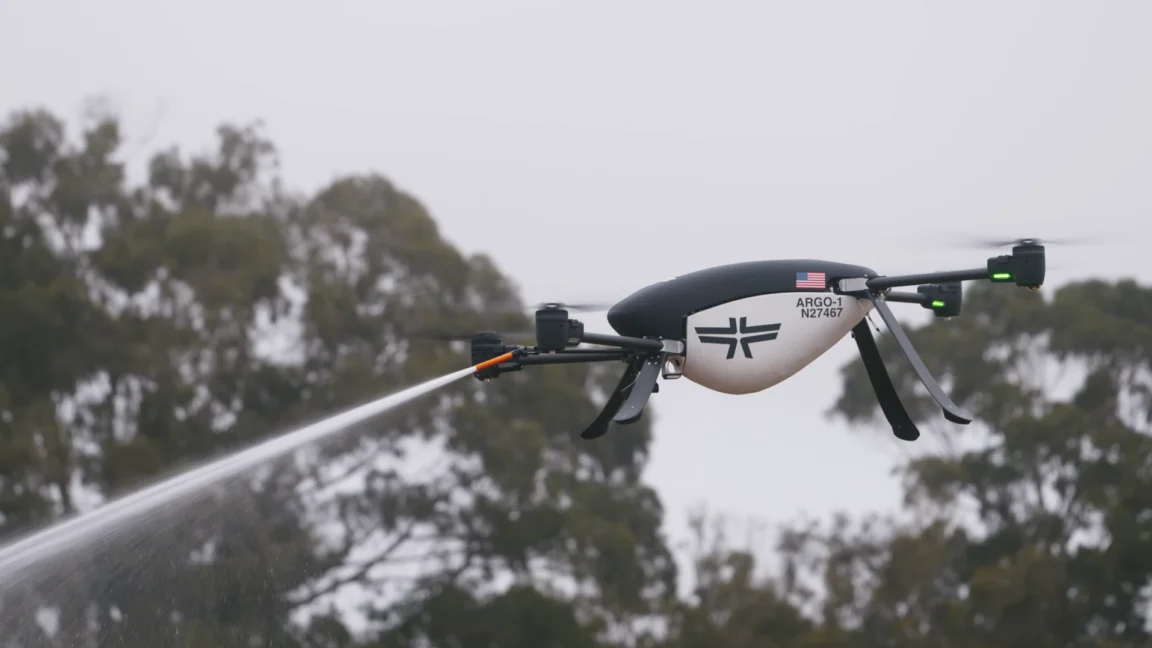
At the heart of these trials is Seneca’s Argo-1 drone system. Each Argo-1 drone is designed to carry approximately 100 pounds of water or fire retardant. The true innovation, however, lies in their ability to operate collaboratively in swarms of four to six drones. This synchronized operation dramatically multiplies their suppression capacity, allowing a single human operator to manage a significant initial attack force.
According to HeliOps Magazine, the operational sequence is highly automated: once a human operator uploads a GPS waypoint to designate the target area, the autonomous drones navigate towards their objective. Crucially, they employ onboard sensors to detect the heat signature of a fire, allowing for precise targeting. Upon locating the fire, the drones individually determine the optimal hovering altitude before lining up to spray the fire, one after the other, in a coordinated sequence. This level of autonomy reduces human workload and allows for faster, more accurate deployment of suppression agents.
While highly advanced, the Argo-1 drones do have operational parameters that dictate their strategic deployment. Fully loaded, they are limited to a round trip of approximately 10 miles while flying at an average speed of about 30 miles per hour. This means that for effective rapid response, they would ideally need to be strategically prepositioned in fire-prone areas or transported quickly by ground vehicle to the vicinity of a new ignition. However, their design facilitates rapid deployment: each drone can fit conveniently in the back of a pickup truck with the tailgate down, and two people can even manually carry the empty drones, highlighting their logistical flexibility for forward staging.
The XPRIZE Wildfire Challenge: Fueling Innovation
Further bolstering the development of such technologies is the $11 million XPRIZE Wildfire competition. Launched to inspire and accelerate innovation in wildfire detection and suppression, the XPRIZE challenges teams globally to develop revolutionary solutions that can detect and extinguish wildfires in their earliest stages, rapidly and safely. The ongoing trials with autonomous drones perfectly align with the core objectives of this competition, which seeks to identify and scale technologies capable of transforming wildfire management. The substantial prize money incentivizes rapid advancements, pushing the boundaries of what’s possible in autonomous systems, sensor technology, and fire suppression agents. Organizers of the XPRIZE have consistently emphasized that solutions must be scalable, cost-effective, and adaptable to diverse global environments, criteria that autonomous drone systems like the Argo-1 are striving to meet.
Strategic Advantages: Why Drones are Game-Changers
The integration of autonomous drones into wildfire management promises several strategic advantages that could fundamentally alter firefighting paradigms:
- Rapid Initial Attack: The ability to respond to ignitions within minutes is paramount. A small fire can double in size every minute under adverse conditions. Drones, being deployable much faster than manned aircraft or ground crews to remote locations, can attack fires when they are small and most manageable, significantly increasing the likelihood of early containment.
- Enhanced Firefighter Safety: Wildland firefighting is one of the most dangerous professions. Drones can operate in hazardous environments, reducing direct exposure of human pilots and ground crews to extreme heat, smoke, and dangerous terrain. This is particularly relevant for scouting dangerous areas or conducting suppression in conditions too risky for manned flight.
- Night Operations and Low Visibility: Most manned aerial firefighting operations are restricted to daylight hours due to safety concerns. Drones equipped with thermal cameras can operate 24/7, providing critical detection, monitoring, and even suppression capabilities through the night, a period when fires often grow unchecked.
- Cost-Effectiveness: While initial investment in drone fleets and infrastructure can be significant, the operational costs of drones (fuel, maintenance, personnel) are generally lower than those of large manned aircraft. More importantly, preventing a small fire from becoming a mega-fire saves billions in suppression costs, property damage, and environmental rehabilitation.
- Precision and Targeted Application: Drones offer precise delivery of water or retardant. Their ability to hover and use sensors for accurate targeting minimizes waste and maximizes the effectiveness of each payload, particularly important when dealing with expensive retardants.
- Accessibility to Difficult Terrain: Drones can access steep canyons, dense forests, and other challenging terrains that are inaccessible to ground crews or too dangerous for manned aircraft, providing vital early intervention in remote areas.
Challenges and Limitations on the Path to Widespread Adoption
Despite their immense potential, the widespread integration of autonomous firefighting drones faces several significant hurdles:
- Payload Capacity vs. Scale: As noted, current drones cannot match the payload capacity of large airtankers for massive, well-established fires. They are primarily an initial attack and support tool, requiring a hybrid approach alongside traditional assets.
- Range and Endurance: Battery life and flight range remain limiting factors. While improvements are constant, the need for frequent recharging or refueling requires robust logistical support, including forward-deployed charging stations or rapid ground transport to launch sites.
- Airspace Integration and Regulation: Safely integrating autonomous drone swarms into complex wildfire airspaces, which are often crowded with manned helicopters, airtankers, and surveillance aircraft, is a major regulatory and operational challenge. The Federal Aviation Administration (FAA) and other aviation authorities are still developing comprehensive frameworks for autonomous UAS operations, especially in emergency scenarios.
- Communication and Control: Maintaining robust, secure, and interference-free communication links with multiple autonomous drones in remote, often mountainous, terrain can be challenging. Reliable command and control systems are crucial for safe and effective operations.
- Reliability and Redundancy: As autonomous systems take on critical roles, ensuring their reliability, fault tolerance, and redundancy is paramount. System failures in a wildfire environment could have severe consequences.
- Public Perception and Acceptance: While the concept is gaining traction, public trust and acceptance of autonomous systems, especially those involved in emergency response, will be crucial for their widespread adoption. Addressing concerns about safety, data privacy, and ethical implications is vital.
The Broader Landscape of Drone Technology in Wildfire Management
Beyond direct suppression, drones are already playing an increasingly vital role across the entire spectrum of wildfire management:
- Early Detection and Monitoring: Drones equipped with high-resolution cameras, thermal imaging, and multi-spectral sensors can patrol high-risk areas, detect ignitions far earlier than human patrols or lookout towers, and provide real-time intelligence on fire behavior and spread.
- Mapping and Situational Awareness: During an active fire, drones can create detailed 3D maps of the fire perimeter, identify hotspots, assess fuel types, and provide invaluable real-time situational awareness to incident commanders and ground crews, enabling more effective resource allocation and tactical decisions.
- Prescribed Fire Operations: Drones are now being used to conduct controlled burns (prescribed fires) by dropping incendiary devices with pinpoint accuracy. This safer and more efficient method helps reduce hazardous fuel loads and restore ecological balance.
- Post-Fire Assessment and Rehabilitation: After a fire, drones can rapidly assess damage to infrastructure, map burn severity, monitor erosion risks, and aid in planning reforestation and rehabilitation efforts.
Future Outlook and Integration: A Hybrid Approach
The future of wildfire management will undoubtedly involve a sophisticated, hybrid approach where autonomous drone systems work in seamless conjunction with traditional firefighting assets. Seneca’s projected commercial availability in 2026 underscores the rapid pace of development and the industry’s confidence in these technologies.
Further advancements will likely focus on enhancing AI and swarm intelligence, allowing drones to make more sophisticated autonomous decisions in dynamic fire environments. Developing robust logistical infrastructure—including strategically located drone bases, rapid charging stations, and dedicated drone deployment teams—will be critical for maximizing their operational effectiveness. Moreover, continued government support, funding for research and development, and the establishment of clear, adaptive regulatory frameworks will be essential to realize the full potential of these transformative tools.
In conclusion, the trials in California and Alaska with autonomous firefighting drones represent a critical juncture in humanity’s ongoing battle against increasingly destructive wildfires. While challenges remain, the strategic advantages in rapid response, enhanced safety, and cost-effectiveness position these unmanned systems as a vital component of future wildfire management strategies. By embracing innovation and integrating these advanced technologies, fire agencies hope to turn the tide against the escalating wildfire threat, protecting communities, ecosystems, and the brave individuals on the front lines.