

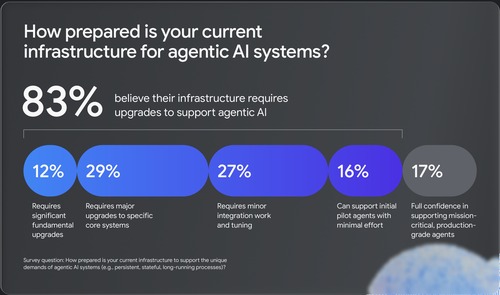
The transition of artificial intelligence from experimental chatbots to autonomous, production-grade agents has hit a significant technical bottleneck. According to the latest research released by Google Cloud, the vast majority of enterprises—83%—find their current IT infrastructure insufficient to handle the rigorous demands of agentic AI. As these autonomous systems evolve to perform complex, multi-step tasks across legacy environments, the gap between traditional cloud architectures and the needs of intelligent agents has become the primary barrier to digital transformation.

The 2026 State of Infrastructure in the Agentic AI Era report highlights that while the excitement surrounding Generative AI (GenAI) has matured into widespread adoption, the underlying hardware, networking, and governance frameworks have failed to keep pace. For organizations aiming to deploy agents capable of browsing, querying, and executing tasks across multiple ERP and CRM systems autonomously, the current state of infrastructure is viewed as a legacy burden rather than a facilitator of innovation.
The Evolution of AI Demands: From Prompt to Execution
To understand the scope of this infrastructure gap, it is necessary to differentiate between standard Large Language Models (LLMs) and autonomous agents. Traditional GenAI workflows often involve a user-initiated prompt that results in a static text response. In contrast, agentic AI operates in a stateful, persistent loop. A single initial prompt can trigger hundreds of downstream sub-tasks, each requiring consistent access to data, secure authentication across disparate systems, and real-time decision-making capabilities.
This shift in functionality changes the hardware and software requirement profile. Agents require "long-term memory" to maintain context throughout extended workflows. They must navigate security protocols as if they were human users, and they require high-availability orchestration to ensure that if a process is interrupted, the agent can recover its state without data corruption. As Google Cloud’s research suggests, the infrastructure is no longer just about compute power; it is about the reliability of the "plumbing" that connects these agents to the organization’s foundational data.
Chronology of the Infrastructure Crisis
The current realization regarding infrastructure readiness did not occur overnight. It follows a distinct trajectory of AI integration within the enterprise:

- 2023: The GenAI Explosion: Organizations began experimenting with foundational models, focusing primarily on user-facing chatbots and basic text generation. Infrastructure needs were met by standard cloud compute instances.
- 2024: Integration Hurdles: As businesses sought to ground models in their own data, the first wave of "missing pieces" emerged—specifically, the need for vector databases and Retrieval-Augmented Generation (RAG) pipelines.
- 2025: The Infrastructure Gap: Google’s 2025 research identified that infrastructure was the primary obstacle to moving GenAI from pilot to production, citing major concerns over data governance, hybrid cloud limitations, and edge deployment.
- 2026: The Agentic Shift: The current landscape is defined by the move toward "action-oriented" AI. The complexity of these agents—which act rather than just respond—has exposed the inadequacy of the foundational layers established during the earlier, simpler phases of AI adoption.
Breakdown of the Readiness Gap
The 83% figure reported by Google Cloud is not a monolithic challenge; it represents a spectrum of technical debt. According to the study, the organizational readiness breakdown is as follows:
- 12% Requiring Fundamental Overhauls: These organizations possess legacy systems that are essentially incompatible with modern, API-driven agentic workflows. They face a "rip and replace" scenario for core infrastructure.
- 29% Requiring Major Upgrades to Core Systems: A significant segment of the market can maintain their basic cloud footprint but must perform intensive refactoring of their core database and security architectures to support persistent agent activity.
- 27% Requiring Minor Integration and Tuning: This group is the closest to production-readiness, requiring fine-tuning of existing middleware, latency optimization, and improved orchestration layers.
- 16% Pilot-Ready: These organizations have built infrastructure capable of supporting early-stage agents but lack the resilience and scale for mission-critical, enterprise-wide deployment.
- 17% Fully Optimized: Only a small minority of enterprises have achieved the necessary architectural maturity to deploy mission-critical agents at scale.
Official Perspectives and Industry Implications
Nirav Mehta, VP of product management at Google Cloud, emphasized that the report serves as more than just a diagnostic tool; it is a strategic roadmap. "This report isn’t just a survey of the landscape; it’s a roadmap for establishing the new standard for production-grade autonomous systems," Mehta stated. The implication of his remarks is that enterprises must stop treating AI infrastructure as an extension of standard software development and begin treating it as a new class of utility, akin to how electricity or network bandwidth is managed.

Industry analysts suggest that the "readiness gap" will force a shift in budget allocations. For the past two years, IT spend has been heavily skewed toward model development and fine-tuning. Moving forward, a larger portion of the enterprise budget will likely shift toward MLOps (Machine Learning Operations), observability, and the creation of "agent-safe" data environments.
The security implications are equally profound. Autonomous agents, by definition, require access to sensitive business systems. Providing these agents with the correct permissions—without creating massive security vulnerabilities—requires a sophisticated identity and access management (IAM) framework that many organizations have yet to implement. The need for continuous monitoring of agent activity is no longer a luxury but a requirement to prevent "hallucinated" actions from causing financial or reputational damage.

Broader Impact on Enterprise Operations
The requirement for infrastructure upgrades extends beyond the server room. The 2026 research highlights that hardware selection is increasingly dictated by power consumption and thermal efficiency. As agents run continuously, the carbon footprint of AI operations has become a board-level concern. Organizations are now pressured to prioritize energy-efficient hardware and optimize model inference to minimize electricity costs, which are ballooning as autonomous agents perform tasks 24/7.
Furthermore, the rise of "distributed execution" at the edge is changing how companies think about cloud architecture. Agents cannot always rely on a round-trip to a centralized data center. To reduce latency, organizations are looking at edge computing—processing data closer to where it is generated. This adds another layer of complexity to the infrastructure, as data must be synchronized, governed, and secured across a distributed, hybrid environment.

Conclusion: The Path Forward
The data suggests that the "agentic era" will be defined by an intense focus on stability, reliability, and security. Organizations that fail to address the infrastructure gap risk creating "brittle" AI systems that break down as soon as they encounter real-world complexity. Conversely, those that invest in the necessary foundational upgrades are likely to gain a significant competitive advantage.
By moving beyond the experimentation phase, the industry is entering a period of professionalization. The focus has shifted from "can we build an agent?" to "can we maintain an agent that operates autonomously, securely, and efficiently within our corporate environment?" For the 83% of organizations currently lacking the necessary infrastructure, the coming months will require a disciplined approach to upgrading core systems, strengthening data governance, and implementing robust observability frameworks. The era of the autonomous agent is here, but the foundation upon which it stands is still very much under construction.







Leave a Reply