
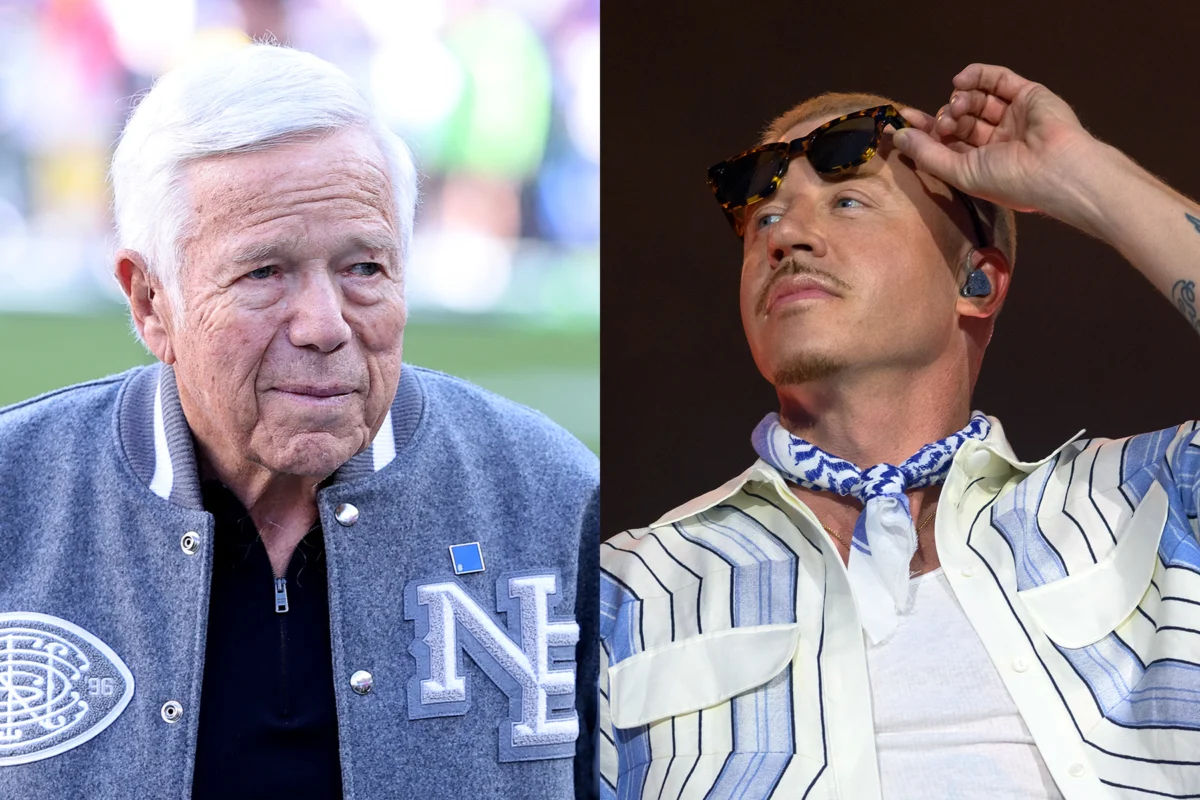
The intersection of mainstream pop music, major athletic venues, and international geopolitics has once again resulted in high-profile public friction. New England Patriots owner and billionaire philanthropist Robert Kraft has officially confirmed that he personally intervened to bar the Seattle-born rapper Macklemore from performing as an opening act for Ed Sheeran at Gillette Stadium. The decision follows a series of public statements and artistic choices made by the rapper regarding the ongoing Israel-Hamas conflict, which culminated in his removal not only from the upcoming Massachusetts dates but from the remainder of Sheeran’s prominent Loop tour.
The controversy brings to light the increasingly complex landscape that venue owners, promoters, and touring artists must navigate as global political crises infiltrate domestic cultural events. As entertainment venues increasingly double as major corporate assets, the calculus governing who is permitted to perform on these stages has expanded far beyond traditional metrics of ticket sales and mainstream appeal.
Main Facts of the Controversy
The core of the dispute centers on statements and performances delivered by Macklemore—legally named Ben Haggerty—during the early September launch of Ed Sheeran’s tour stops at MetLife Stadium in East Rutherford, New Jersey. During these performances, the rapper explicitly expressed solidarity with the populations of Gaza and the occupied West Bank, shouted "Free Palestine" from the stage, displayed visual representations of the devastation occurring in Gaza, and performed his dedicated protest song, "Hind’s Hall." The track, named in honor of a pro-Palestinian student demonstrator at Columbia University, serves as a direct critique of foreign policy and institutional responses to the humanitarian crisis in the Middle East.
In response to these demonstrations, Robert Kraft—who is Jewish, a prominent supporter of Israeli causes, and a major donor to various philanthropic initiatives in the region—asserted that the content presented on stage crossed a definitive line. Kraft stated that the performance utilized a major platform to spread rhetoric that he and venue administration deemed harmful and deeply offensive to the Jewish community, pointing specifically to what he characterized as a history of problematic public behavior, including a controversial 2014 costume incident for which the rapper previously issued an apology.
Consequently, Gillette Stadium leadership pulled the plug on Macklemore’s scheduled appearances for Sheeran’s two-night run in Foxborough, Massachusetts. The decision swiftly cascaded, resulting in the rapper being dropped from the entire remainder of the tour itinerary.
Chronology of Events Leading to the Ban
To fully understand the velocity with which this controversy escalated, it is necessary to examine the timeline of events that transformed a routine tour opening slot into a national debate over free speech and hate speech.
Early September: Ed Sheeran kicks off the latest leg of his high-profile tour at MetLife Stadium in New Jersey, with Macklemore serving as the primary supporting act.
First Night of the New Jersey Run: During his set, Macklemore addresses the crowd directly, stating his intention to utilize stadium platforms to voice support for Palestine. He performs "Hind’s Hall" and leads the audience in chanting "Free Palestine," emphasizing his desire to ensure that individuals in Gaza and the West Bank know they remain visible to international audiences.
Mid-September: Word reaches venue executives and stakeholders regarding the stage content. Behind the scenes, discussions initiate regarding the parameters of acceptable speech under venue rental agreements and corporate policies aimed at preventing hate speech. According to public statements later released by Macklemore, Robert Kraft directly contacted Ed Sheeran to inform him that the rapper would be barred from performing at Gillette Stadium. Furthermore, Macklemore alleged that Kraft coordinated with owners of other participating stadiums to issue a collective ultimatum to the headlining artist, effectively forcing the tour’s management to sever ties with the opener or face venue lockouts nationwide.
Late September: Representatives for Robert Kraft issue a formal statement to media outlets, including Rolling Stone, confirming the venue’s ban and detailing the rationale behind the decision. While acknowledging the ban on the Gillette Stadium performances, Kraft’s team remains silent regarding the specific allegations of organizing a multi-stadium coalition against the artist. Concurrently, Macklemore publishes his own extensive reaction statement online, decrying the decision as an attempt to weaponize the definition of antisemitism to silence criticism of the Israeli government.
Official Responses and Competing Arguments
The public discourse surrounding the ban has exposed a deep ideological rift regarding where the boundaries of legitimate political discourse end and hate speech or bigotry begin.
In his official statement, Robert Kraft framed his decision as a matter of venue safety, corporate responsibility, and protection against discrimination. He argued that the ban was not intended to diminish the suffering of innocent Palestinian civilians or to strip individuals of their right to advocate for humanitarian causes. However, Kraft insisted that such advocacy must not be pursued at the expense of the Jewish community or function as a mechanism to obscure the responsibility of Hamas in the ongoing conflict.
"Too many lives have been lost and there has been too much suffering, but only sharing selective information and ignoring the actions of Hamas is not honest and only advances more divisiveness and hate," Kraft stated. He highlighted his decades-long record of directing financial resources toward athletic and entrepreneurial opportunities for Palestinians whom he deeply respects, arguing that standing with the Palestinian people while simultaneously standing against Hamas and antisemitism should not be viewed as mutually exclusive concepts.
Conversely, Macklemore and his supporters have forcefully rejected the notion that advocating for Palestinian rights or criticizing the actions of the State of Israel constitutes antisemitism. In his post-tour statement, the rapper acknowledged that antisemitism remains a dangerous and pervasive reality globally, but argued that labeling legitimate geopolitical critique as bigotry strips the term of its meaning.
"Antisemitism is real," Macklemore wrote. "And that is exactly why the word matters too much to be used as a shield against criticism of the Israeli state. When criticizing Israel, opposing Zionism or saying ‘Free Palestine’ gets conflated with hatred of Jewish people, it doesn’t protect Jewish people. It protects Israel from accountability."
Broader Impact and Industry Implications
The removal of an opening act from a major stadium tour over political speech highlights several critical developments within the contemporary entertainment and sports industries.
First, it illustrates the growing vulnerability of touring musicians and performers who choose to integrate contemporary geopolitical issues into their mainstream sets. While artists have a long history of utilizing their platforms for political protest—ranging from the anti-war music of the Vietnam era to more recent demonstrations for racial justice—the current polarization surrounding the Middle East has introduced uniquely high stakes for venue operators, corporate sponsors, and investors.
Second, the incident sheds light on the dual role played by modern sports team owners. Figures like Robert Kraft operate expansive business ecosystems where sports stadiums function not only as athletic arenas for the New England Patriots or New England Revolution, but as multi-purpose entertainment complexes hosting massive global concert tours. Consequently, stadium owners wield immense private authority over who is granted access to these lucrative performance spaces. The alleged coordination among venue owners, if accurate, signals an emerging mechanism of private-sector gatekeeping that can effectively sideline artists whose political stances clash with the personal convictions or corporate interests of venue stakeholders.
Finally, the controversy underscores the ongoing debate over the commercialization of free expression. While private venues maintain the legal right to establish codes of conduct and deny facility rentals based on policies against hate speech and disruptive public behavior, critics argue that applying these standards selectively to suppress pro-Palestinian advocacy sets a troubling precedent for artistic freedom within major American entertainment venues.
As the dust settles on the touring fallout, the prospects for reconciliation remain uncertain. In the concluding remarks of his public statement, Robert Kraft expressed deep respect for Ed Sheeran’s ability to bring diverse audiences together through music, while extending an offer to sit down directly with Macklemore. Kraft suggested that a face-to-face dialogue could help bridge the gap, maintaining that their ultimate objectives—peace for all people, an end to widespread suffering, and the eradication of hate—should theoretically align, even if their methods and rhetoric remain poles apart. As of publication, representatives for Macklemore have not indicated whether the artist intends to accept the invitation for private dialogue.






Leave a Reply