
The sprawling, intricate subterranean networks of mycorrhizal fungi that anchor global ecosystems are facing an unprecedented crisis, remaining largely unprotected despite their fundamental role in sustaining planetary life. According to a landmark study published in the journal Nature, an overwhelming 90 percent of global mycorrhizal fungi biodiversity hotspots are located outside of formally protected areas. This stark oversight leaves Earth’s primary biological "circulatory systems" vulnerable to agricultural expansion, industrial development, and the escalating impacts of climate change.
Compiled by researchers from the Society for the Protection of Underground Networks (SPUN), the study provides the first high-resolution, predictive maps of global underground fungal communities. By analyzing more than 2.8 billion fungal sequences spanning 130 countries, scientists have unveiled a hidden biological architecture that has historically been ignored by international conservation frameworks, climate strategies, and environmental policy.
The Unseen Architects of Planetary Life
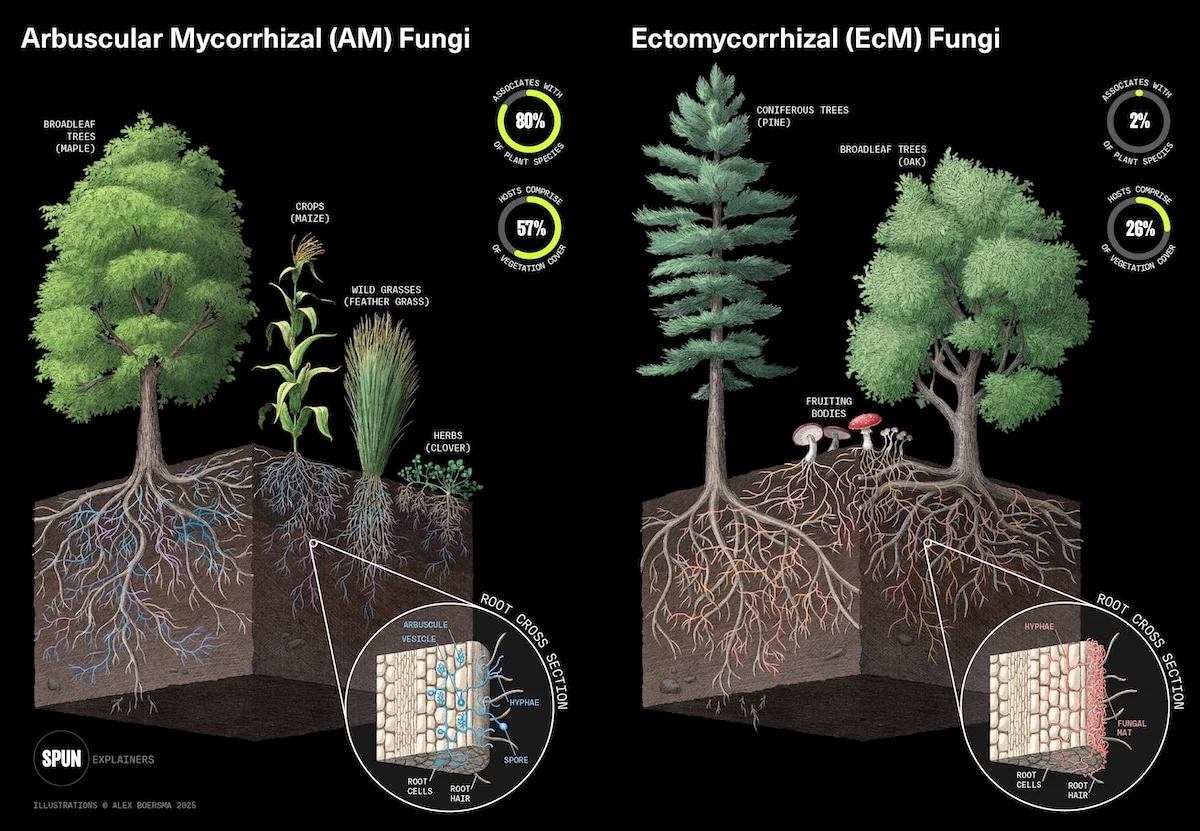
Mycorrhizal fungi—encompassing arbuscular mycorrhizal and ectomycorrhizal types—form symbiotic relationships with the roots of the vast majority of land plants. Through these delicate subterranean networks, fungi trade essential soil nutrients and water for the carbon photosynthesized by plants. Beyond facilitating plant nutrition, these networks draw down more than 13 billion tons of carbon annually into the Earth’s soils, offsetting approximately one-third of global fossil fuel emissions.
The evolutionary history of terrestrial life is inextricably linked to these organisms. Approximately 450 million years ago, barren landmasses were devoid of vegetation. It was the colonization of land by primitive plants in partnership with mycorrhizal fungi that transformed the Earth’s surface, paving the way for the development of complex ecosystems and, ultimately, human life.
Despite their foundational status, these organisms have suffered from what researchers term "fungus blindness"—the systemic failure of policymakers and conservationists to account for biodiversity that exists beneath the topsoil. When these subterranean networks are disrupted by plowing, deforestation, urbanization, or chemical runoff, the consequences cascade upward. Forest regeneration slows, agricultural productivity drops, and aboveground biodiversity unravels.

A Chronology of Discovery: From Mapping Initiative to Global Data
The publication in Nature represents the realization of a scientific vision that began years prior.
- 2021: SPUN was officially launched with the ambitious goal of mapping the world’s underground fungal communities to create actionable resources for legal, political, and environmental decision-makers.
- Ongoing Expeditions: An international network comprising nearly 100 "Underground Explorers" from approximately 80 countries—backed by more than 400 scientists—began sampling some of the most remote and challenging environments on Earth, spanning regions in Bhutan, Mongolia, Ukraine, and Pakistan.
- Present Day: Utilizing massive computational power and sequencing data from 130 countries, the research team successfully cataloged over 40,000 specimens representing 95,000 mycorrhizal fungal taxa, translating this data into the comprehensive biodiversity maps now available to the public.
Even with these monumental strides, scientists emphasize that only about 0.001 percent of the planet’s surface has been directly sampled, underscoring the vast amount of subterranean biodiversity that remains undiscovered and undocumented.
Quantifying the Vulnerability
The data unveiled by SPUN’s Underground Atlas paints a precarious picture of global conservation gaps. While conservation initiatives routinely prioritize charismatic megafauna, old-growth forests, and marine reserves, the subterranean foundation supporting these ecosystems has been left off the map.
Key statistical takeaways from the research include:
- 90 Percent Vulnerability: Ninety percent of global mycorrhizal biodiversity hotspots fall completely outside current protected area boundaries.
- Paltry Protection: Merely 9.5 percent of these critical fungal richness zones overlap with existing conservation reserves.
- Carbon Sequestration: The annual carbon draw of 13 billion tons managed by these networks rivals major geopolitical climate commitments, yet remains entirely uncredited in formal carbon budgeting frameworks.
- Geographic Concentrated Risk: Unique, endemic fungal communities have been identified in irreplaceable ecosystems, such as West Africa’s Guinean forests, Tasmania’s temperate rainforests, and Brazil’s Cerrado savanna—many of which face severe anthropogenic pressures.
Official Responses and Expert Consensus
The study has drawn widespread acclaim from prominent conservationists, international scientists, and policy advisors. High-profile supporters of SPUN’s mission include renowned primatologist Jane Goodall, environmental authors Paul Hawken and Michael Pollan, and Fungi Foundation founder Giuliana Furci.
Dr. Toby Kiers, executive director of SPUN, emphasized the urgency of shifting public and political perception. "For centuries, we’ve mapped mountains, forests, and oceans. But these fungi have remained in the dark, despite the extraordinary ways they sustain life on land," Kiers stated. "This is the first time we’re able to visualize these biodiversity patterns—and it’s clear we are failing to protect underground ecosystems."

Dr. Michael Van Nuland, lead data scientist at SPUN and lead author of the Nature study, highlighted the direct connection between fungal health and human survival. "These maps are more than scientific tools—they can help guide the future of conservation," said Van Nuland. "Food security, water cycles, and climate resilience all depend on safeguarding these underground ecosystems."
From a restoration perspective, experts note that previous habitat recovery projects were fundamentally flawed due to their exclusive focus on aboveground flora and fauna. Dr. Alex Wegmann, a lead scientist at The Nature Conservancy, noted that historical restoration practices have been dangerously incomplete. "These high-resolution maps provide quantitative targets for restoration managers to establish what diverse mycorrhizal communities could and should look like," Wegmann explained.
Dr. Merlin Sheldrake, impact director at SPUN, reiterated the need to overcome cultural blind spots regarding the natural world. "For too long, we’ve overlooked mycorrhizal fungi. These maps help alleviate our fungus blindness and can assist us as we rise to the urgent challenges of our times."
Broader Implications and Strategic Applications
The release of these high-resolution predictive maps marks a paradigm shift in environmental management. Moving forward, conservation groups, researchers, and government policymakers can utilize SPUN’s platform to identify unprotected biodiversity hotspots, prioritize regional interventions, and inform the designation of new protected areas.
Crucially, the mapping tool empowers decision-makers to establish "underground conservation corridors"—contiguous zones designed to protect both surface wildlife and the subterranean networks that sustain them. By integrating subterranean data into satellite imagery and environmental impact assessments, organizations aim to make underground biodiversity as fundamental to policy decisions as surface-level geography.
As international bodies grapple with accelerating climate change and biodiversity loss, the inclusion of mycorrhizal networks in global climate agendas offers a dual benefit. Protecting these systems not only secures agricultural food supplies and fortifies ecosystems against extreme weather events, but also prevents the massive release of stored soil carbon into the atmosphere. Without immediate, targeted policy shifts to safeguard the unseen world beneath our feet, the structural integrity of Earth’s life-support systems will remain profoundly compromised.










Leave a Reply