
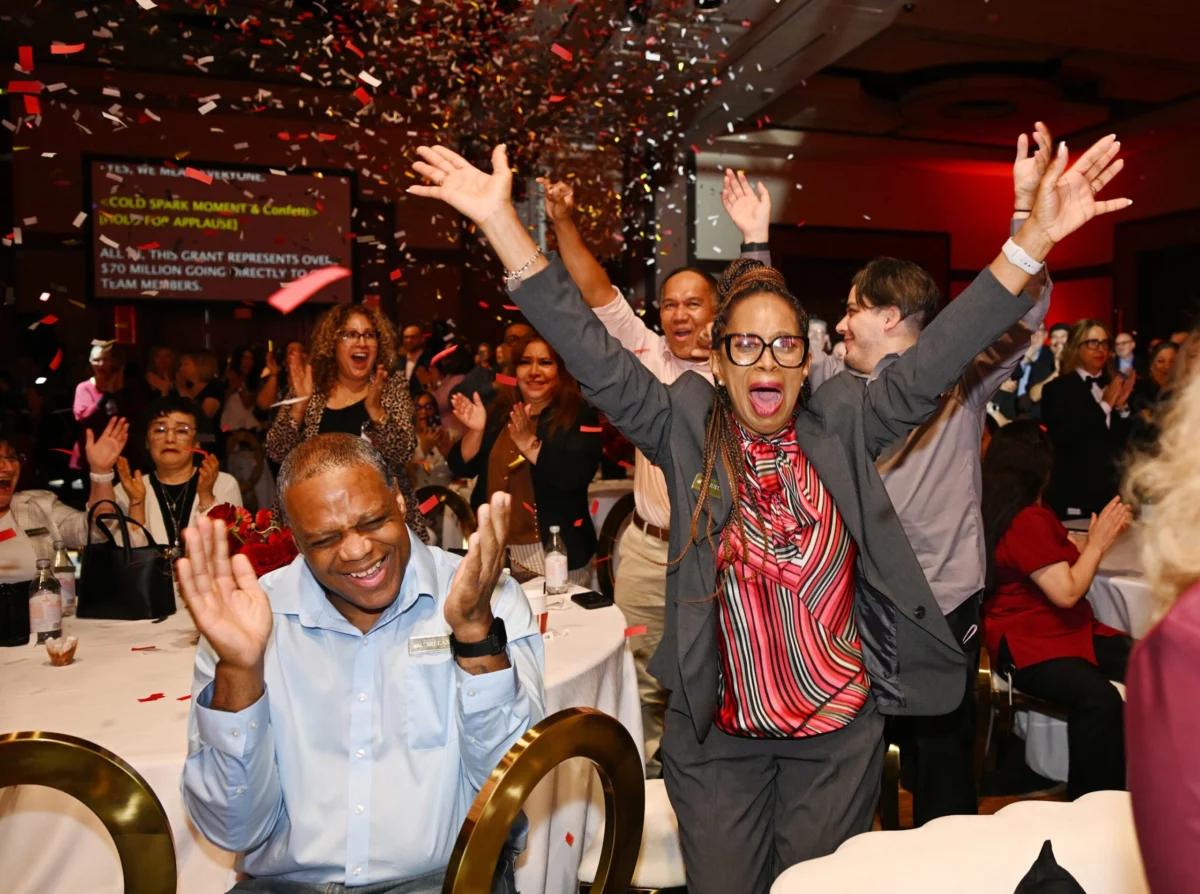
The traditional markers of corporate longevity—such as the gold watch, the guaranteed traditional pension, and the symbolic retirement party—have largely faded from the modern American employment landscape. In their place, corporate compensation strategies have increasingly favored short-term performance metrics, volatile bonuses, and stock options restricted almost exclusively to executive suites. Yet, exceptions to this pervasive trend do surface, demonstrating that employee loyalty and long-term tenure can still be recognized through substantial financial investment. A striking example of this occurred in Las Vegas, where casino operator Station Casinos surprised nearly 10,000 of its full-time and part-time workers with a massive equity distribution totaling more than $70 million in Red Rock Resorts stock.
The announcement was made during a landmark company event celebrating the enterprise’s 50th anniversary. Frank Fertitta III, chairman and chief executive officer of Station Casinos’ parent company, Red Rock Resorts, alongside Vice Chairman Lorenzo Fertitta, addressed a large ballroom filled with employees. During the gathering, leadership revealed that every staff member employed as of that date would be awarded $1,000 in Red Rock Resorts Class A common stock for every year of dedicated service they had provided to the company.
This multi-million-dollar equity reward bridges the gap between executive-level compensation and rank-and-file wages, fundamentally altering the financial standing of thousands of hospitality workers in the Las Vegas valley. For a workforce that navigated decades of economic shifts, industry evolution, and localized challenges, the sudden transformation from employee to shareholder marks a significant departure from standard corporate operational norms.
The Historic Event and Employee Reactions
The atmosphere inside the ballroom shifted dramatically as the details of the stock distribution were unveiled. For many long-term workers, the announcement translated into life-changing financial assets. Employees began claiming their shares through corporate administrative channels shortly after the announcement, with some of the enterprise’s longest-tenured personnel securing tens of thousands of dollars in equity.
Among the primary beneficiaries was Ida Johnson, who began her career with the company in 1977. Johnson received $49,000 in company shares, reflecting nearly five decades of continuous service. Similarly, six other staff members who commenced their employment at the original Bingo Palace during the 1970s and maintained their employment through subsequent decades each received upwards of $45,000 in company stock.
Lorenzo Fertitta underscored the philosophical shift intended by the leadership team during his address to the workforce. He emphasized that the intention was for employees to leave the venue with a fundamentally altered perspective on their role within the enterprise. By acquiring a direct equity stake, workers transition from traditional labor providers to vested co-owners of the commercial entity. Every shift worked, every guest accommodated, and every operational challenge met now directly impacts their personal financial portfolio as shareholders.
Chronology and Evolution: From Galveston to the Las Vegas Strip
The roots of Station Casinos trace back well before its official corporate incarnation, anchored in a family business model established by founder Frank Fertitta Jr. In 1959, the elder Fertitta relocated from Galveston, Texas, to Las Vegas, seeking opportunity in the rapidly expanding desert gaming hub. After spending years working within the burgeoning casino industry, he established his own gaming establishment in July 1976.
Known initially as "The Casino," the modest 5,000-square-foot property opened its doors with a mere 100 slot machines, six table games, and a foundational team of 90 employees. As Frank Fertitta III recounted during the anniversary celebration, the operation underwent its first major identity shift just one year later, rebranding as the Bingo Palace in 1977 to capitalize on localized entertainment trends. By 1984, the venue adopted the name Palace Station, establishing a blueprint for expanding community-focused gaming properties throughout the Las Vegas Valley.
The historical trajectory of the company can be broken down into several foundational milestones:
- 1959: Founder Frank Fertitta Jr. moves from Galveston, Texas, to Las Vegas.
- 1976: The opening of "The Casino," a 5,000-square-foot establishment featuring 100 slot machines and 90 employees.
- 1977: The property transitions into the Bingo Palace, welcoming long-term employees such as Ida Johnson.
- 1984: The casino is officially renamed Palace Station, marking the beginning of a broader regional expansion.
- Present Day: The enterprise owns and operates 14 properties across the Las Vegas Valley, employing thousands of staff members and anchoring local entertainment.
Today, the corporate footprint has expanded far beyond its single-room origin. The portfolio now encompasses 14 major properties distributed strategically across the Las Vegas Valley. Among these are premier regional destinations such as the Red Rock Casino Resort Spa, the Green Valley Ranch Resort Spa Casino, and the newer Durango Casino & Resort, alongside controlling stakes in several smaller gaming venues.
Leadership Philosophy and Corporate Values
Throughout its half-century existence, leadership has consistently attributed the survival and growth of the enterprise to its human capital. Speaking directly with media outlets following the event, Frank Fertitta III reiterated the foundational pillars instilled by his father.
According to leadership, the core tenets of the business have always centered on serving the local residential community, delivering tangible value to patrons, and prioritizing the well-being of the team members who interact with the public daily. This structural philosophy guided management’s decision to allocate a substantial portion of corporate equity directly to the frontline workforce rather than retaining all capital for institutional investors or executive bonuses.
As the anniversary ceremony concluded, Frank Fertitta III expressed formal gratitude to the workforce, acknowledging their resilience through economic recessions, competitive market shifts, and public health disruptions. He emphasized that the collective effort of the employees is what transformed a single 5,000-square-foot gaming hall into an indispensable fixture of the Las Vegas community.
Broad Industry Context: The Growing Trend of Broad-Based Equity
While Station Casinos’ $70 million distribution stands out for its scale within the regional hospitality sector, it forms part of a broader, evolving conversation regarding employee wealth-sharing in the global economy. For decades, broad-based stock grants were restricted primarily to high-tech startups or executive compensation packages. However, mounting economic pressures, labor shortages, and rising costs of living have prompted major multinational corporations and private enterprises to reevaluate how wealth is distributed among frontline workers.
Several notable precedents illustrate this shifting corporate mindset across various industries:
- Bank of America: In response to sustained economic challenges and internal performance milestones, the financial institution distributed a $1 billion restricted-stock pool to nearly its entire global workforce.
- Apple: Following the implementation of major federal tax legislation, the technology giant awarded the vast majority of its global staff a $2,500 stock bonus to align employee interests with corporate valuations.
- Samsung Electronics: Expanding its equity programs, the major electronics manufacturer began issuing significant share allocations worth up to $20,000 to non-executive staff members, broadening corporate ownership down the organizational chart.
- Fibrebond Corp.: Demonstrating an extraordinary commitment upon the sale of the enterprise, the family-owned Louisiana manufacturing firm carved out a $240 million bonus pool, resulting in an average payout of approximately $443,000 per employee.
These examples highlight a growing recognition among corporate leadership teams that traditional wages alone may no longer suffice to secure long-term employee retention or foster deep institutional loyalty. By distributing ownership stakes, companies aim to mitigate turnover costs while providing workers with an avenue toward meaningful wealth accumulation.
Economic Implications and Future Outlook
The decision by Red Rock Resorts to distribute $70 million in equity to its nearly 10,000 employees carries significant economic and operational implications. From an internal perspective, the move is expected to bolster staff morale and reinforce institutional stability. In an industry historically characterized by high employee turnover—particularly within the housekeeping, food and beverage, and gaming operations sectors—providing a direct financial incentive tied to company performance offers a powerful retention mechanism.
From an analytical standpoint, transforming thousands of hourly and salaried workers into shareholders introduces unique dynamics regarding corporate governance and internal communication. Employees who hold equity often demonstrate a heightened awareness of operational efficiencies, customer service standards, and waste reduction. Because the value of Class A stock fluctuates based on market performance and corporate earnings, every staff member possesses a vested interest in the collective profitability of the enterprise’s 14 regional properties.
Furthermore, the timing of the distribution aligns with a competitive labor market in Southern Nevada, where hospitality and gaming employers vie for qualified talent against rival resorts on the Las Vegas Strip and downtown corridors. By offering equity that rewards tenure, Station Casinos establishes a competitive advantage that appeals to career-oriented hospitality professionals seeking long-term stability rather than short-term hourly wages.
As Station Casinos looks toward its next 50 years of operation in the Las Vegas Valley, the success of this stock distribution will likely serve as a case study for corporate compensation committees across the hospitality and service sectors. By aligning employee longevity with direct financial ownership, the company has not only commemorated a half-century of regional commerce but has also established a modern framework for corporate stewardship and worker appreciation.








Leave a Reply