
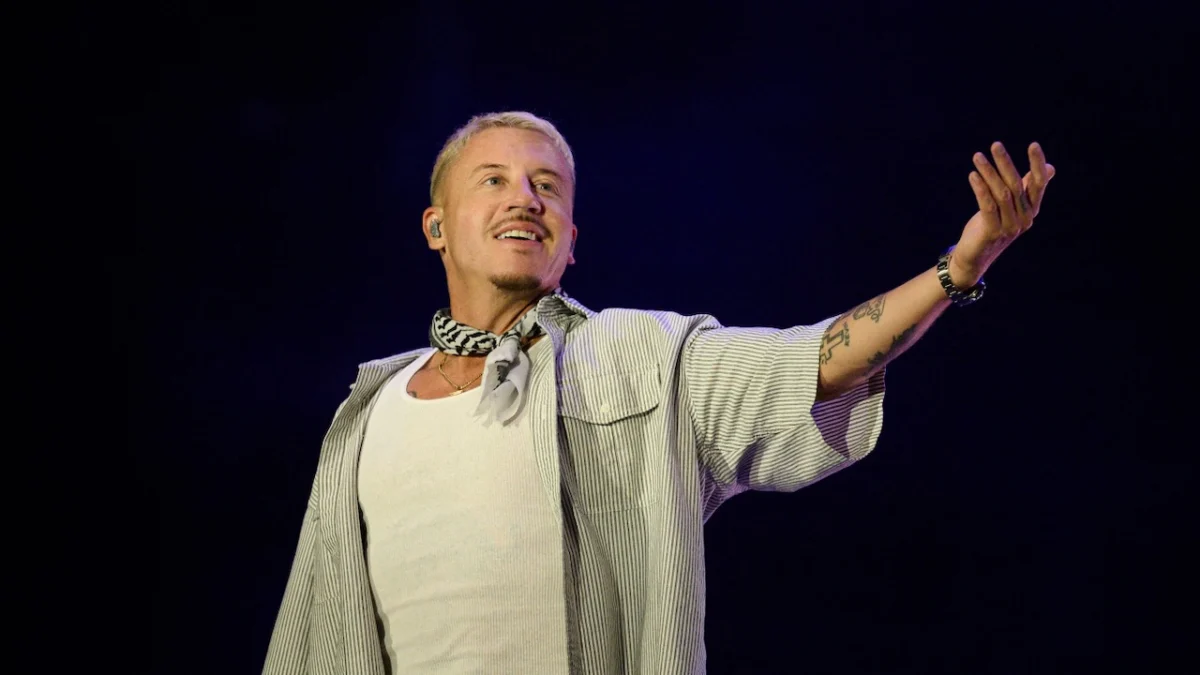
In a significant intersection of celebrity activism and geopolitical tension, rapper Macklemore has announced that he will donate $1 million—representing his entire net earnings from Ed Sheeran’s "LOOP Tour"—to six organizations dedicated to humanitarian relief for the Palestinian people. This decision follows a highly publicized week of controversy that culminated in the rapper’s removal from a performance at Gillette Stadium, a venue owned by New England Patriots owner Robert Kraft.
The dispute began when Macklemore’s vocal support for the Palestinian cause led to internal friction regarding his scheduled appearance at the Massachusetts venue. Following his removal from the lineup, the artist issued a public statement on Wednesday, shifting the focus away from his personal professional setbacks and toward the ongoing humanitarian crisis in the Middle East. By inviting Robert Kraft to join him in a financial commitment to the region, Macklemore has transformed a localized cancellation into a broader conversation regarding corporate responsibility, political speech, and humanitarian aid.
A Chronology of the Conflict
The friction between the artist and the stadium ownership reached a breaking point earlier this week. Following his removal from the bill, Macklemore publicly criticized the decision, framing it as a silencing of his advocacy for Palestinian liberation.
In response to the removal, Robert Kraft provided an explanation for his decision to bar the artist from the stadium. Kraft, a prominent philanthropist who has long been involved in various humanitarian and community-building initiatives, stated that his objection was not to the support of Palestinians, but to what he characterized as a one-sided approach to a complex geopolitical conflict. Kraft argued that advocacy should not come at the cost of alienating the Jewish community or minimizing the actions of Hamas, the organization responsible for the October 7, 2023, attacks that significantly escalated the current regional conflict.
The situation escalated rapidly over 48 hours. By Wednesday, Macklemore issued his statement pledging the $1 million donation and challenging Kraft to match the funds. By late Wednesday, the narrative took an unexpected turn when it was revealed that, prompted by a conversation with Ed Sheeran, Kraft had agreed to contribute $2 million to humanitarian efforts in the region, effectively exceeding the challenge posed by Macklemore.
Contextualizing the Humanitarian Crisis
The impetus for this donation lies in the dire conditions currently facing the Palestinian population. International observers, including the United Nations and various NGOs, have consistently reported on the catastrophic humanitarian conditions in Gaza. According to data provided by the World Health Organization (WHO) and local health authorities, the healthcare infrastructure in the region has been decimated, with hospitals operating under extreme duress, lacking basic electricity, clean water, and surgical supplies.
The organizations Macklemore intends to support operate on the front lines of this crisis, providing medical intervention, food security, and logistical support to civilians displaced by the ongoing military operations. The artist emphasized that his donation is intended to support those "carrying their children into hospitals without the basic resources to treat them," as well as the journalists and aid workers who remain in the conflict zone despite significant personal risk.
The Debate Over Advocacy and Accountability
The public exchange between Macklemore and Kraft highlights a deep-seated tension in modern public discourse: the divide between supporting Palestinian rights and addressing the broader complexities of the conflict, including the actions of Hamas and the historical security concerns of Israel.
Robert Kraft’s public stance serves as a microcosm of the argument held by many who believe that public figures carry a responsibility to address the entirety of a conflict. In his statement, Kraft noted, "Standing with the Palestinian people and standing against Hamas, antisemitism, and hate should not be mutually exclusive." His argument rests on the premise that ignoring the role of non-state actors in the violence obscures the truth and serves to further polarize an already divided global public.
Conversely, Macklemore’s position centers on the immediate suffering of the civilian population, arguing that the political debate often serves to distract from the urgency of the humanitarian catastrophe. He maintains that while political change is required to solve the structural injustices he cites, the immediate priority must be the preservation of life and the alleviation of suffering for those currently caught in the crossfire.
Financial Commitments and Strategic Implications
The dual commitment—Macklemore’s $1 million and the $2 million pledge facilitated by Ed Sheeran and Robert Kraft—represents a significant infusion of capital into humanitarian efforts. However, this development raises questions about the role of high-profile entertainment figures in global politics.
When artists of Macklemore’s stature align their professional earnings with specific political outcomes, they effectively pressure corporate entities, such as stadium owners and tour promoters, to navigate the volatile landscape of public opinion. This case suggests that the "neutrality" once expected of major venues is increasingly difficult to maintain. As public figures continue to use their platforms to drive social and political change, the lines between personal advocacy and professional operation will likely continue to blur.
Ed Sheeran’s involvement, as noted by Kraft, suggests an attempt at diplomatic mediation. By acting as a liaison between the two parties, Sheeran sought to shift the focus from a personal conflict between a performer and a venue owner toward a collaborative effort to address a humanitarian emergency. This "bridge-building" approach may set a precedent for how future disputes involving artists with strong political convictions are handled in high-profile entertainment settings.
The Broader Impact on Public Discourse
The public nature of this donation and the subsequent response from Kraft underscore the power of the "news cycle" in shaping modern activism. Macklemore specifically addressed his followers, warning them against the tendency to move on once the news cycle shifts away from a particular topic. By committing a significant portion of his income, he has attempted to tether his personal brand to a long-term, sustained commitment to the cause.
The incident also highlights the evolving nature of celebrity philanthropy. Historically, celebrity giving has been characterized by general aid to global causes. Today, there is a clear trend toward "cause-driven" giving, where the funding is specifically earmarked for ideological or political objectives. This shift creates both opportunities for significant humanitarian impact and challenges regarding the transparency and neutrality of aid distribution.
Looking Ahead
As the dust settles on this particular controversy, several implications remain for the music and live-event industry. Venue operators, sponsors, and artists are forced to reckon with a new reality where professional agreements are no longer insulated from the global political climate.
The commitment from both parties to fund aid in the region is a tangible outcome of a heated public dispute. Whether this will lead to a more nuanced conversation regarding the conflict or simply entrench the existing divisions remains to be seen. What is clear, however, is that the intersection of pop culture and international relations has entered a new phase of intense visibility.
Macklemore concluded his statement by reaffirming his commitment to the "fight for liberation," signaling that this donation is likely only one step in a larger, sustained effort to keep the plight of the Palestinian people at the forefront of the public consciousness. Meanwhile, the $2 million fund announced by Kraft, which aims to engage other venue owners in similar efforts, represents a corporate-led approach to humanitarian relief, suggesting that the industry may attempt to standardize its response to such crises in the future.
Ultimately, the events of this week demonstrate that in an era of global connectivity, the professional, the personal, and the political are inextricably linked. For the millions affected by the crisis in Palestine, the outcome of this dispute—while rooted in a clash of personalities and principles—has resulted in a significant, if temporary, increase in resources for those in desperate need. Whether this will lead to the "immediate political change" that the artist calls for is a question that extends far beyond the reach of the entertainment world and into the complex, often intractable, arena of international diplomacy.






Leave a Reply