
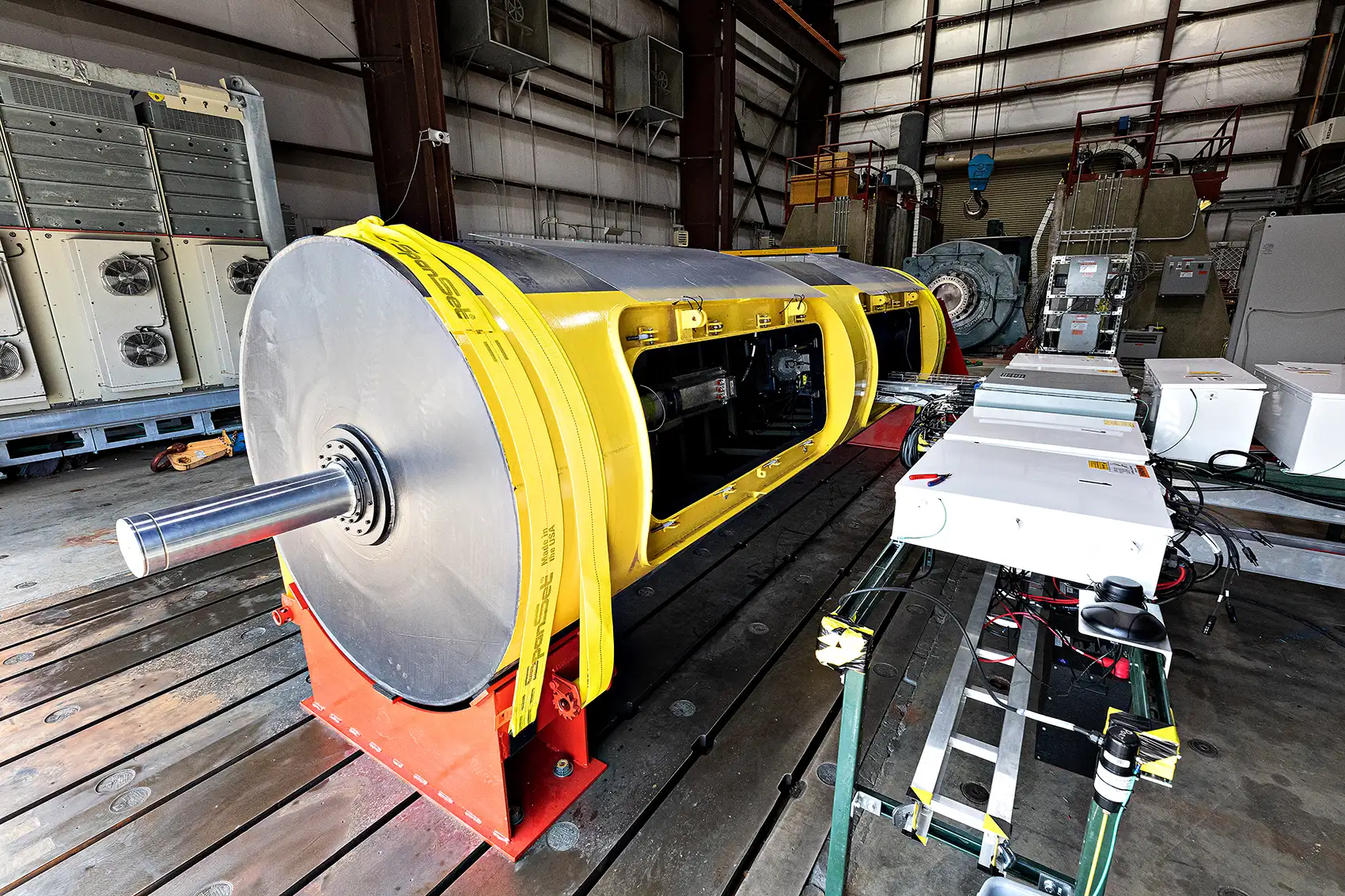
The quest to harness the kinetic energy of the world’s oceans has moved from a theoretical pursuit to a critical infrastructure frontier. As the global demand for reliable, carbon-neutral power grows, the focus is shifting toward offshore and coastal microgrids that can support everything from underwater sensor arrays to remote, islanded communities. However, the transition from the drawing board to the turbulent, unforgiving marine environment is fraught with technical and financial risks. To bridge this "valley of death" for emerging marine energy technologies, the National Laboratory of the Rockies (NLR) has scaled the capabilities of its Advanced Research on Integrated Energy Systems (ARIES) platform, creating a comprehensive, high-fidelity sandbox for testing the future of ocean power.
The challenge of marine energy integration lies in the inherent variability of the resource. Unlike solar or wind, which have established forecasting models and mature power conversion technologies, wave and tidal energy converters must operate in high-salinity, high-pressure environments with fluctuating mechanical inputs. When these converters are connected to microgrids—which often lack the stability of massive national grids—the risk of system failure, equipment damage, or inconsistent power delivery increases exponentially. ARIES serves as a de-risking ecosystem, allowing developers to subject their hardware to the stresses of the ocean without ever leaving the laboratory floor.
The Evolution of Marine Energy Testing
The journey toward reliable ocean power has accelerated significantly over the last decade. Early experiments in the 2010s were often limited by siloed testing: a device would be tested for mechanical buoyancy in a tank, and then its electrical output would be simulated via software. There was little opportunity to observe how the two interacted in real-time under dynamic conditions.
By 2024, the NLR began shifting its focus toward "cyber-physical" testing—a methodology that treats the power grid, the physical wave energy converter, and the control software as a single, interdependent entity. The ARIES platform represents the pinnacle of this approach. By 2026, the facility had reached a level of maturity where it could not only replicate the mechanical forces of the ocean but also simulate the complex electrical behavior of a remote microgrid, including the sudden surges or drops in voltage that occur when a wave hits a converter.

Technological Core: LAMP and Dynamic Emulation
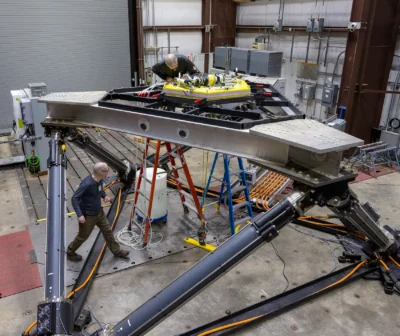
Central to the ARIES platform is the Large-Amplitude Motion Platform (LAMP). This massive, six-degree-of-freedom robotic system acts as a "dry simulator" of the ocean. It is capable of moving 10,000-kilogram prototypes with precision, mimicking the erratic, multi-directional motion of real ocean swells. By utilizing high-resolution data sets collected from buoy networks and satellite observations, researchers can program LAMP to replicate the exact conditions of a specific coastal site, such as the choppy waters of the Pacific Northwest or the more rhythmic swells of the Atlantic coast.
However, mechanical motion is only half the battle. As LAMP undulates, the device under test must convert that motion into electricity. This is where the laboratory’s grid emulation capabilities become critical. The power take-off (PTO) systems—the internal gears and generators that convert wave energy into electrical current—are subjected to dynamometers. These dynamometers provide the necessary resistance and rotational force to simulate the load of an electrical grid, effectively "tricking" the prototype into believing it is already powering a remote mining operation or an aquaculture facility.
This creates a high-fidelity feedback loop. If the converter’s power output spikes, the electrical system responds as if it were a real-world microgrid. Researchers can then observe how the power electronics—the inverters and controllers—handle these fluctuations. This is essential for protecting the integrity of the microgrid; without robust power electronics, the erratic input of ocean energy could damage sensitive local infrastructure or lead to total system failure.
Institutional Perspectives and Industrial Collaboration
The philosophy behind the ARIES platform is one of radical accessibility. Al LiVecchi, the water power laboratory program manager at the NLR, emphasizes that the platform is designed to be a catalyst for the entire industry. "This helps de-risk and ready systems for ocean deployments and accelerate technology development," LiVecchi stated. "There isn’t a marine energy company which has leveraged NLR’s laboratory infrastructure who hasn’t incorporated the learnings in next-generation systems."
The collaboration model is structured to assist both startups and established energy firms. For instance, in the development of the HEROS (Hydraulic and Electric Reverse Osmosis) wave energy converter, researchers utilized ARIES to specifically calibrate the charge controllers. By managing the energy flow between the offshore generator and a simulated battery bank, the team successfully demonstrated that the system could maintain a stable voltage even when wave conditions were unpredictable. This success story has become a blueprint for subsequent projects, proving that the integration of digital twins—virtual models that run in parallel with physical tests—can reduce the need for expensive, time-consuming sea trials by up to 40%.
Broader Implications for Remote and Islanded Power
The implications of successful marine energy integration extend far beyond technical milestones. For many remote communities, particularly those in the U.S. islands and isolated Tribal villages, energy security is a constant challenge. Currently, many of these locations rely on diesel generators, which require the costly and dangerous transportation of fuel across long distances.
If marine energy can be successfully "de-risked" at ARIES, these communities gain a pathway to energy independence. A microgrid powered by a combination of wave energy, local battery storage, and perhaps secondary solar or wind inputs could provide a resilient, 24/7 power source that is decoupled from global fuel markets.
Furthermore, the defense and commercial sectors stand to gain from the proliferation of autonomous ocean sensing. The ability to charge underwater drones (AUVs) directly from the waves they are monitoring would revolutionize ocean exploration, enabling longer-duration missions without the need for ships to return to port to swap batteries. The work conducted by the NLR on the SeaRAY Autonomous Offshore Power System is a primary example of this, demonstrating that ARIES is effectively lowering the barrier to entry for the blue economy.
Looking Ahead: A Roadmap for Integration
The year 2026 marks a pivotal transition for marine energy. With the launch of the NLR’s comprehensive webinar series, the focus is now on standardizing the integration of hydrokinetic power. By sharing best practices on cyber-physical security and grid-forming inverters, the NLR is attempting to foster a common language for the industry.
As the ARIES platform continues to evolve, the focus will likely shift toward larger-scale arrays. While current testing often focuses on individual converters, the future of ocean power lies in "wave farms"—clusters of devices working in concert. Emulating the collective output of a multi-unit farm will require even greater computational power and more sophisticated grid simulators, areas in which the NLR is currently investing significant resources.

For the private sector, the message is clear: the path to commercial viability is no longer a solo journey. By partnering with federal laboratory infrastructure, firms can bypass the "trial-and-error" phase that has historically hampered ocean energy. The combination of the LAMP motion platform, advanced dynamometers, and real-time grid emulation provides a unique environment that mirrors the harsh reality of the ocean while maintaining the control and precision of a laboratory.
As the energy sector continues its broader transition toward decentralization, the ocean—once seen only as a source of environmental risk—is being redefined as a vast, untapped battery. Through platforms like ARIES, the technical hurdles that once made this prospect seem like science fiction are being systematically dismantled, one wave at a time. The transition to a marine-integrated power future is not merely about generating electricity; it is about building the necessary, resilient infrastructure to ensure that remote, offshore, and coastal operations have a reliable, clean, and sustainable future.







Leave a Reply