
As asphalt and concrete bake under relentless summer suns and towering architectural monoliths trap stagnant air, urban environments worldwide are increasingly transforming into perilous heat traps. The urban heat island (UHI) effect—a well-documented phenomenon where metropolitan centers experience significantly higher temperatures than their surrounding rural counterparts—is no longer a distant projection of climate models. It is an immediate, deadly reality for millions of city dwellers. With global temperatures steadily climbing and extreme heat waves becoming more frequent and severe, researchers are racing to find scalable, economically viable interventions to protect vulnerable populations.
Against this backdrop, an international team of scientists has introduced a promising, nature-based technological solution. By merging smart automation with traditional rainwater harvesting, researchers have developed an artificial intelligence-driven model that uses rooftop rainwater collection tanks and automated sprinkler systems to cool both the interiors of buildings and the surrounding outdoor air. The findings, which offer a dual-benefit approach to mitigating urban heat and managing stormwater runoff, were recently published in the peer-reviewed journal Earth’s Future.
The Genesis of an Urban Cooling Strategy
The concept of utilizing water to cool buildings is rooted in elementary thermodynamics: evaporation absorbs heat. However, the innovation detailed in the recent study lies in its systematic integration of existing urban practices into a cohesive, automated network.

Led by Zhonghua Zheng, an associate professor of urban climate and environmental data science at the University of Manchester in the United Kingdom, the research team sought to replicate the natural relief brought by a sudden summer rain shower. Zheng and his colleagues, including study co-author Junjie Yu, recognized that while many cities already engage in rainwater harvesting and localized street or rooftop watering, these practices typically operate in silos without real-time optimization.
To bridge this gap, the research team deployed machine learning algorithms to simulate an integrated system. The proposed architecture consists of decentralized rooftop rainwater collection tanks connected to smart sprinkler arrays. Governed by artificial intelligence, these sprinklers are programmed to activate automatically when outdoor temperatures cross a specific threshold, releasing a measured film of water across the roof’s surface.
As the water evaporates, it draws thermal energy away from the building envelope, decreasing surface temperatures and cooling the air immediately above and around the structure. According to the study’s data, this localized cooling successfully permeates indoor spaces, reducing the reliance on energy-intensive air conditioning units.
Testing the Model in Tokyo
To test the viability of their machine learning model, the researchers selected Tokyo, Japan, as a primary case study. Tokyo offered an ideal testing ground due to its temperate climate, pronounced seasonal variations, and status as a global leader in urban rainwater collection infrastructure. Furthermore, the sprawling megalopolis features vast expanses of flat rooftop surface area—a ubiquitous characteristic of modern cities that is typically underutilized in climate adaptation strategies.

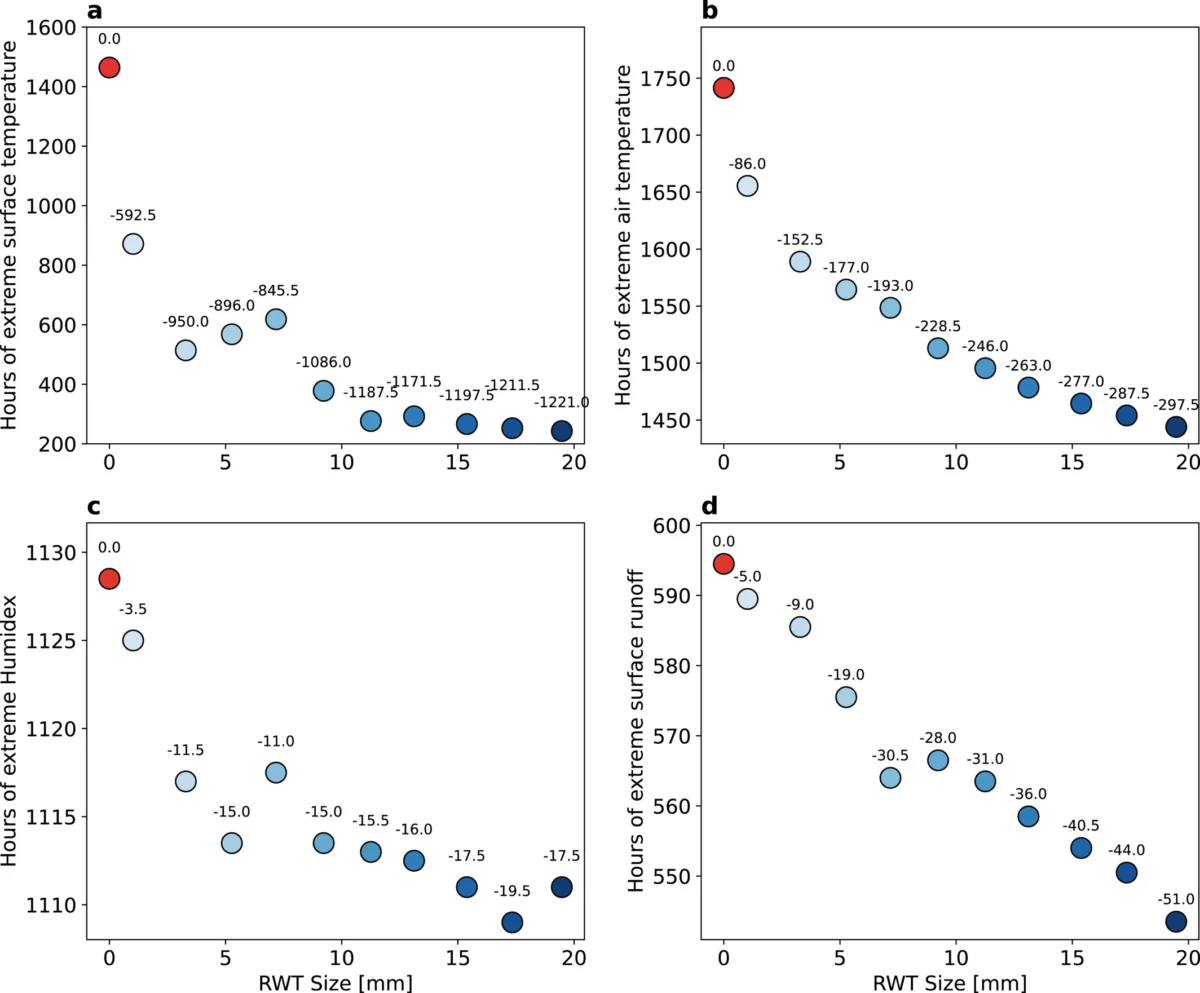
When the researchers ran their simulations across Tokyo’s diverse urban topography, the results confirmed that widespread adoption of the rooftop sprinkler strategy would yield measurable drops in both surface temperatures and ambient air temperatures. Furthermore, the model evaluated the Humidex—an index measuring how hot and sticky the air feels to the human body—and recorded notable improvements in thermal comfort during peak afternoon hours.
The study identified three critical variables that dictate the success of the system:
- Tank Capacity: Larger rainwater collection tanks provide a greater volume of water, allowing the system to sustain cooling operations through extended heat wave conditions.
- Sprinkler Intensity: While increased water output enhances cooling up to a point, the researchers discovered diminishing returns past a low operational threshold, indicating that water conservation and efficiency can be maintained without sacrificing performance.
- Trigger Threshold: The ambient temperature at which the automated system activates is vital. Optimizing this trigger ensures that water is deployed precisely when the marginal benefit to human health and thermal comfort is highest.
Understanding the Urban Heat Island Effect
To fully grasp the significance of the Manchester team’s research, one must examine the mechanics of the urban heat island effect. Cities are significantly hotter than surrounding rural areas—often by 7 to 7 degrees Fahrenheit (3 to 4 degrees Celsius) on average, with mid-afternoon spikes reaching 15 to 20 degrees Fahrenheit (8 to 11 degrees Celsius) in heavily built environments.
Xuhui Lee, a climate scientist at Yale University who was not involved in the research, explains that this extreme thermal differential is driven primarily by a deficit in surface evaporation. In natural landscapes, moisture in soil and vegetation absorbs solar energy and releases it through evapotranspiration, a natural cooling process. In cities, impervious surfaces like asphalt and concrete shed water rapidly, eliminating this natural cooling mechanism.

Furthermore, urban geometry plays a critical role. Tall buildings create canyons that trap solar radiation and restrict wind circulation, preventing cool breezes from clearing stagnant hot air. Anthropogenic heat sources—such as industrial operations, vehicular traffic, and the exhaust heat rejected by millions of air conditioning units—compound the problem, creating a self-reinforcing cycle of warming.
Public Health Implications and Excess Mortality
The consequences of unmitigated urban heat are profound. Heat stress is widely recognized as a silent killer, disproportionately impacting older adults, individuals with pre-existing cardiovascular and respiratory conditions, and low-income urban populations who may lack access to reliable air conditioning.
The urgency of these findings is underscored by recent global casualty figures. During the summer months, extreme heat events across Europe resulted in a minimum of 35,000 excess deaths, while consecutive heat waves in Asia hospitalized thousands and disrupted daily life for hundreds of millions.
Proponents of the rooftop sprinkler model emphasize its potential to act as a life-saving intervention for vulnerable communities that cannot afford continuous air conditioning or the associated electricity costs. Moreover, by reducing the reliance on mechanical cooling, the system indirectly curbs greenhouse gas emissions generated by fossil-fuel-powered electrical grids.

Addressing Stormwater Management and Urban Flooding
Beyond thermal regulation, the research team is expanding its focus to evaluate a crucial co-benefit: the mitigation of urban stormwater runoff. Climate change has intensified hydrological cycles, leading to sudden, torrential downpours that frequently overwhelm municipal drainage infrastructure.
In major global metropolises such as New York, London, and Paris, heavy precipitation routinely overwhelms combined sewer outflows (CSOs). When this occurs, untreated sewage and urban pollutants bypass wastewater treatment facilities entirely, discharging directly into rivers, streams, and marine estuaries. This poses severe public health risks and triggers ecological damage, including toxic algal blooms and marine heat waves.
By capturing precipitation at the source—on rooftops across the city—distributed rainwater tanks function as decentralized retention basins. This localized retention flattens peak runoff curves, easing the burden on municipal sewer systems during severe storms while simultaneously reserving that water for subsequent use during heat waves.
Pathways to Global Implementation and Future Challenges

While the computer model developed by the University of Manchester team is adaptable to virtually any city across various climate zones, transitioning from digital simulation to physical infrastructure presents distinct challenges.
Junjie Yu cautions that the efficacy of rooftop sprinkler systems is fundamentally tied to regional background climates. In humid tropical environments, where ambient humidity levels are already exceptionally high, the thermodynamic benefits of water evaporation are constrained. In such regions, adding moisture to the air via sprinklers could inadvertently raise the heat index, demonstrating that the technology must be tailored to local environmental conditions.
Additional hurdles involve financial and logistical considerations. Questions remain regarding the capital costs of retrofitting existing buildings with automated tanks and smart valves, as well as determining whether the system is more effective when mandated at a municipal scale or implemented voluntarily by individual property owners.
Yale’s Xuhui Lee advocates for empirical validation through pilot projects. "You need to bring it into the real world first. Set up a few houses and test it out. The idea is cool though," Lee noted, emphasizing that adaptation requires a dual approach. Humanity must pursue aggressive macro-level strategies to curb global greenhouse gas emissions while simultaneously deploying localized micro-solutions to manage the unavoidable warming baked into the climate system over the coming decades.
As cities search for innovative, low-cost resilience measures, the integration of smart rooftop sprinklers and rainwater harvesting offers a compelling pathway forward. By turning the built environment’s vast expanse of rooftops into an active network of cooling and water retention, urban planners may soon harness the principles of nature to shield cities from the extremes of a warming world.







Leave a Reply