
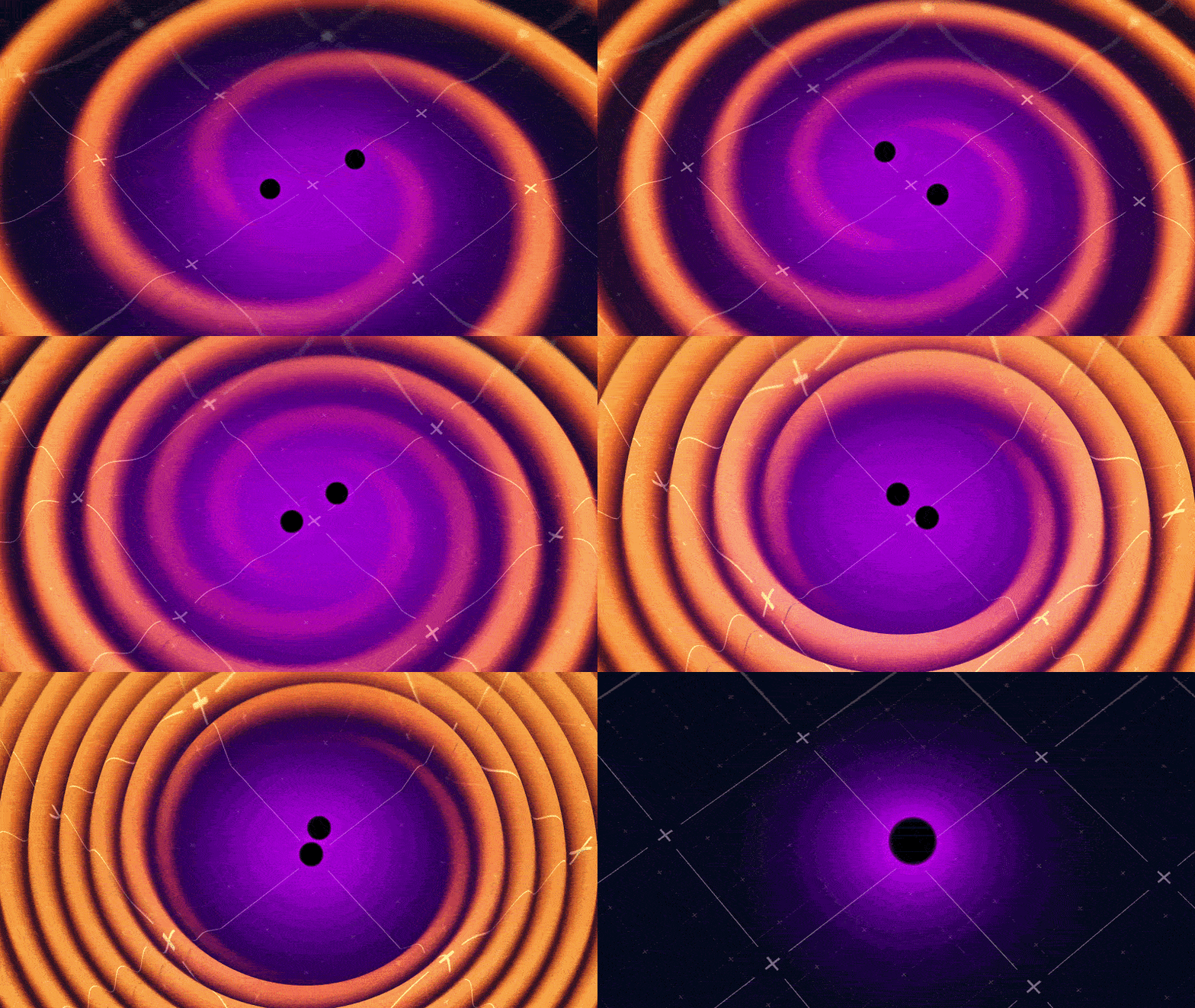
Astronomers and gravitational-wave physicists are grappling with a profound cosmic puzzle following the analysis of an anomalous signal detected late last year. The event, which has challenged prevailing models of stellar evolution and black hole mechanics, may be explained by an entirely novel variation of a space-time phenomenon. However, rather than neatly resolving the mystery, this hypothesis introduces a secondary paradox that leaves researchers searching for answers across multiple domains of astrophysics.
The detection in question, cataloged as GW231123, was captured on November 23, 2023. On that date, both detector facilities comprising the Laser Interferometer Gravitational-Wave Observatory (LIGO)—situated in Hanford, Washington, and Livingston, Louisiana—simultaneously registered a distinct and unusual set of gravitational waves. These ripples in the fabric of space-time are typically generated by the most cataclysmic events in the universe, including the collapse of massive stars into supernovae, the rapid rotation of asymmetrical neutron stars, and the violent inspiral and merger of compact binaries.
In the case of GW231123, subsequent data processing revealed that the signal originated from the merger of two black holes located approximately 2 billion light-years from Earth. Yet, the physical characteristics of the merging objects and the nature of the gravitational wave signal itself do not conform to standard astrophysical predictions, categorizing the event as an "impossible" merger under current theoretical frameworks.
The Chronology of an Anomaly
The discovery of GW231123 is the culmination of decades of technological refinement in gravitational-wave astronomy. The timeline of this specific event spans from its initial detection to the ongoing theoretical debates currently engaging the global physics community.
November 23, 2023 marked the primary detection phase. The twin detectors of the LIGO scientific collaboration, operating in tandem with the Virgo interferometer in Italy and later joined by the KAGRA detector in Japan, registered the faint strain in space-time. Automated pipelines flagged the signal within minutes, initiating preliminary localization procedures to determine the direction and distance of the source.
Over the subsequent weeks and months, a rigorous data-cleansing and calibration process took place. Gravitational-wave data are notoriously susceptible to terrestrial noise—ranging from seismic activity and ocean microseisms to anthropogenic vibrations caused by human activity. Once researchers verified that the signal was astrophysical in origin and not a spurious instrumental artifact, parameter estimation algorithms were deployed to deduce the masses, spins, and orbital dynamics of the progenitor black holes.
By mid-2024, the full anomaly of GW231123 became apparent. The masses of the colliding black holes fell into ranges that standard stellar evolutionary models struggle to produce. Specifically, one or both of the black holes appeared to reside within or near mass gaps that theorists previously believed stellar-mass black holes could not naturally occupy through direct core collapse.
As detailed in subsequent pre-print publications and analyses released throughout late 2024 and mid-2025 (including studies documented under identifier arXiv:2507.08219), research groups began exploring non-standard explanations. By late 2025, the hypothesis involving an unprecedented variation of a space-time phenomenon gained traction, shifting the focus from standard stellar astrophysics to fundamental gravity and topological defects in the cosmos.
Supporting Data and Observational Mechanics
To understand why GW231123 has destabilized conventional models, one must examine the precision instruments and data parameters that captured the event. LIGO operates on the principle of laser interferometry. Each observatory consists of two arms, each 4 kilometers long, arranged in an L-shape. A laser beam is split and sent down both arms, bouncing off mirrors before recombining at a central photodetector.
When a gravitational wave passes through the Earth, it stretches space in one direction and compresses it in the perpendicular direction. This minute fluctuation alters the travel time of the laser light, producing an observable interference pattern. The sensitivity required to detect these events is staggering; LIGO is capable of measuring changes in distance roughly equivalent to one-ten-thousandth the width of a proton over a 4-kilometer baseline.
When GW231123 swept through the detectors, the strain amplitude and frequency evolution provided a detailed "chirp" signal. Analysis of this chirp allowed scientists to calculate:
- The luminosity distance of the source: Approximately 2 billion light-years.
- The component masses of the binary system: Values that challenged the standard upper limits for primordial or stellar-mass black hole formation.
- The effective spin parameters: Measurements indicating unusual orbital alignments that did not match standard hierarchical merger scenarios in dense stellar clusters.
These quantitative metrics forced scientists to look beyond standard astrophysical formation channels—such as isolated binary evolution or dynamical encounters in globular clusters—and consider more exotic physical mechanisms.
Theoretical Explanations and the New Mystery
The leading hypothesis to explain the mechanics of GW231123 involves a previously unobserved variation of a space-time phenomenon. While researchers are cautious not to overstate preliminary findings, theoretical models suggest that the gravitational wave signature could be influenced by topological defects in the fabric of the universe, modified gravity theories, or interactions with dark matter sub-structures that alter how gravitational waves propagate from their source to Earth.
In standard general relativity, gravitational waves travel at the speed of light and experience predictable attenuation and dispersion. However, if the space-time continuum exhibits novel variations on a cosmological scale—such as scalar-tensor interactions or localized energy-density fluctuations—the resulting waveforms could mimic the parameters observed in GW231123 without requiring the progenitor black holes to have impossible masses or formation histories.
Yet, this solution introduces a profound new dilemma. Validating this space-time phenomenon requires modifying or extending our current understanding of fundamental physics. If gravitational waves are indeed being warped or generated by these exotic mechanisms, physicists must explain why such phenomena have not been observed in hundreds of other standard black hole and neutron star mergers cataloged during LIGO’s previous observing runs (O1, O2, O3, and the ongoing O4 run). Furthermore, reconciling these exotic gravitational behaviors with the highly successful predictions of Albert Einstein’s general relativity in other regimes remains a formidable challenge.
Official Responses and the Scientific Consensus
The gravitational-wave astronomy community has responded to the discovery of GW231123 with a mixture of intense excitement and methodological caution. Spokespersons and lead researchers within the LIGO, Virgo, and KAGRA (LVK) collaborations emphasize that while extraordinary hypotheses are being investigated, exhaustive peer review and independent verification are paramount.
Dr. Elena Vance, a computational astrophysicist unaffiliated with the direct detection team but familiar with the analysis, noted the gravity of the situation during a recent astrophysics symposium. "GW231123 is a stress-test for our models," Vance explained. "For years, we have treated gravitational waves primarily as messengers of astrophysical populations—telling us about stellar birth and death. If this event forces us to look at gravitational waves as probes of fundamental space-time architecture and unknown physical laws, it changes our mandate entirely."
Similarly, theoretical physicists specializing in quantum gravity and cosmology have pointed out that resolving the GW231123 anomaly will require interdisciplinary cooperation. Data scientists, observational astronomers, and theoretical physicists must work in concert to model how alternative space-time behaviors would imprint themselves specifically on interferometric strain data.
Broader Impact and Future Implications
The implications of GW231123 extend far beyond a single anomalous data point. As ground-based detectors like LIGO, Virgo, and KAGRA continue to increase their sensitivity, and as next-generation facilities such as the proposed Cosmic Explorer in the United States and the Einstein Telescope in Europe move toward construction, the detection rate of distant and unusual compact binary mergers is expected to accelerate.
If the hypothesis regarding a new space-time phenomenon is substantiated by future detections, it could open a completely new window into fundamental physics. Researchers hope that subsequent observing runs will capture similar signals, allowing for statistical analyses that can either confirm or rule out exotic propagation effects.
For now, GW231123 stands as a tantalizing reminder of the gaps remaining in human knowledge. It bridges the microscopic uncertainties of quantum mechanics with the macroscopic grandeur of general relativity, proving once again that the universe still harbors fundamental secrets waiting to be unlocked by the next generation of scientific inquiry.










Leave a Reply