
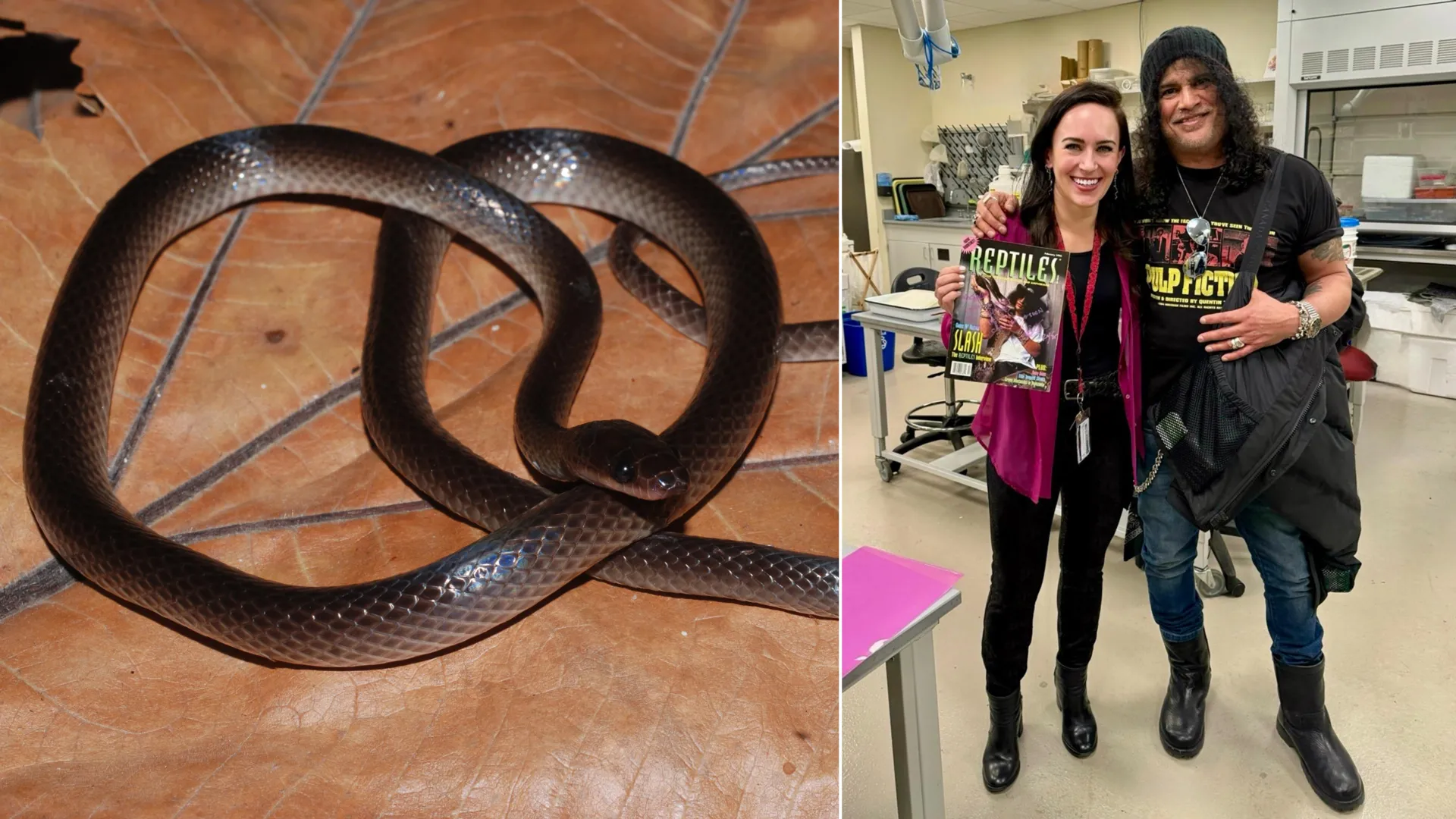
Saul Hudson, globally recognized as the iconic lead guitarist Slash of the legendary rock band Guns N’ Roses, has long been associated with the grit and volume of stadium rock. However, beneath the top hat and the leather, Hudson has maintained a lifelong, quieter passion: an intense fascination with herpetology. This duality of his public persona—the rock icon and the reptile enthusiast—has culminated in a unique scientific tribute. Researchers have officially named a newly identified species of snake discovered in the biodiverse forests of New Guinea Lielaphis slashi, or Slash’s groundsnake, marking a rare intersection between the worlds of high-decibel music and high-stakes field biology.
The formal description of Lielaphis slashi, published in the scientific journal Zootaxa, serves as more than just a nomenclature choice. It represents the culmination of years of taxonomic research and underscores the critical need for continued exploration in one of the world’s most ecologically complex regions. For the scientific team involved, the naming serves to highlight not only the specific characteristics of this reddish-brown, 28-inch-long serpent but also the ongoing struggle to catalog global biodiversity before it vanishes due to habitat loss.
A Chronology of Discovery
The journey to identifying Lielaphis slashi began nearly two decades ago. In 2006, Dr. Chris Austin, a prominent professor and curator of herpetology at the Louisiana State University (LSU) Museum of Natural Science, was conducting nocturnal fieldwork in the dense, tropical terrain of New Guinea. The island, which is the second-largest in the world, remains a frontier for biological discovery, with its rugged geography and climate creating isolated pockets of unique evolutionary development.
During a night excursion, Austin encountered a specimen that did not conform to the known morphological descriptions of local groundsnakes. At the time, the specimen was collected for further study, but it would take years of collaborative effort and technological advancement to confirm its status as a distinct species. The collaboration gained significant momentum in 2016, when Dr. Sara Ruane, then a researcher at LSU, joined forces with Austin. Their partnership sought to synthesize data from decades of specimens, applying modern genomic sequencing to clarify the taxonomy of New Guinea’s elusive reptile population.
For Dr. Ruane, now an Associate Curator of Herpetology at the Field Museum in Chicago, the naming of the species was a moment of profound personal significance. A self-described "herpephile" since childhood, Ruane grew up idolizing the same rock star who, decades later, would become the namesake for her discovery. Her decision to honor Hudson was rooted in his long-standing, documented support for zoos, museums, and natural history education. "I reread his old interviews, and he talked about his love for natural history and how, as a kid, he’d go outside and look for snakes—it was all stuff that I really related to," Ruane noted.
The Science of Classification: Genetics and Morphology
The process of distinguishing L. slashi from its relatives within the genus Lielaphis was a rigorous endeavor involving multiple layers of analysis. Simply observing the physical traits of the snake was insufficient, as many species within the New Guinea groundsnake family exhibit convergent evolution, appearing nearly identical to the untrained eye.
The research team, led by post-doctoral researcher Tianqi Huang, employed advanced genetic sequencing to determine the evolutionary divergence of the specimen. By analyzing DNA samples, the team identified clear genetic markers that separated L. slashi from its closest neighbors. These findings were then corroborated by physical examinations, specifically focusing on lepidosis—the arrangement and number of scales—which provides definitive diagnostic features for herpetologists.
Furthermore, the team utilized ecological modeling to define the snake’s niche. They discovered that L. slashi occupies a distinct habitat profile compared to similar snakes in the region. While many groundsnakes in New Guinea share similar nocturnal behaviors—often emerging after sunset near the base of large trees to hunt—the specific environmental requirements for L. slashi suggest a specialized evolutionary path that the researchers are only beginning to understand.
Behavior and Ecological Context
Understanding the ecology of L. slashi presents significant challenges. Nocturnal snakes in the tropical forests of New Guinea are notoriously difficult to track, as they are adept at concealment. "It’s incredibly hard to observe snakes in the wild before they slither away," Dr. Ruane explained.
However, the anatomical structure of the snake offers clues regarding its diet and behavior. Unlike constrictors, which use force to subdue prey, L. slashi is equipped with specialized, large teeth in the back of its mouth. Scientists hypothesize that these teeth are adapted to grip and manipulate slippery prey, such as small lizards and reptile eggs, rather than to kill through compression.
Despite the "dangerous" reputation of its namesake’s band, L. slashi is entirely non-venomous and poses no threat to humans. This contrast between the band’s aggressive public image and the harmless nature of the snake has become a point of amusement for both the scientific community and the musician. Upon hearing of the honor, Slash stated, "As a long-time herpephile, I am extremely honored and humbled to have Lielaphis slashi from New Guinea named after me. It is really exciting; I never would have imagined this moment would arrive."
Broader Implications for Conservation
The identification of Lielaphis slashi is not merely an academic exercise; it is a critical step in the conservation of New Guinea’s biodiversity. The region is currently facing rapid environmental change, driven by industrial activities such as large-scale mining and coffee farming. These industries threaten the delicate, high-biodiversity ecosystems that have evolved over millennia in isolation.
"That’s part of why describing the species that live there is important," Dr. Ruane emphasized. "We can’t conserve animals or other living things that we don’t know about." The formal naming of a species provides it with a legal and scientific identity, which is the first step toward potential habitat protection and government-mandated conservation efforts. By mapping the presence of L. slashi, researchers can better understand the health of the broader ecosystem and identify which regions are in most urgent need of protection.
The study, which included a diverse team of contributors from institutions including the Field Museum, Rutgers University, the Louisiana State University Museum of Natural Science, and the Papua New Guinea National Museum and Art Gallery, highlights the necessity of international cooperation in taxonomy. The inclusion of researchers from Papua New Guinea ensures that the discovery remains tied to the local institutions responsible for protecting the nation’s natural heritage.
Conclusion: A Legacy Beyond Music
The naming of Lielaphis slashi serves as a bridge between popular culture and scientific inquiry. It highlights the importance of public figures using their platforms to advocate for the natural sciences. For Slash, the tribute is a validation of a lifelong interest that existed long before his musical success. For the scientific community, it is a reminder that the world remains full of hidden species, many of which are waiting to be identified in the world’s last remaining wild forests.
As scientists continue to categorize the flora and fauna of New Guinea, the hope is that the story of this small, reddish-brown groundsnake will raise public awareness about the fragility of tropical ecosystems. Every new species identified is a piece of a larger puzzle—a puzzle that, if left incomplete, could see the extinction of organisms before they are even acknowledged by the human race. With Lielaphis slashi, the record is now set, ensuring that this particular inhabitant of the New Guinean forest will have its place in the biological, and perhaps even the cultural, history of the planet.










Leave a Reply