
Human history is punctuated not only by what has been preserved, documented, and placed behind glass in the world’s grandest institutions, but equally by the profound voids left by what has vanished. From the enigmatic disappearance of the Ark of the Covenant during the Babylonian siege of Jerusalem more than two millennia ago to the elusive gold reserves spirited away during the chaotic Spanish conquest of the Aztec Empire, the annals of antiquity are filled with missing material culture. These historical blanks continue to captivate the public imagination, driving generations of archaeologists, historians, and amateur sleuths to chase phantoms across continents.
In his new publication, The Museum of Lost Things: True Tales of Fabled Treasures, Legendary Cities, and Mythical Creatures That Vanished From History, released by National Geographic Partners, acclaimed science writer Sam Kean turns his analytical eye toward these enduring historical enigmas. Among the most compelling mysteries dissected in the book is the final resting place of Genghis Khan. Nearly eight centuries after his death in 1227 AD, the tomb of the Mongol Empire’s founder remains completely undiscovered, protected as much by the deliberate secrecy of his loyal followers as by the vast, unforgiving expanse of the Mongolian steppe.
The Magnitude of the Conqueror and the Secret of His Passing
To understand the mystery of Genghis Khan’s burial, one must first grasp the colossal scale of his historical impact. Born Temüjin around 1162, he rose from a life of brutal deprivation and tribal fragmentation to unite the warring nomadic tribes of the Mongolian plateau. By the time of his death, the empire he forged stretched from the Sea of Japan to the Caspian Sea, encompassing millions of square kilometers and incorporating diverse populations, cultures, and economies.
Despite ruling over a domain that vastly exceeded the territorial reach of the Roman Empire at its height, Genghis Khan lived and died a nomad. He eschewed permanent palaces, grand stone capitals, and elaborate dynastic monuments during his lifetime, preferring the mobility of the felt tent, or yurt. It is entirely consistent with his lifestyle—and calculated for political survival—that his death should be marked by a total absence of monumental architecture.
According to historical accounts, Genghis Khan died in August 1227 during a military campaign against the Western Xia dynasty in northwestern China. The exact cause of death remains a subject of historical debate, with medieval chronicles citing everything from battle injuries and illness to a fall from a horse. Regardless of the immediate cause, his death presented an immediate crisis for the nascent Mongol Empire. The empire was still fragile, held together largely by his formidable charisma, strategic genius, and terror-inducing military reputation. Revealing his death, or creating a permanent, recognizable tomb, would have invited rival factions, conquered peoples, and external enemies to desecrate his remains and destabilize the state.
The Legend of the Cover-Up: Chronology and Folklore
To prevent desecration, Genghis Khan’s inner circle enacted an elaborate, multi-layered concealment protocol that has passed into both historical lore and modern archaeological frustration. While medieval European and Persian chroniclers recorded various versions of the event, the prevailing narrative suggests a calculated effort to erase all physical markers of the burial site.
According to legend, the funeral cortege carrying the Great Khan’s body executed anyone encountered along the route back to his ancestral homeland in the Khentii Province of modern-day Mongolia. Once the burial party reached the designated remote region—often associated with the sacred mountain Burkhan Khaldun—they interred him in a secret location.
To ensure the landscape revealed nothing, historical accounts claim the Mongols drove a herd of thousands of horses back and forth over the burial site to trample the earth until it was entirely indistinguishable from the surrounding steppe. Alternatively, some legends suggest a river was diverted to flow over the grave, effectively washing away any remaining topographic anomalies. Finally, according to Marco Polo and other chroniclers, the soldiers who participated in the burial were themselves hunted down and killed by a secondary security force to maintain absolute secrecy.
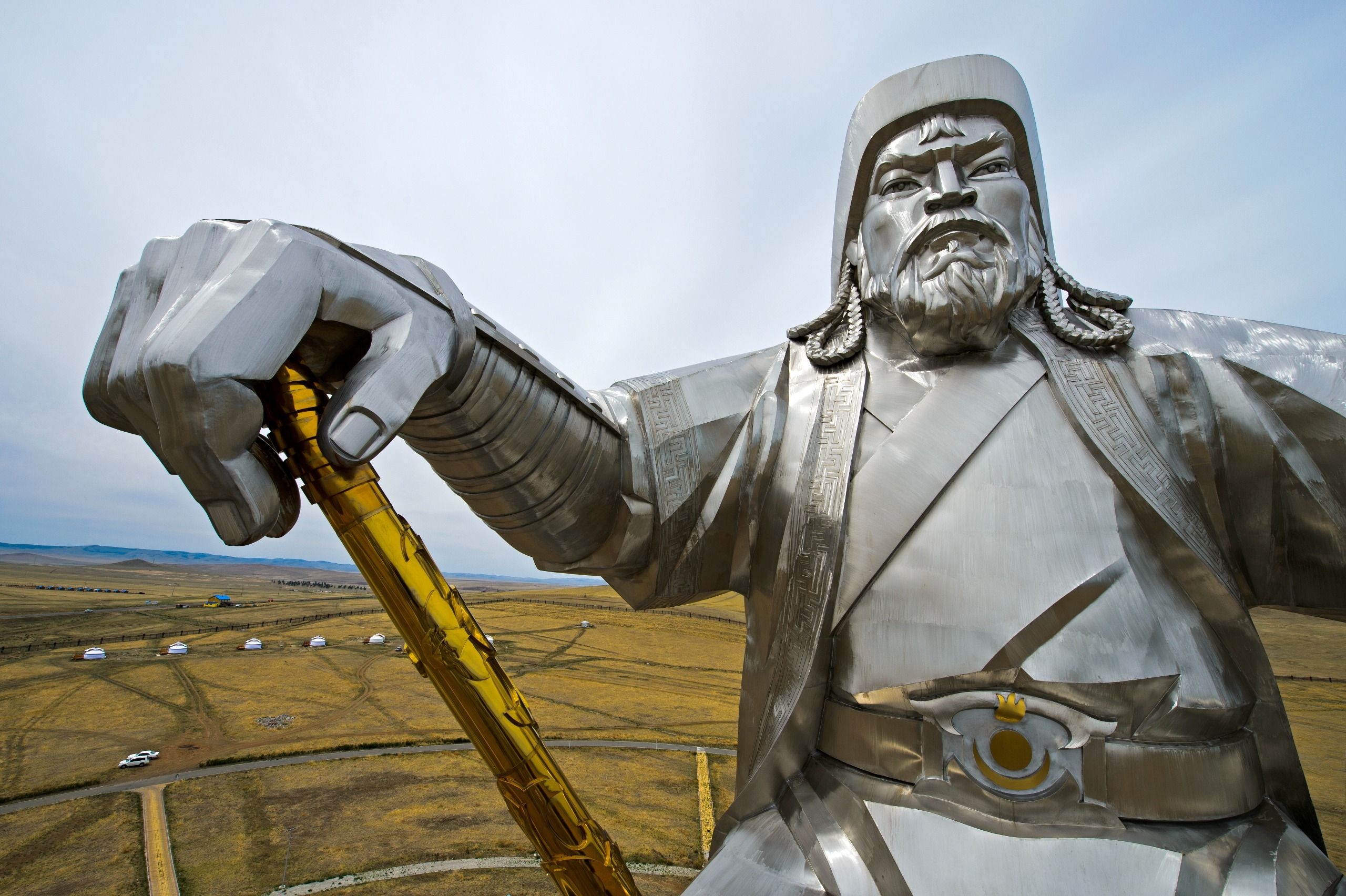
While modern historians view the execution of the entire funeral party and guards as likely medieval hyperbole designed to heighten the mystique of the Mongol conqueror, the core strategy of deliberate, radical concealment is well-documented within nomadic traditions of the era.
Archaeological Challenges and Modern Search Efforts
For decades, the search for the tomb of Genghis Khan has been hampered by a combination of geographical vastness, cultural sensitivities, and government restrictions. The Khentii Province, widely believed by historians and local traditions to house the burial site, covers thousands of square kilometers of dense forests, steep mountains, and rolling grasslands with virtually no modern infrastructure.
In the late 20th and early 21st centuries, technological advancements have brought non-invasive survey methods to the forefront of the search. Archaeologists and remote-sensing specialists have employed high-resolution satellite imagery, synthetic aperture radar, and drone-mounted magnetometers to scan vast tracts of Mongolian terrain for subsurface anomalies that could indicate an ancient burial vault.
Projects such as the "Valley of the Khans" initiative, spearheaded by prominent researchers in collaboration with Mongolian institutions, have mapped hundreds of square miles of the region. These surveys have identified numerous Bronze Age and Xiongnu-era archaeological sites, providing valuable context regarding ancient burial practices in the area. However, the specific, undisturbed tomb of Genghis Khan continues to elude detection.
Furthermore, the search is governed by complex cultural and political dynamics within modern Mongolia. For many Mongolians, Genghis Khan is revered not merely as a historical conqueror, but as the founding father of the nation and a deeply spiritual figure. Consequently, some local communities and political leaders view aggressive archaeological excavations of suspected sacred sites as disrespectful or taboo. Balancing the scientific desire for historical discovery with the cultural preservation of national heritage remains a delicate challenge for researchers operating in the region.
Implications of the Missing Tomb
The ongoing elusiveness of Genghis Khan’s tomb carries significant implications for both historical scholarship and the philosophy of archaeology. In a contemporary world defined by total digital mapping, satellite surveillance, and hyper-transparency, the existence of a major historical monument completely hidden from science offers a compelling reminder of the limits of modern knowledge.
From an academic perspective, discovering the tomb—should it ever occur—would likely revolutionize our understanding of early Mongol material culture, elite burial rites, and intercontinental trade during the 13th century. Items buried with a ruler of such magnitude could include precious textiles, metalwork, weapons, and diplomatic artifacts sourced from across Eurasia, reflecting the vast economic and cultural networks synthesized by the Mongol Empire.
Conversely, some preservationists argue that the enduring mystery is, in its own way, the most appropriate monument to Genghis Khan. By remaining untraced, unexcavated, and uncommercialized, the tomb resists the reduction of a complex historical legacy into a standard tourist attraction. As Sam Kean highlights in The Museum of Lost Things, certain historical voids possess a power that far surpasses physical discovery, keeping the imagination tethered to the vast, untamed horizons of the Mongolian steppe where the great conqueror built his legendary empire.









Leave a Reply