
The sprawling exhibition halls of Hannover, Germany, served as the epicenter for the global logistics industry this week, as IAA Transportation 2026 underscored the rapid transition toward decarbonized freight. Amidst this high-stakes environment, Chinese commercial vehicle giant BAIC Foton delivered a definitive message regarding its long-term strategy: the company is no longer content with being a peripheral exporter. Instead, Foton is positioning itself as a localized, vertically integrated competitor within the European Union, signaling a fundamental shift in how Chinese manufacturers intend to capture market share in the West.
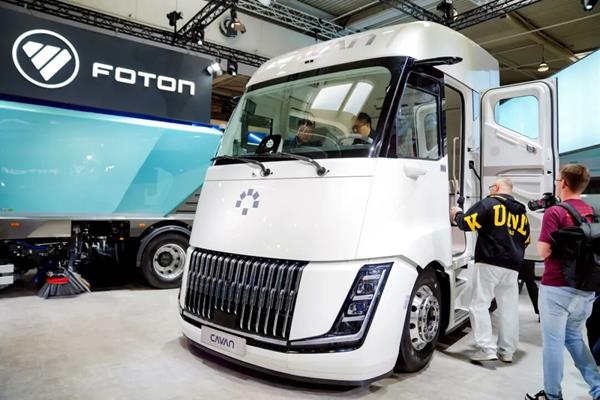
During a high-profile press briefing in Hall 21, Foton executives unveiled a multifaceted product and infrastructure roadmap. The centerpiece of this announcement was the global debut of the Cavan Beacon, a heavy-duty freight vehicle that represents a departure from traditional industry practices. While many legacy manufacturers have historically retrofitted diesel-powered chassis to accommodate battery packs, the Beacon is a purpose-built, modular platform. This architecture is designed to support a diverse range of powertrains, including battery-electric, hydrogen fuel cell, and swappable battery configurations, totaling 15 distinct operational permutations.
The Engineering Behind the Cavan Beacon
The technical specifications of the Cavan Beacon reflect a direct response to the primary challenges facing long-haul fleet electrification: charging latency and range anxiety. By utilizing an 800-volt electrical architecture, the vehicle is capable of extreme fast-charging speeds. When paired with the company’s proprietary megawatt charging infrastructure—which can deliver up to 1.44 megawatts of power—the Beacon can charge from 20 percent to 80 percent capacity in approximately 18 minutes. In practical highway applications, this translates to the ability to regain 100 kilometers of range in roughly six minutes of charging, a metric that moves battery-electric logistics significantly closer to the efficiency of diesel refueling stops.
Performance data for the Beacon is equally ambitious. The battery-electric variant boasts a single-charge range exceeding 600 kilometers, while the hydrogen fuel cell version extends that operational radius to over 1,000 kilometers. To maximize these figures, Foton engineers optimized the tractor’s aerodynamics, achieving a drag coefficient of 0.28. This results in energy consumption rates of approximately 105 kilowatt-hours per 100 kilometers for 4×2 configurations, and 115 kilowatt-hours for 6×4 variants.
Advanced Driver Assistance and Interior Ergonomics
Recognizing that the long-haul trucking sector is currently grappling with a significant driver shortage, Foton has integrated a sophisticated suite of safety and comfort technologies into the Beacon. The cab utilizes a centralized domain control unit that synthesizes data from seven optical cameras, five millimeter-wave radar units, and a roof-mounted lidar sensor. This sensor fusion allows for 22 distinct driver-assistance features, including semi-autonomous lane changes, adaptive cruise control, and precision lane centering.
Inside the cabin, the design philosophy prioritizes operator longevity and fatigue mitigation. The interior features a four-point floating air suspension seating system, dual high-definition digital displays (12.3 and 15.6 inches), and 420 liters of integrated storage, reflecting a modern approach to the mobile workspace.
A Chronology of Strategic Growth
The exhibition in Hannover served as the backdrop for a significant company milestone. BAIC Group General Manager and BAIC Foton Chairman Chang Rui personally oversaw the handover of the company’s 13 millionth production vehicle. The unit in question—a Galaxus 9 heavy tractor—was not merely a symbolic trophy; it had recently completed rigorous operating trials on Spanish highways, serving as a physical demonstration of Foton’s readiness to meet the grueling standards of European logistics.
Foton’s roadmap, branded under the slogan "In Europe, For Europe," outlines a clear trajectory for the next four years. By 2030, the company aims to have new energy vehicles account for 50 percent of its total corporate sales, with 40 percent of its total volume generated from markets outside of China. Achieving these targets requires a transition from a pure export model to a localized manufacturing and service ecosystem. Currently, Foton maintains a network spanning nearly 20 European nations, supported by 300 service outlets and a central parts hub in Germany, with national warehouses established in 17 countries including the United Kingdom, France, and Hungary.
Localization and Future Infrastructure
The most significant strategic pivot revealed at IAA 2026 is Foton’s intention to establish a dedicated European engineering center. Furthermore, the company plans to launch localized knock-down vehicle assembly within the European Union by 2028. This move is designed to mitigate the risks associated with international logistics and to insulate the company from potential future trade volatility. By localizing production, Foton aims to shorten supply chains and offer more tailored solutions to regional logistics firms.
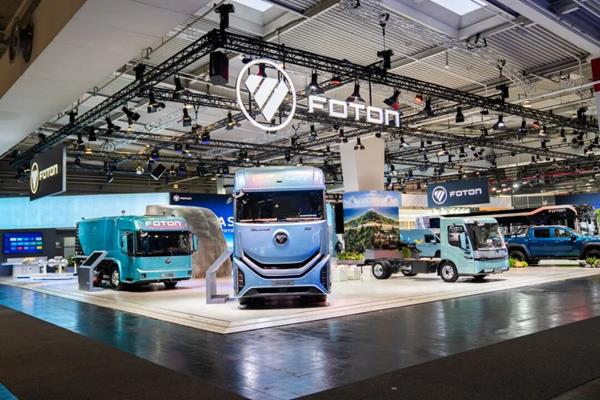
Complementing this manufacturing push is the company’s focus on the "ecosystem" approach. Foton showcased six standalone component exhibits, including industrial megawatt charging pedestals, light and heavy electric drive axles, and proprietary battery enclosures. By presenting itself as a comprehensive energy and hardware provider rather than a standalone truck seller, Foton is attempting to lower the barrier to entry for large-scale fleet operators who may be hesitant to integrate unfamiliar Chinese technology into their existing workflows.
Addressing the Municipal and Urban Market
While the Cavan Beacon captured the spotlight, Foton’s stand also highlighted its readiness for urban and municipal duty cycles. The Cavan C1 electric urban delivery van and the eAurora transit bus were both displayed with full EU whole-vehicle type approvals. This regulatory clearance allows these models to be sold across the European bloc immediately.
Additional models presented included the Daystar electric distribution truck, which provides a 600-kilometer urban operating range, and the eGalaxus D3, a specialized sanitation chassis built for the high-frequency stop-and-start requirements of city waste management. For those sectors requiring a transitional bridge between combustion and electrification, Foton displayed the Galaxus R9 plug-in hybrid tractor—featuring a transmission with a claimed 99.8 percent mechanical efficiency—and the Tunland V9 plug-in hybrid pickup, which offers a 1,000-kilometer total cruising range.
Implications for the European Logistics Landscape
The implications of Foton’s presence at IAA 2026 are profound. For decades, the European commercial vehicle market has been dominated by a handful of legacy manufacturers—most notably Daimler Truck, Traton (MAN and Scania), and Volvo Group. Foton’s aggressive entry strategy threatens to disrupt this status quo by offering high-tech, integrated solutions at a scale that is difficult for smaller, specialized manufacturers to match.
The focus on "megawatt charging" and "modular architecture" signals that Foton has studied the European market’s pain points closely. By addressing the charging infrastructure bottleneck head-on through its own proprietary hardware, Foton is attempting to solve the "chicken-and-egg" problem that often delays the adoption of electric heavy-duty vehicles.

However, challenges remain. The company must navigate a complex regulatory environment, including potential future tariffs and the necessity of building brand trust among conservative logistics operators who prioritize long-term reliability and resale value. The commitment to a German-based subsidiary, Brock, which will handle telematics and localized fleet services, suggests that Foton understands the importance of local service and data sovereignty in winning the confidence of European enterprises.
As the industry moves toward 2030, the presence of Foton at events like IAA is likely to become the new standard. The shift toward a "global" manufacturing footprint, rather than a centralized "export-only" model, is a hallmark of the new generation of Chinese commercial vehicle manufacturers. Whether Foton can successfully transition from an ambitious newcomer to a trusted European partner will depend on its ability to execute its localized manufacturing and service roadmap over the next 24 to 36 months. For now, the message from Hall 21 is clear: the European logistics market is entering a period of intensified competition, and the race to provide the next generation of zero-emission freight solutions has officially gone global.









Leave a Reply