The inland shipping industry in Europe stands at a critical juncture where short-term market resilience masks a profound long-term transformation in the cargo landscape. Recent data from the Port of Rotterdam indicates a 15.3% surge in coal throughput during the first nine months of 2026, alongside increased volumes in crude oil and petroleum products. While these figures suggest a robust demand for traditional vessel operations, industry analysts warn that capital investments in vessel propulsion and electrification must be calibrated against the reality of a decarbonizing economy. An inland vessel or battery conversion system commissioned today will likely remain operational through 2050, by which time the composition of Europe’s freight market will be fundamentally different.
The Paradox of Current Throughput Trends
The recent uptick in coal movements at major European hubs like Rotterdam is largely attributed to temporary market distortions. Recovering coking-coal demand, coupled with the volatility of natural gas prices and specific power-market conditions, has temporarily incentivized the movement of fossil-based energy carriers. However, this trend contrasts sharply with broader structural shifts reported by Eurostat, which noted a 3% decline in EU inland-waterway freight—falling to 118 billion tonne-kilometres—during 2025.
While coal and crude petroleum saw temporary spikes in that year, the overarching trend in agricultural and industrial freight has been one of contraction. For vessel operators, this creates a significant strategic challenge: relying on year-over-year fluctuations to justify long-term capital expenditure is increasingly viewed as a high-risk strategy. The Central Commission for the Navigation of the Rhine (CCNR) provides a stark illustration of this adaptation process, documenting a decline in the number of dry-cargo vessels from 6,410 in 2023 to 6,224 in 2025. Conversely, the tanker fleet has expanded, rising from 1,400 to 1,477 vessels in the same period, signaling a fleet that is actively reconfiguring its composition to match shifting demand profiles.
Modeling the 2050 Cargo Landscape
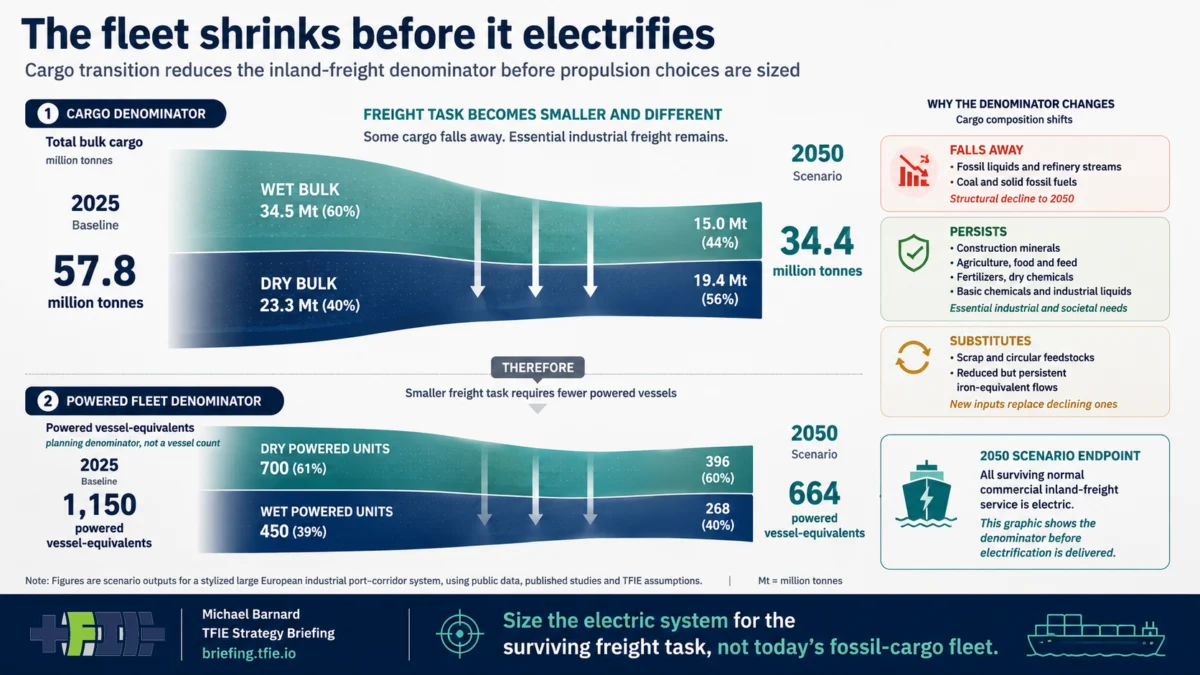
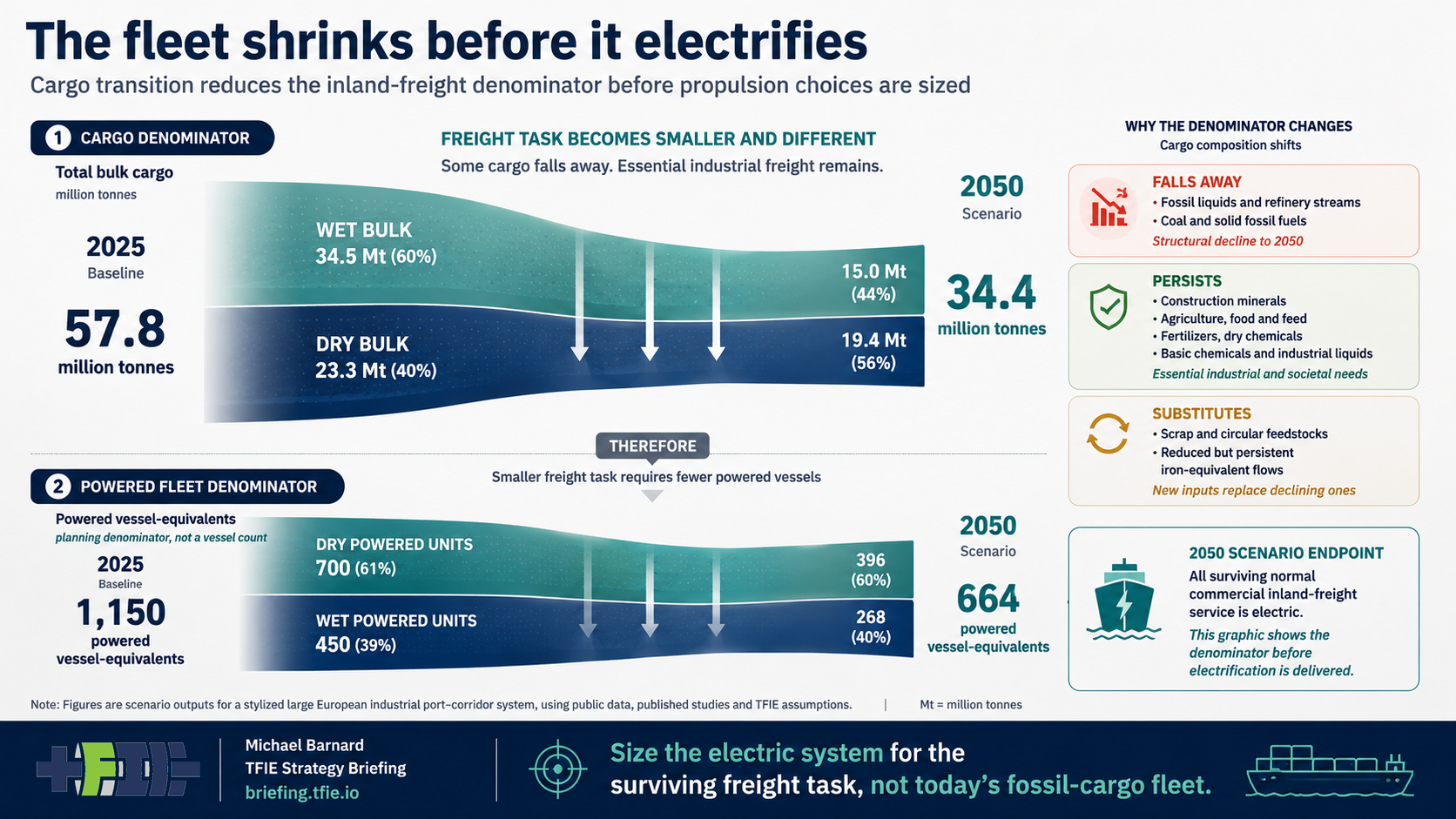
To move beyond reactive decision-making, strategic planners are increasingly employing “cargo-first” modeling to map the freight requirements of 2050 against the necessity for an electrified fleet. A central scenario for a major European industrial port corridor, projected from a 2025 baseline, suggests a dramatic reduction in bulk cargo throughput. Under this model, total bulk volumes are expected to drop from 57.8 million tonnes to 34.4 million tonnes—a decline of roughly 40%.
The most significant driver of this decline is the reduction in fossil-linked commodities. The model projects that fossil fuels and refinery streams will plummet from 19.0 million tonnes to just 1.5 million tonnes, while the movement of coal and other solid fossil fuels is expected to reach near-zero. Collectively, these fossil-dependent categories account for approximately 20 million tonnes of the total 23.4-million-tonne net reduction in the modeled corridor.
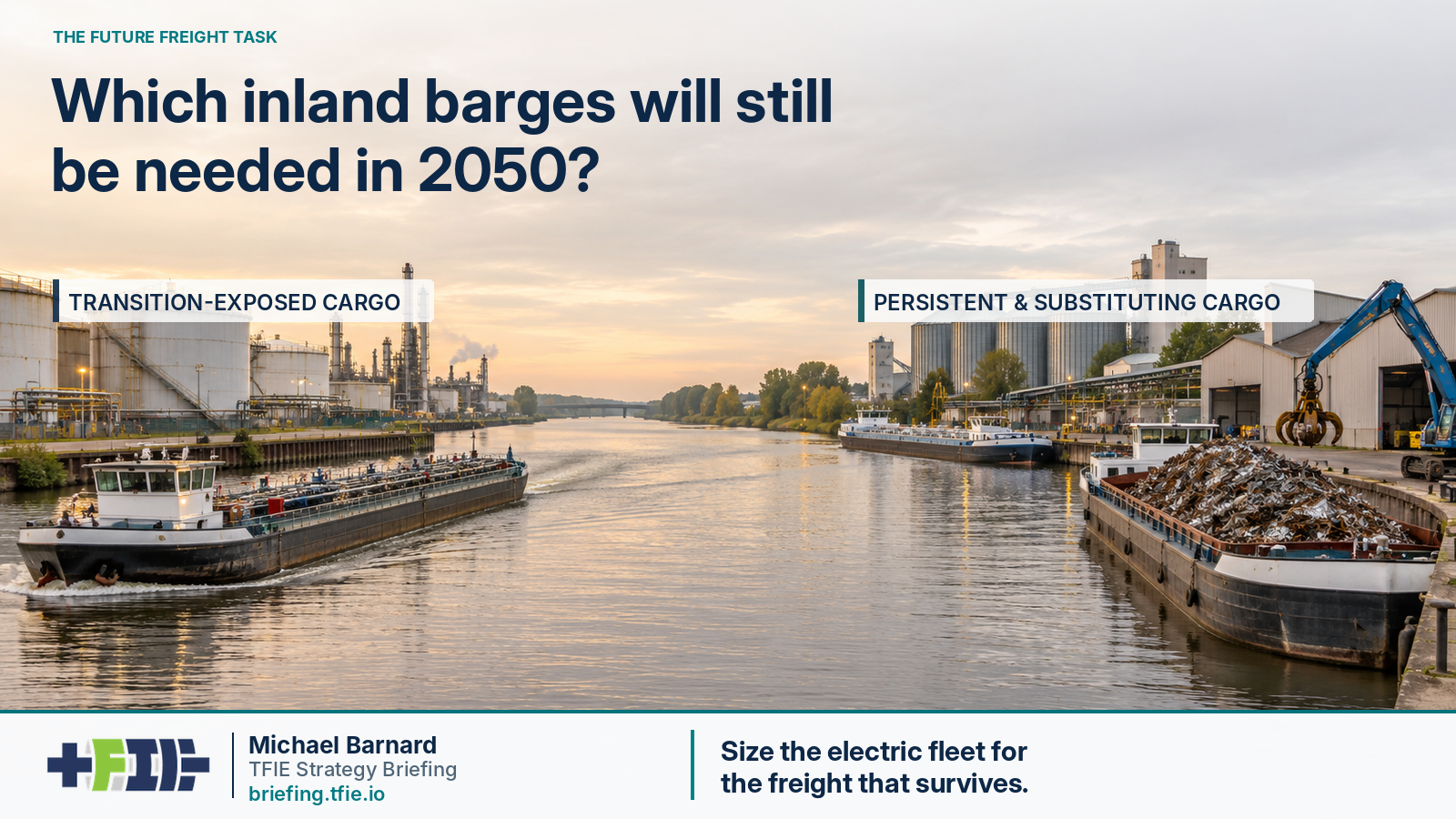
For operators, the implications are clear: the economic viability of a vessel is no longer tied to its ability to perform a generic transport function, but to its specialization in commodities that will persist in a post-fossil economy. For instance, the steel industry is currently undergoing a structural transformation where imported iron ore is being partially substituted by scrap and circular feedstocks. While the total volume of materials required for industrial output may remain relatively stable, the nature of the cargo, the parcel sizes, and the required loading systems are evolving. Operators who fail to align their fleet assets with these new material flows risk holding "stranded assets"—vessels that are mechanically sound but economically irrelevant.
The Biofuel Feedstock Trap
A secondary risk factor involves the temporary surge in biofuel feedstock movements. Projections indicate a peak in these volumes near 2030, followed by a decline to roughly 1.5 million tonnes by 2050. Industry observers caution that this temporary freight boom, while profitable in the short term, does not provide a sufficient foundation for the 30-year lifecycle investment required for new vessel construction or terminal infrastructure. The durability of freight contracts is as critical as the volume transported in any given year, and investors are urged to distinguish between transient cargo spikes and long-term, sustainable trade routes.
Sizing the Electric Fleet
The transition to an electrified fleet requires a precise calibration of propulsion capacity. Cargo tonnage alone is a misleading metric for fleet sizing; instead, analysts must calculate "powered vessel-equivalents" by factoring in parcel sizes, route efficiency, loaded calls, and operational productivity.
In the model of a major European corridor, the number of powered vessel-equivalents is expected to drop from approximately 1,150 to 664, a reduction of 42%. While dry cargo volumes are modeled to fall by 17% in tonnage, the reduction in required powered vessels is much steeper (43%) due to changes in logistical efficiency and the consolidation of freight services. This distinction is vital for pushed formations, where a single pusher vessel may support several unpowered barges. A failure to distinguish between powered units and total hulls can lead to significant over-investment in battery systems and charging infrastructure.
Environmental and Operational Constraints
Climate-related challenges, such as the low water levels frequently observed on the Rhine, further complicate these projections. When draught is restricted, vessels are forced to carry less cargo per journey, effectively reducing the productivity of the existing fleet. This phenomenon forces cargo owners to consider alternative transport modes, such as rail or road, or to invest in more specialized, shallow-draught hulls. Consequently, any electrification strategy must integrate route-depth data and seasonal load factors into its core assumptions.
Strategic Recommendations for Stakeholders
The path forward for ports, utility providers, and vessel owners involves a coordinated, data-driven approach to infrastructure development:

- Cargo-Driven Infrastructure: Ports should establish and maintain a "living register" of freight flows, segmenting cargo into declining, stable, and emerging categories. This register provides the baseline for where and when to deploy charging infrastructure.
- Asset Lifecycle Alignment: Vessel owners must evaluate remaining hull life against the specific cargo contracts they expect to serve in 2050. Electrification should be prioritized for routes with established, long-term customer bases.
- Grid and Terminal Planning: Utilities must work with terminal operators to size grid connections and battery-container pools based on verified, bankable routes. Building infrastructure around transitory freight risks significant financial loss.
- Integrated Planning: Rather than viewing vessel propulsion as a siloed technical decision, it must be viewed as an extension of the broader logistics chain. Efficiency gains achieved through digitizing routes and optimizing terminal access are as important to the energy transition as the battery technology itself.
The Economic Case for Early Action
Despite the challenges, the case for electrifying established, high-utilization inland freight routes remains compelling. Battery-powered vessels are already demonstrating operational viability in both container and bulk transport. The commercial opportunity lies in identifying the specific corridors where cargo demand is resilient and investing in the electrification of those services today.
As Europe accelerates its transition to a circular and climate-neutral economy, the inland shipping sector must transition from a model of volume-based expansion to one of value-based optimization. By aligning capital investment with the long-term realities of the European industrial landscape, stakeholders can ensure that the transition to electric propulsion is not only environmentally necessary but economically sustainable. The current period of market volatility serves as a necessary wake-up call, reinforcing the need for strategic foresight over short-term reactive behavior. The future of the inland fleet will not be determined by the throughput records of 2026, but by the ability of the industry to adapt to the material demands of 2050.