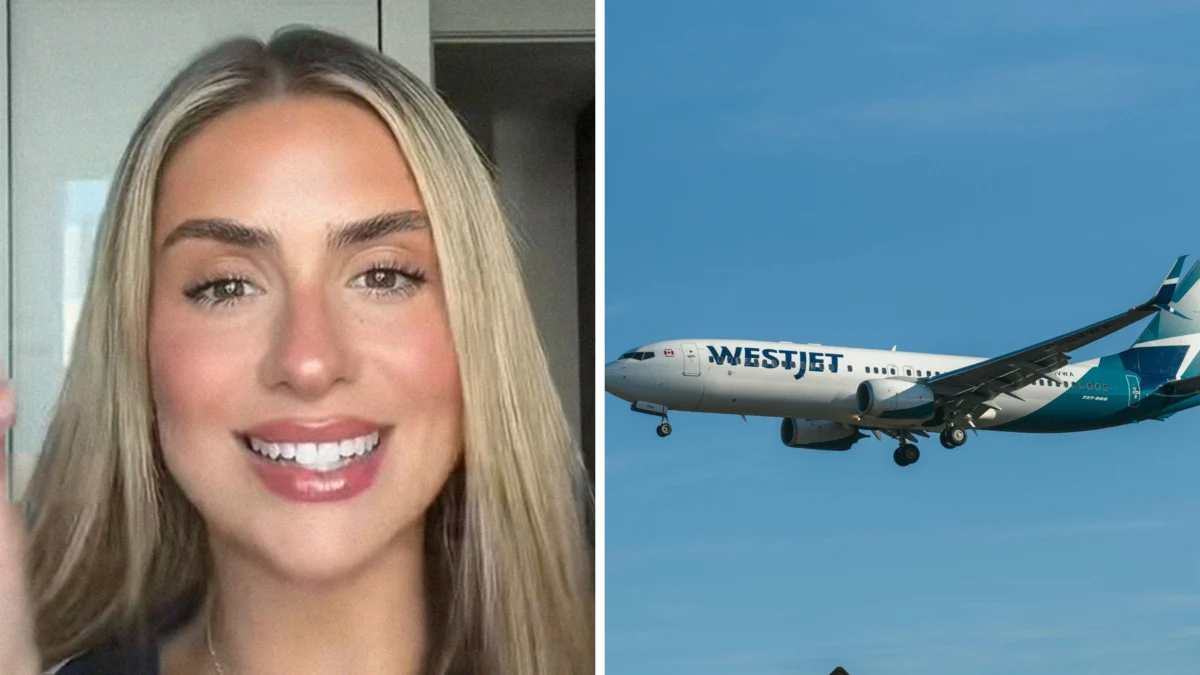
A prominent Canadian beauty influencer, Sarah Lauren, known to her nearly one million followers as @sarahlauren71, has publicly declared a permanent boycott of WestJet following a contentious encounter at the boarding gate. The incident, which Lauren documented in a viral TikTok video, centers on a missed flight, allegations of inconsistent customer service, and a disputed $169 rebooking fee for a service she claims was never provided. While the influencer expressed frustration over the perceived "runaround" from airline staff, the situation highlights the rigid operational protocols of the aviation industry and the complexities of third-party booking agreements.
Chronology of the Boarding Dispute
The incident began during a scheduled midday departure. According to Lauren’s account, she had successfully checked in for her flight and her checked baggage had already been loaded onto the aircraft. She arrived at the boarding gate at 11:45 a.m. for a flight scheduled to depart at 12:00 p.m. Despite being physically present at the gate 15 minutes prior to the scheduled takeoff, Lauren found the boarding door already closed.
In her video, which has garnered over 31,900 views and is tagged with #westjetfail, Lauren recounts her immediate interaction with the gate agent. Upon asking why the door could not be reopened given that it was still 15 minutes before departure, she was informed that 11:45 a.m. constituted the final boarding cutoff. Lauren questioned the protocol, and the agent confirmed that the 15-minute window is a standard operational requirement.
The situation escalated when Lauren sought assistance for rebooking. She alleges that a kiosk agent charged her $169 for what was described as a "same-day change fee." However, after the transaction was processed, Lauren claims she was directed to another staff member who informed her that such a fee did not exist in their system for her specific situation. This began a cycle of conflicting information, with Lauren stating she spoke to approximately 10 different employees, none of whom could provide a consistent answer regarding the fee or the status of her travel.
Understanding WestJet’s Boarding and Cut-off Policies
To analyze the validity of the dispute, it is necessary to examine WestJet’s official terms and conditions. The airline’s "Check-in and Boarding" policy is explicit regarding domestic and international departures. For most flights, WestJet establishes a strict "boarding cut-off" at 15 minutes before the scheduled departure time. The policy states: "Guests must arrive at the gate before boarding cut-off to travel on their flight."
In the context of a 12:00 p.m. departure, the cutoff is exactly 11:45 a.m. Industry experts note that arriving "at" the cutoff time often means the door is already secured, as flight crews must finalize manifest documentation, secure the cabin, and coordinate with ground control for an on-time pushback.
Furthermore, the presence of Lauren’s bag on the aircraft introduces a significant security and operational hurdle known as "Positive Passenger Bag Match" (PPBM). International aviation security regulations generally prohibit an airline from transporting the baggage of a passenger who is not on board the aircraft. When a passenger misses the boarding cutoff, the airline is often required to locate and remove that passenger’s luggage before the plane can depart, a process that can cause further delays for the remaining passengers.
The Financial Conflict: Same-Day Change Fees vs. No-Show Policies
The most significant point of contention in Lauren’s experience is the $169 charge. WestJet’s published fee schedule provides a framework for same-day flight changes. For travel within Canada, these fees typically range from $100 to $118 CAD, while international or "all other destination" fees range from $150 to $177 CAD. Lauren’s charge of $169 falls within the upper tier of this bracket.
However, the application of this fee becomes complicated when a passenger is classified as a "no-show." Under WestJet’s policy, if a guest fails to board before the gate closes, they are considered a no-show. In many fare classes—particularly "Basic" or "Econo"—a no-show results in the forfeiture of the entire ticket value, with no option for refund or travel credit.
Lauren’s frustration stems from the allegation that she paid the fee but did not receive a confirmed seat on a subsequent flight. If the $169 was processed as a same-day change fee, the airline would typically be expected to provide a seat on the next available flight. The conflicting reports from staff—where some confirmed the fee and others denied its existence—suggest a breakdown in internal communication or a misunderstanding of the fare rules associated with Lauren’s specific ticket.
The Third-Party Booking Complication
A critical factor in this dispute is that Lauren booked her travel through a third-party provider rather than directly through WestJet. Airline policies for tickets purchased via Expedia, Air Miles, or travel agencies are notoriously more restrictive. WestJet’s official "Change and Cancellation" policy directs customers who booked through third parties to contact those entities directly for any modifications.
When a passenger misses a flight on a third-party ticket, the airline’s gate agents often have limited "ownership" of the ticket in their computer systems. This frequently leads to a "deadlock" where the airline cannot modify the booking, and the third-party agency cannot assist because the flight has already departed. This structural barrier likely contributed to the "runaround" Lauren described, as airport staff may have been unable to override the restrictions placed on a third-party ticket.
Regulatory Framework: Canada’s Air Passenger Protection Regulations (APPR)
In Canada, air travelers are protected by the Air Passenger Protection Regulations (APPR), overseen by the Canadian Transportation Agency (CTA). These regulations mandate compensation and rebooking for delays and cancellations that are within the airline’s control.
However, the APPR offers little protection for passengers who miss the boarding cutoff. Because arriving at the gate on time is considered the passenger’s responsibility, the airline is not legally obligated to provide a free rebooking or compensation. Lauren acknowledged this in her video, stating, "I understand that it’s my responsibility. I didn’t clearly know that they closed it 15 minutes before."
Despite the lack of coverage for the missed flight itself, the APPR and general consumer protection laws do cover "services not rendered." If an airline charges a passenger a specific fee for a rebooking and then fails to provide that rebooking, the passenger may have grounds for a claim based on the failure of the carrier to fulfill the contract of the new transaction.
Industry Reaction and Social Media Sentiment
The response to Lauren’s video has been polarized. While her followers expressed sympathy for her financial loss and the stress of the situation, several commenters identifying themselves as airline industry professionals offered a different perspective.
Flight attendants from various North American carriers, including United Airlines and WestJet, pointed out that the 15-minute rule is a standard safety and operational necessity. One commenter noted that "the door closes at 15 minutes so the pilots can finish their paperwork. If we opened it for one person, we’d have to do it for everyone, and the flight would never leave on time."
Other viewers suggested practical remedies for the disputed $169 fee. Former banking employees in the comment section advised Lauren to initiate a chargeback through her credit card issuer. A chargeback for "service not rendered" is a common consumer remedy when a merchant processes a payment but fails to provide the agreed-upon service. This route is often more effective than seeking a refund from an airline’s customer service department, which can be a lengthy process.
Broader Implications for the Aviation Industry
This incident underscores a growing tension between the high-speed, automated nature of modern air travel and the expectations of consumers. As airlines increasingly rely on strict cutoffs to maintain on-time performance metrics, the "human element" of customer service can sometimes be lost.
For influencers like Lauren, the ability to broadcast a negative experience to a million followers presents a significant PR challenge for airlines. However, the aviation industry remains one of the few sectors where operational safety and strict scheduling often override individual customer satisfaction.
The takeaway for travelers is twofold: first, the "scheduled departure time" is not the time to arrive at the gate, but rather the time the aircraft is expected to be moving; and second, booking directly through an airline remains the most reliable way to ensure that gate agents have the authority to assist when things go wrong.
As of the time of publication, WestJet has not issued a formal public response to Lauren’s specific allegations regarding the $169 fee. Lauren continues to maintain her stance, suggesting that the lack of consistency among staff was the primary driver of her decision to boycott the carrier. The $169 remains a point of contention that may ultimately be settled by financial institutions rather than the airline itself.