Home to more than 100 known species, Madagascar stands alone as the exclusive natural habitat for lemurs. These charismatic primates—characterized by their large, expressive eyes, pointed snouts, and long, bushy tails—have evolved in isolation for millions of years, turning the vast island nation into a living laboratory of biodiversity. Yet, despite their unique ecological significance, lemurs represent one of the most threatened groups of mammals on Earth. Pressured by relentless habitat destruction, agricultural expansion, climate change, and hunting, many of these species face an uncertain future.
To mark World Lemur Day, celebrated annually on the last Friday of October, conservation scientists, local communities, and international organizations are taking stock of the multifaceted strategies deployed to protect these vulnerable primates. From ambitious reforestation corridors and the unexpected complications posed by invasive species to grassroots campaigns for neglected ecosystems, the battle to save Madagascar’s lemurs requires balancing ecological restoration with human livelihoods.
The Fragmentation Crisis: Healing the Split Between East Madagascar’s Parks
In the verdant landscapes of eastern Madagascar, Andasibe-Mantadia National Park and the Analamazoatra Special Reserve serve as vital arks of biodiversity. Together, these protected areas shelter approximately a dozen distinct lemur species, alongside an extraordinary array of endemic flora and fauna found nowhere else on the planet.
However, this ecological sanctuary bears the scars of historical deforestation. For generations, the landscape between the two parks formed a continuous, unbroken rainforest canopy. That connectivity was severely fractured in the 1960s, when large tracts of forest were cleared to clear ground for agriculture and cattle pasture. What remained was a fragile archipelago of forest fragments separated by degraded, scrub-covered land. This fragmentation severely restricted wildlife movement, divided animal populations, and heightened the risk of inbreeding and local extinction.
To reverse this historical damage, a collaborative coalition of researchers, conservationists, and local community members launched a major reforestation initiative in 2023. Spearheaded by local stakeholders with academic and institutional support, the project aims to restore 150 hectares (approximately 370 acres) of native forest. By planting endemic tree species, the initiative seeks to rebuild a functional forest corridor that will reconnect Andasibe-Mantadia and Analamazoatra, allowing lemurs and other arboreal wildlife to traverse safely between the two habitats once more.
The Invasive Guava Dilemma: When Reforestation Backfires
While restoring native forests is widely acknowledged as an indispensable step for lemur conservation, field reports reveal a complex ecological paradox. Once tropical forests are degraded, they become acutely vulnerable to biological invasions—most notably by the invasive strawberry guava (Psidium cattleyanum).
Native to Brazil, the strawberry guava produces sweet, highly appealing fruits that have inadvertently thrown a wrench into reforestation efforts. Field observations highlight that when these invasive trees are in fruit, native lemurs frequently bypass native food sources in favor of the exotic guava. Because lemurs are primary frugivores and seed dispersers, their consumption habits inadvertently accelerate the spread of the invasive plant throughout recovering forest zones.

This dynamic creates a frustrating feedback loop for conservationists attempting to nurture native seedlings. Anthropologist Cortni Borgerson, an associate professor at Montclair State University in the United States, underscored the gravity of the issue, noting that the prolific guava acts as an ecological trap. By providing a high-calorie reward, the invasive plant lures Madagascar’s remaining frugivorous primates into spreading seeds that ultimately crowd out the very native forests upon which these animals depend. Consequently, modern conservation management plans in Madagascar must incorporate targeted invasive species removal alongside tree-planting campaigns to ensure that reforestation efforts achieve their intended biodiversity goals.
Beyond the Rainforest: Elevating the Plight of Madagascar’s Dry Forests
While the lush rainforests of the east receive substantial international attention, Madagascar’s tropical dry forests face an equally perilous trajectory. These arid and semi-arid ecosystems in the western and southern regions of the country are declining at alarming rates due to charcoal production, slash-and-burn agriculture, and livestock grazing. Despite their high levels of endemism, dry forests historically receive a fraction of the funding and conservation priority directed toward their humid rainforest counterparts.
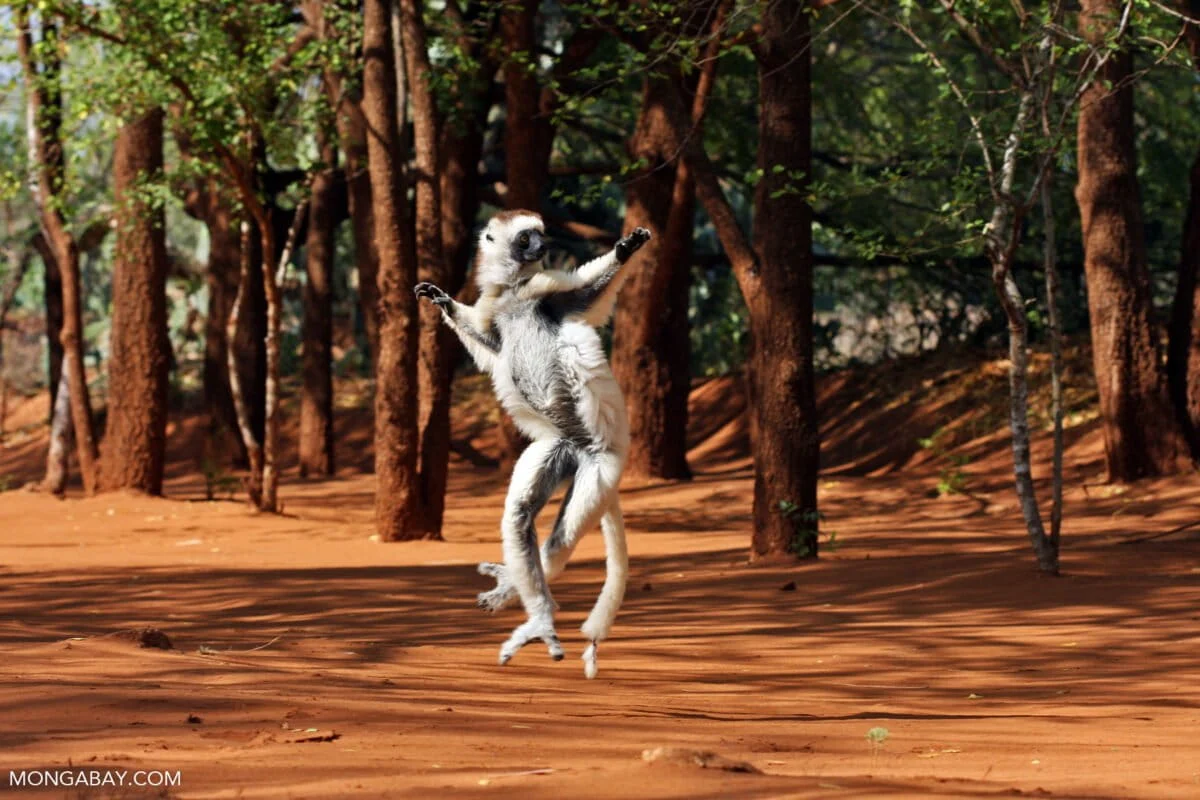
To combat this disparity, international NGOs and Malagasy government representatives initiated a concerted push to elevate the visibility of dry forest inhabitants. Central to this strategy was the high-profile advocacy for the Verreaux’s sifaka (Propithecus verreauxi), a charismatic lemur species renowned for its distinctive, balletic sideways leaps across the ground.
In late 2025, conservation advocates successfully campaigned for the inclusion of Verreaux’s sifaka on the prestigious list of the World’s 25 Most Endangered Primates. Conservationists hope that anchoring public attention to this iconic dry-forest dweller will catalyze funding, spur legislative protections, and draw much-needed resources to the neglected arid zones of western and southern Madagascar.
Cultivating the Next Generation of Conservationists: The Mouse Lemurs
Ensuring the long-term survival of Madagascar’s primates ultimately depends on fostering environmental awareness among the nation’s youth and global audiences alike. Educational platforms, including targeted outreach programs by organizations like Mongabay Kids, have increasingly focused on the country’s micro-fauna to engage younger readers.
Among these are the mouse lemurs (genus Microcebus). Weighing no more than a few ounces, these nocturnal primates are the smallest known primates in the world. Despite their diminutive size, mouse lemurs inhabit a remarkable variety of forests across the island, serving as vital pollinators and seed dispersers in both dry and humid ecosystems. By highlighting these miniature mammals, educators aim to cultivate an appreciation for the vast spectrum of Madagascar’s biodiversity, proving that conservation success relies on protecting species of every scale.
Implications and the Road Ahead
The challenges facing Madagascar’s lemurs reflect broader global conservation crises where ecological degradation, climate pressures, and socioeconomic realities intersect. The ongoing success of reforestation corridors in the east, the management of invasive flora, and the elevation of dry forest priorities demonstrate that conservation strategies must be adaptive, locally rooted, and scientifically rigorous.
As human populations grow and economic pressures mount in rural Madagascar, the margin for error narrows. However, the dedication of local communities working alongside international scientists offers a resilient blueprint for survival. By healing fragmented landscapes, controlling invasive biological threats, and expanding protection to neglected ecosystems, conservationists hope to secure a future where Madagascar’s lemurs continue to thrive in the wild for generations to come.