
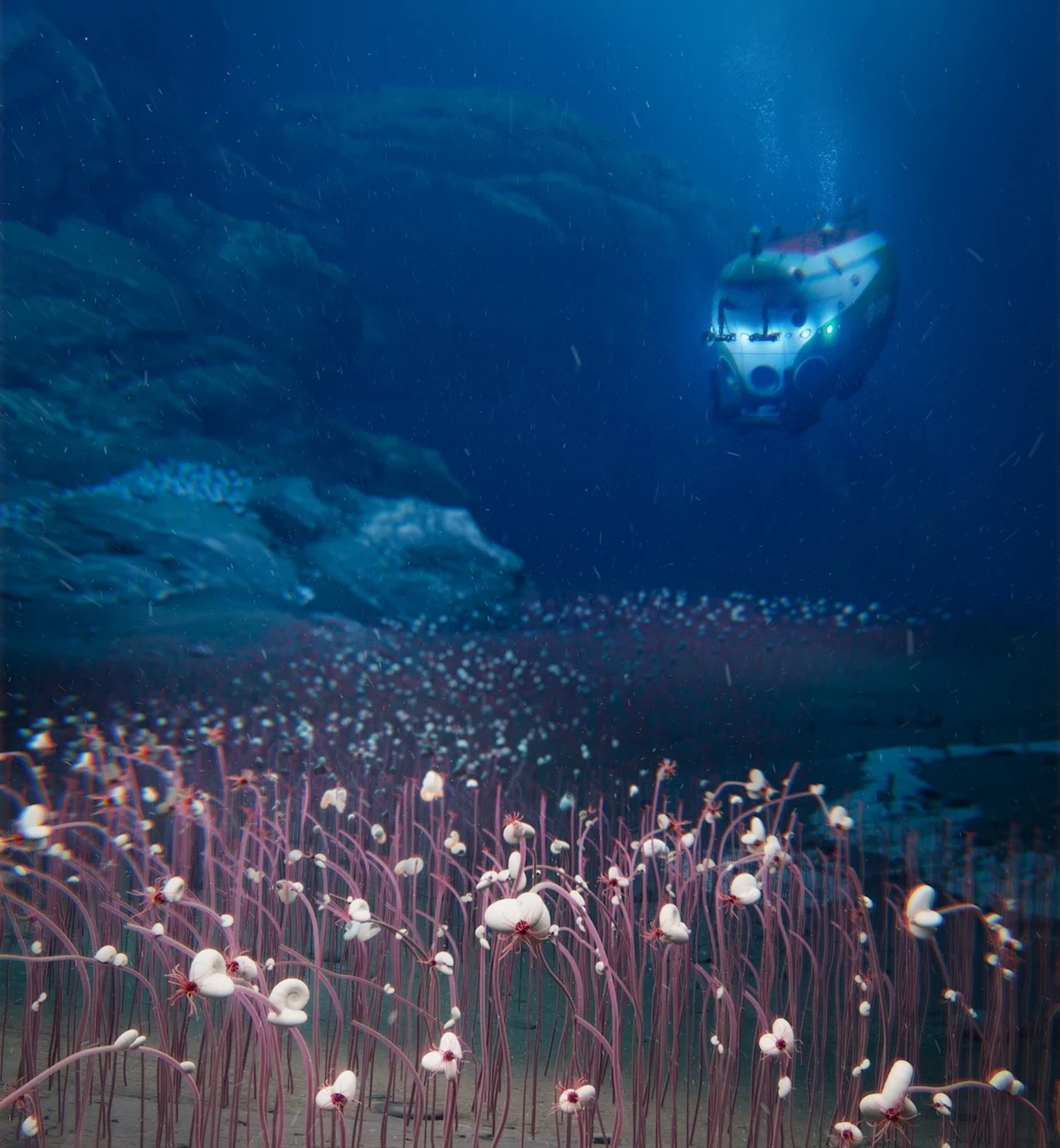
A team of researchers from the Institute of Deep-sea Science and Engineering at the Chinese Academy of Sciences has documented the deepest and most extensive animal communities ever observed on Earth. During a series of expeditions to the Mariana Trench, the Kuril–Kamchatka Trench, and the western Aleutian Trench, the scientists utilized the manned submersible Fendouzhe to reach depths previously thought to be largely devoid of complex multicellular life. The findings, published in the journal Nature, reveal a thriving ecosystem composed of thousands of mollusks and worms living nearly six miles below the surface of the ocean. This discovery challenges long-held assumptions about the limits of life in extreme environments and provides a new perspective on the biological diversity of the hadal zone—the deepest region of the ocean, extending from 6,000 to 11,000 meters.
The discovery was made during a series of 23 dives conducted by the Fendouzhe submersible in the Mariana Trench throughout 2023 and 2024. The research team identified vast colonies of siboglinid Polychaeta (tubeworms) and Bivalvia (clams and mussels) spanning a distance of approximately 1,553.4 miles (2,500 kilometers). These communities were found at depths ranging from 3.6 to 5.92 miles (5.8 to 9.5 kilometers). At such depths, the pressure exceeds 1,000 times that of sea level, and temperatures hover just above freezing, creating an environment that was historically characterized as a "biological desert." However, the visual evidence captured by the submersible depicts a "vibrant oasis" that rivals the density of life found in much shallower waters.
The Fendouzhe Submersible and the Expedition Framework
The Fendouzhe, which translates to "Striver," is a state-of-the- trench-class manned submersible capable of reaching the deepest points of the global ocean. It represents the pinnacle of Chinese deep-sea engineering, designed to withstand the crushing pressures of the Challenger Deep, the lowest known point of the Mariana Trench. The recent missions were part of a broader scientific effort to map hadal trenches, which remain some of the least explored environments on the planet.
During the expeditions, the crew of the Fendouzhe recorded high-definition video and collected biological and geological samples from the seafloor. The researchers targeted the western Pacific’s hadal trenches due to their unique geological configurations. While previous studies using remotely operated vehicles (ROVs) had identified single-cell organisms and occasional scavengers at these depths, the Fendouzhe missions were the first to document large-scale, sedentary animal communities. Lead author Xiatong Peng noted that the geological similarities between the Mariana, Kuril–Kamchatka, and Aleutian trenches suggest that these chemosynthesis-based communities might be a widespread feature of hadal environments rather than isolated anomalies.
Biological Diversity in the Hadal Zone
The primary inhabitants of these deep-sea colonies are tubeworms and bivalves, but the ecosystem supports a diverse array of other invertebrates. Video footage released by the research team shows fields of tubeworms reaching lengths of up to one foot, alongside dense mounds of clams. The scientists also observed free-floating marine worms, spiky crustaceans, sea lilies (crinoids), and sea cucumbers.
The sheer abundance of life was a surprise to the scientific community. Mengran Du, a marine geochemist with the Institute of Deep-sea Science and Engineering and a co-author of the study, described the experience of descending in the submersible as "traveling through time." Du emphasized that the discovery is groundbreaking not only for the depth at which these creatures were found but for the complexity of the community. Unlike the isolated pockets of life found near hydrothermal vents in other parts of the ocean, these hadal communities appear to be part of a vast, interconnected network of life that thrives in total darkness.
The organisms have adapted to the extreme pressure through specialized cellular structures and proteins. Furthermore, the lack of sunlight means that the entire food web is independent of photosynthesis. Instead, these animals rely on a process known as chemosynthesis, where microbes convert inorganic chemicals into organic matter.
The Science of Chemosynthesis and Deep-Sea Fluid Dynamics
In the absence of sunlight, the energy that sustains the Mariana Trench colonies comes from the Earth’s interior. The researchers found that these communities are powered by fluids rich in methane and hydrogen sulfide. These chemical-rich fluids are transported along massive geological faults that traverse the deep sediment layers of the trenches.
Isotopic analysis conducted by the team indicates that the methane is produced microbially from organic matter that has settled in the trenches over millions of years. As the tectonic plates shift and grind against one another, these gases are squeezed out of the sediment and seep through cracks in the ocean floor. Microbes, often forming thick, snow-like mats on the seafloor, consume these chemicals to produce energy. The tubeworms and bivalves then live in a symbiotic relationship with these microbes or consume them directly.
This discovery provides "compelling evidence" for the role of methane-rich seeps in supporting high-order life in the hadal zone. It also suggests that the volume of biological activity at these depths has been significantly underestimated in current global carbon cycling models. If these communities are as widespread as the study suggests, the deep ocean may play a much larger role in sequestering or processing carbon than previously believed.

Historical Context of Deep-Sea Exploration
The exploration of the Mariana Trench has a brief but storied history. The first human descent occurred in 1960, when Jacques Piccard and Don Walsh reached the bottom of the Challenger Deep in the bathyscaphe Trieste. During their 20-minute stay on the bottom, they reported seeing a flatfish, though this observation was later debated by some scientists who suggested it might have been a sea cucumber.
In 2012, filmmaker James Cameron became the first person to make a solo descent to the bottom of the trench in the Deepsea Challenger. Cameron described the environment as "desolate" and "alien," noting a lack of large organisms. Subsequent expeditions using unmanned landers and ROVs gradually increased our understanding of hadal life, identifying specialized species like the Mariana snailfish (Pseudoliparis swirei), which holds the record for the deepest fish ever recorded at approximately 8,000 meters.
The recent Fendouzhe expeditions represent a shift from exploring the "bottom" of the trench to surveying the vast slopes and floor of the entire trench system. By discovering extensive colonies of sedentary animals, the Chinese team has proven that the hadal zone is not merely a collection of isolated organisms but a functional, large-scale ecosystem.
Implications for Carbon Cycling and Marine Science
The study’s findings are expected to force a revision of deep-ocean carbon models. Traditionally, scientists believed that life in the deep sea was almost entirely dependent on "marine snow"—the detritus of dead organisms and organic matter that drifts down from the sunlit surface waters. Because only a tiny fraction of this organic matter reaches the bottom of a six-mile-deep trench, it was assumed that the hadal zone could only support a very low biomass.
The discovery of a chemosynthesis-based system means that the energy source is internal rather than external. This decoupling from the surface world means that hadal ecosystems could potentially remain stable even if surface conditions change drastically due to climate change. However, it also means that these ecosystems are uniquely sensitive to geological changes and human interference on the seafloor.
The Deep-Sea Mining Controversy
The discovery comes at a critical juncture in international maritime policy. For years, the International Seabed Authority (ISA) has been debating the regulations for deep-sea mining. Several nations and private corporations are eager to mine the seafloor for polymetallic nodules, which contain cobalt, nickel, and manganese—minerals essential for the production of electric vehicle batteries and green energy technologies.
Environmentalists and ocean scientists have expressed grave concerns that mining activities would cause irreparable damage to deep-sea ecosystems. The process of mining involves scraping the seafloor, which would destroy the very sedentary communities discovered by the Fendouzhe team. Furthermore, mining creates massive sediment plumes that can travel for miles, potentially choking filter-feeding organisms and disrupting the delicate chemical balance of chemosynthetic environments.
The new evidence of "vibrant oases" at the greatest depths of the ocean adds weight to the argument for a moratorium on deep-sea mining. Critics argue that we cannot safely mine an environment that we are only just beginning to understand. The presence of these extensive animal communities suggests that the deep sea is one of the last true wildernesses on Earth, harboring biological secrets that could be lost before they are even documented.
Conclusion and Future Research
The research conducted by the Chinese Academy of Sciences marks a new chapter in oceanography. By proving that thousands of complex animals can thrive at the limits of terrestrial pressure and darkness, the study expands the definition of the "habitable zone" on our planet.
Future missions are expected to focus on the genetic makeup of these hadal organisms to understand the evolutionary pathways that allowed them to colonize the trenches. Scientists also hope to investigate whether similar chemosynthetic communities exist in other unexplored trenches, such as the Peru-Chile Trench or the Java Trench.
As the Fendouzhe continues its dives, the data it collects will be vital for both conservation efforts and the fundamental understanding of life’s resilience. The "hidden world" revealed by this study serves as a reminder that the Earth still holds vast mysteries, tucked away in the crushing depths of its deepest valleys. For now, the Mariana Trench stands not as a desolate void, but as a testament to the enduring and adaptable nature of life.










Leave a Reply