The introduction of the Airbus A350-1000 into Philippine Airlines’ long-haul fleet marks a critical chapter in the carrier’s ongoing modernization strategy. As flag carriers worldwide race to upgrade their widebody cabins to meet rising passenger expectations for privacy and comfort, Philippine Airlines has deployed its newest flagship aircraft on the nearly 12-hour transpacific route between Manila’s Ninoy Aquino International Airport (MNL) and San Francisco International Airport (SFO). This deployment provides an opportunity to evaluate whether the airline’s latest hardware successfully bridges the gap between its legacy regional footprint and premier global competitors.

Background Context of the Fleet Modernization and Strategic Position
Philippine Airlines has historically operated in a challenging competitive landscape, contending with dominant legacy carriers across Asia and the Middle East that routinely set global benchmarks for premium travel. The acquisition of the Airbus A350-1000 is part of a broader fleet renewal initiative designed to enhance fuel efficiency, expand non-stop route capabilities to North America and Europe, and elevate the passenger experience to rival top-tier Skytrax-rated airlines.

Prior to the introduction of the A350-1000, the airline’s long-haul and regional business class offerings—particularly aboard aircraft like the Airbus A330—received mixed reviews from frequent flyers regarding seat comfort and aging entertainment systems. Furthermore, ground experiences at the carrier’s primary hub in Manila have historically presented operational bottlenecks that contrasted sharply with the seamless connections offered by competing Asian mega-hubs like Singapore Changi or Hong Kong International.
Cabin Hardware, Seating, and Onboard Accommodations

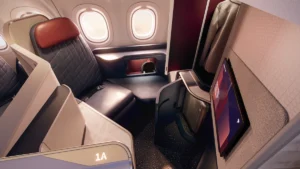
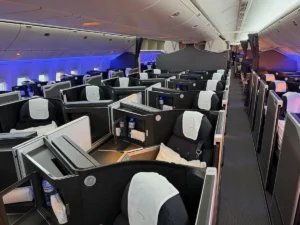
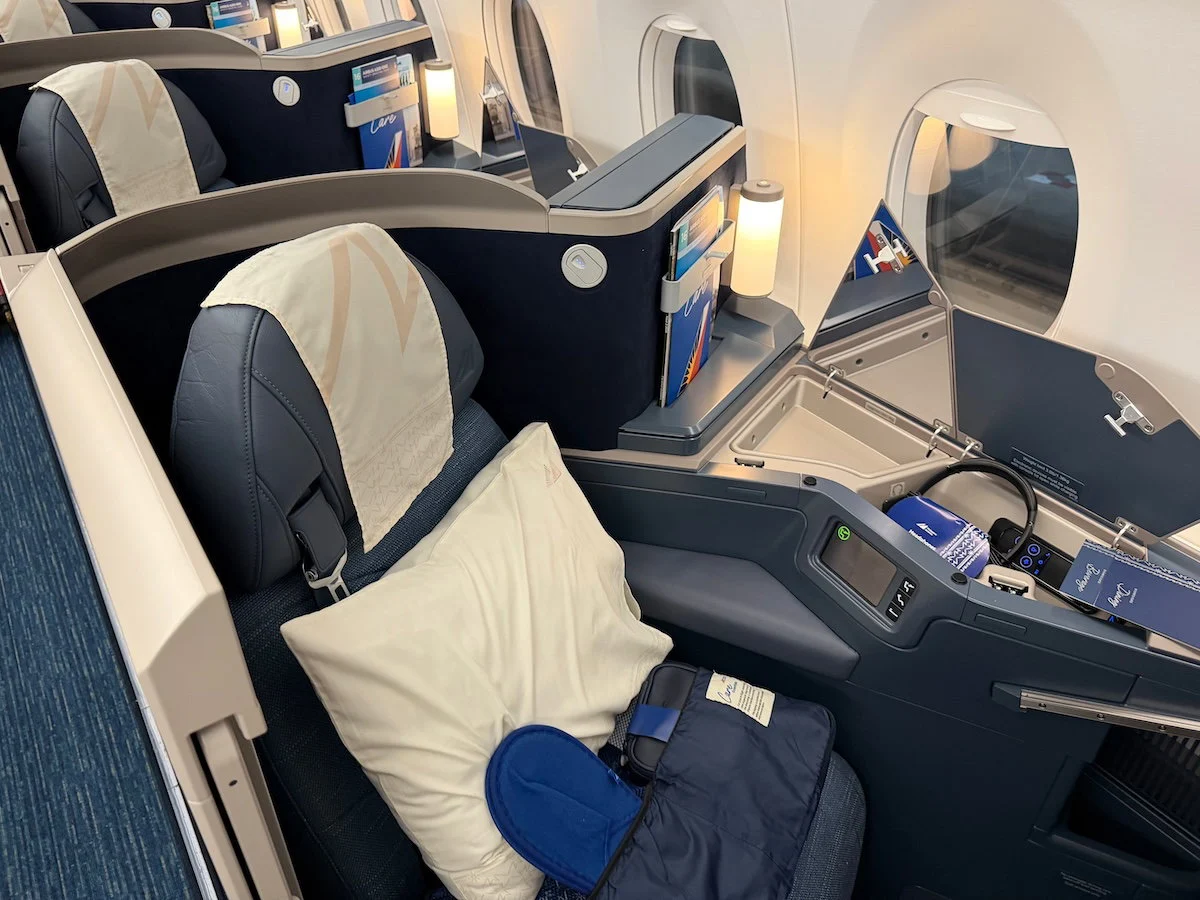
The standout feature of the new Airbus A350-1000 is its modern business class cabin, which features private suites equipped with sliding doors. Utilizing the Collins Aerospace Super Diamond suite architecture—or a closely related bespoke variant—the cabin layout optimizes personal space and direct aisle access for every passenger.
Initial reports from the nearly 12-hour flight from Manila to San Francisco highlight several distinct improvements over the carrier’s previous generation of seating. The suites offer enhanced storage compartments, intuitive lighting controls, and high-definition entertainment screens. When converted into a fully flat bed, the sleeping surface is augmented by premium bedding, including supportive pillows and plush duvets. Amenity kits distributed to business class passengers feature high-end skincare products, such as items from L’Occitane, signaling an alignment with international luxury standards.

Culinary Offerings and In-Flight Service Standards
Catering plays a pivotal role in long-haul premium travel, and Philippine Airlines has structured its onboard dining program to highlight both international favorites and traditional Filipino cuisine. The multi-course meal service on the Manila-to-San Francisco route begins shortly after takeoff, featuring an appetizer course, a choice of elevated main courses, and a detailed dessert selection.

Throughout the 11-hour and 55-minute journey, cabin crew maintain attentive service intervals, supplementing the primary meals with mid-flight snacks and a comprehensive pre-landing meal service. While the presentation and flavor profiles of the dishes generally receive positive assessments, consistency in service timing remains an area where the airline continues to refine its operations to match the intuitive pacing found on elite Middle Eastern and Asian carriers.
Operational Challenges and Areas for Improvement

Despite the hardware upgrade represented by the A350-1000, the overall journey underscores persistent operational hurdles that prevent Philippine Airlines from fully ascending to the absolute top tier of global aviation.
Foremost among these challenges is the reliability of onboard connectivity. During the recent transpacific flight, passengers encountered significant disruptions with the aircraft’s Wi-Fi system, an increasingly critical amenity for business travelers and long-haul flyers who require continuous connectivity. In an era where high-speed satellite internet is becoming standard across premier cabins, unreliable Wi-Fi represents a notable operational vulnerability.

In addition to onboard technical constraints, the ground experience at Manila’s Ninoy Aquino International Airport continues to draw scrutiny. Premium passengers navigating the departures terminal and airline lounges face infrastructure limitations that lag behind the ultra-modern facilities of competing regional hubs. Although the airline provides competitive fare pricing that often undercuts regional rivals, the ground transit and airport lounge experience remain areas requiring substantial investment.
Timeline and Chronology of the Modernization Effort

The integration of the Airbus A350-1000 follows a structured timeline of fleet adjustments aimed at strengthening Philippine Airlines’ long-haul network:
- Pre-2023: Reliance on older widebody aircraft, including the A330 and older A350 variants, with varying business class configurations.
- 2024–2025: Strategic planning and phased delivery schedules for the new Airbus A350-1000 aircraft, aimed at capturing high-yield traffic on key transpacific corridors.
- Late 2025/2026: Official entry into service of the A350-1000 on flagship routes connecting Manila to major North American gateways such as San Francisco.
- Ongoing: Continuous evaluation of cabin performance, Wi-Fi stability, and ground infrastructure improvements in Manila.
Broader Industry Implications and Market Analysis

The deployment of the Airbus A350-1000 highlights a broader trend among non-alliance or mid-sized legacy carriers striving to maintain competitiveness through targeted product enhancements rather than massive, network-wide overhauls. By focusing capital investment on high-demand routes like Manila-San Francisco, Philippine Airlines can attract revenue-generating business travelers who prioritize direct routing and competitive pricing over absolute uniformity in ground services.
From an economic perspective, the airline’s pricing strategy serves as a critical equalizer. While frequent flyers acknowledge that Philippine Airlines does not yet match the flawless end-to-end execution of carriers like Singapore Airlines or Qatar Airways, the aggressive fare positioning of its business class cabin offers a compelling value proposition. For travelers willing to navigate the complexities of transiting Manila and minor technical inconsistencies—such as sporadic Wi-Fi connectivity—the A350-1000 product delivers a globally competitive hard product at a more accessible price point.

Industry analysts suggest that securing "easy wins," such as resolving recurring connectivity issues and streamlining airport lounge access in Manila, will be essential for Philippine Airlines if it aims to solidify its reputation as a premier transpacific option. As the carrier evaluates feedback from early A350-1000 operations, future schedule expansions will depend heavily on the reliability and passenger reception of this new flagship fleet.