
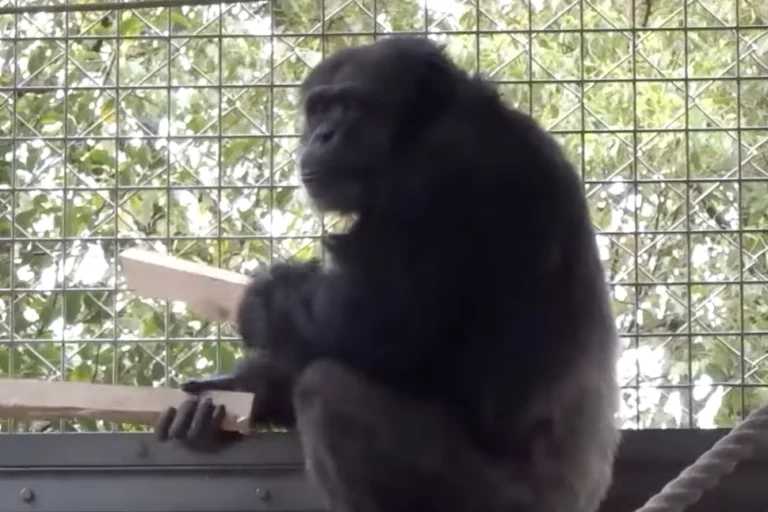
The intersection of rhythmic percussion and vocalization has long been considered a uniquely human trait, a cornerstone of musicality that bridges the gap between raw emotion and structured art. However, new research from Japan’s Kyoto University suggests that the evolutionary roots of this behavior may be far older and more deeply embedded in the primate lineage than previously understood. At the center of this discovery is Ayumu, a 26-year-old male chimpanzee and the alpha of his group at the Institute for the Evolutionary Origins of Human Behavior (EHUB). Researchers have documented Ayumu spontaneously prying floorboards from his enclosure’s walkway, fashioning them into percussion tools, and performing complex, rhythmic drumming displays accompanied by vocalizations.
The study, led by primatologist Yuko Hattori and published in the Annals of the New York Academy of Sciences, provides a rare glimpse into what researchers call "combinatorial instrumental sound-making." While wild chimpanzees have been known to drum on natural surfaces, Ayumu’s behavior represents a significant leap in complexity, involving the deliberate modification of his environment to create instruments and the execution of performances that mirror the structural progression of chimpanzee vocal communication.
The Discovery of Ayumu’s Musicality
The observation of Ayumu’s behavior began in earnest in February 2023. Over a two-year period, Hattori and her team recorded 89 distinct performances across 37 days. Unlike the erratic or aggressive banging sometimes seen in captive primates, Ayumu’s sessions were characterized by a clear, underlying structure. He did not merely strike objects; he engaged in what researchers classify as "detachment"—the act of prying loose floorboards to use as drumsticks or resonating surfaces. This behavior is a hallmark of early-stage tool-making, suggesting that the drive to create sound can motivate the same cognitive processes used for foraging or hunting tools.
"I was surprised," Dr. Hattori noted regarding the initial discovery. While chimpanzees have been observed hitting old tree trunks or throwing stones in the wild, the use of a detached stick in a manner that so closely resembles human drumming had never been formally reported in scientific literature. Ayumu’s performances were not brief outbursts but extended displays, sometimes lasting several minutes, incorporating up to 14 distinct behavioral components. These included tool-assisted drumming, object dragging, and object throwing, all woven into a non-random sequence.
Statistical Analysis of Rhythmic Structure
To determine if Ayumu’s drumming was truly rhythmic or merely a series of random impacts, the EHUB team applied rigorous statistical analysis to the recordings. They measured the "inter-beat intervals"—the timing between individual drum strikes—and found that the rhythms were predominantly evenly spaced, functioning much like a metronome.

One of the study’s most significant findings was the increased stability of the rhythm when Ayumu used tools. The data indicated that drumming with floorboards produced a more consistent and stable beat than drumming performed with bare hands or feet. This mirrors findings in human cognitive studies, which demonstrate that the use of drumsticks allows for greater temporal precision than bare-handed percussion. This suggests that the physics of tool use may have played a critical role in the evolution of human rhythm, providing the mechanical stability necessary for complex musical timing.
Furthermore, the researchers analyzed the "syntax" of the performances. They found that Ayumu’s transitions between different actions followed a predictable pattern: drumming usually led to dragging, which often culminated in throwing. This progression—from slower, rhythmic sounds to louder, more chaotic movements—is not accidental. It bears a striking resemblance to the "pant-hoot," the primary long-distance vocalization used by wild chimpanzees.
Comparison with Wild Chimpanzee Percussion
The behavior of Ayumu offers a fascinating contrast to the drumming habits of wild Pan troglodytes. In the forests of Africa, chimpanzees are known to use the large buttress roots of trees as natural drums. These roots act as resonators, producing low-frequency "booms" that can travel more than a kilometer through dense vegetation.
A 2025 study published in Current Biology, which analyzed over 370 drumming bouts across 11 wild communities, revealed that this behavior is not only rhythmic but culturally specific. Western chimpanzees (Pan troglodytes verus) tend to drum with evenly spaced, "isochronous" beats. In contrast, Eastern chimpanzees (Pan troglodytes schweinfurthii) often use more complex rhythms, alternating between short and long intervals.
Ayumu’s drumming aligns more closely with the even spacing seen in Western chimpanzees, but his use of detached tools adds a layer of sophistication rarely seen in the wild. While wild chimps use the environment as they find it, Ayumu’s "detachment" of floorboards suggests that in a stable environment with reduced predatory pressure, chimpanzees may redirect their cognitive energy toward more elaborate forms of instrumental expression.
The Emotional Context of Performance
Beyond the technical aspects of rhythm and tool use, the EHUB researchers were struck by the apparent emotional state of the alpha male during his performances. Dr. Hattori reported that Ayumu often displayed a "play face"—a primate expression equivalent to human laughing—while drumming.

"This suggests that the drumming may have been more than just a display directed at others—it may also have been enjoyable for Ayumu himself," Hattori explained. This observation supports a leading hypothesis in the evolution of music: that instrumental expression grew out of vocal emotion. According to this theory, the internal emotional states that were once conveyed only through the voice eventually became "externalized" through the use of external objects and tools.
If Ayumu is indeed using tools to express an internal state of playfulness or excitement, it marks a significant milestone in our understanding of animal cognition. It suggests that the capacity to find joy in the creation of sound—and to use tools to amplify that joy—is a trait shared by the common ancestor of humans and chimpanzees.
Ayumu’s Unique Cognitive History
While the findings are groundbreaking, the researchers acknowledge the limitations of the study, primarily that it focuses on a single individual. Ayumu is not an ordinary chimpanzee; he is a world-renowned cognitive subject who has been part of EHUB’s research programs for decades. He is perhaps most famous for his "extraordinary" short-term memory, often outperforming humans in tasks involving the rapid recall of numbers on a screen.
Ayumu’s long history of cognitive experiments, which included exposure to electronic keyboards and complex rhythmic sounds, may have primed him for this behavior. As the alpha male, he also possesses the social confidence to engage in loud, disruptive displays without fear of reprisal from other group members. His life in captivity, provided with ample "raw materials" like wooden floorboards and free from the daily struggle for survival, likely provided the "leisure time" necessary for such a complex hobby to emerge.
Reactions from the Scientific Community
The study has garnered significant attention from the global scientific community. Valérie Dufour, an animal cognition biologist at the French national research agency (CNRS), emphasized the importance of such longitudinal observations. Speaking to Science magazine, Dufour noted that studies like Hattori’s are essential for tracing the deep history of musicality. While Ayumu is currently the only individual at EHUB to display this specific floorboard-drumming behavior, his actions provide a "proof of concept" for the latent musical abilities of the species.
The broader implications of the study touch upon the very definition of music. If music is defined as structured, rhythmic sound-making used to convey or externalize emotion, then Ayumu’s performances meet the criteria. This challenges the anthropocentric view that music is a cultural invention of modern humans, suggesting instead that it is a biological affordance of the primate brain.

Future Research and Social Implications
The team at Kyoto University plans to expand their research to look at the social impact of Ayumu’s drumming. Early observations have already noted that other chimpanzees in the group sometimes respond to his performances by swaying their bodies or moving in sync with the beat.
"We would like to analyze those responses in more detail to better understand what communicative function Ayumu’s display may have," Hattori said. The goal is to determine if Ayumu’s drumming serves as a form of social bonding or if it is purely an individualistic expression of the alpha’s dominance and emotional state.
As researchers continue to monitor the EHUB colony, they will look for signs of "cultural transmission"—whether younger chimpanzees begin to mimic Ayumu’s tool-making and drumming techniques. If the behavior spreads, it would provide a real-time look at the birth of a musical tradition within a non-human society.
Ayumu’s spontaneous performances serve as a powerful reminder of the thin line between human and non-human primate behavior. By prying up the very floor of his world to create a drum, Ayumu has opened a new door for scientists to explore the ancient, rhythmic heart of primate evolution. The study confirms that the drive to make music—to take an object and turn it into a voice—is a profound impulse that echoes across the branches of the evolutionary tree.










Leave a Reply