
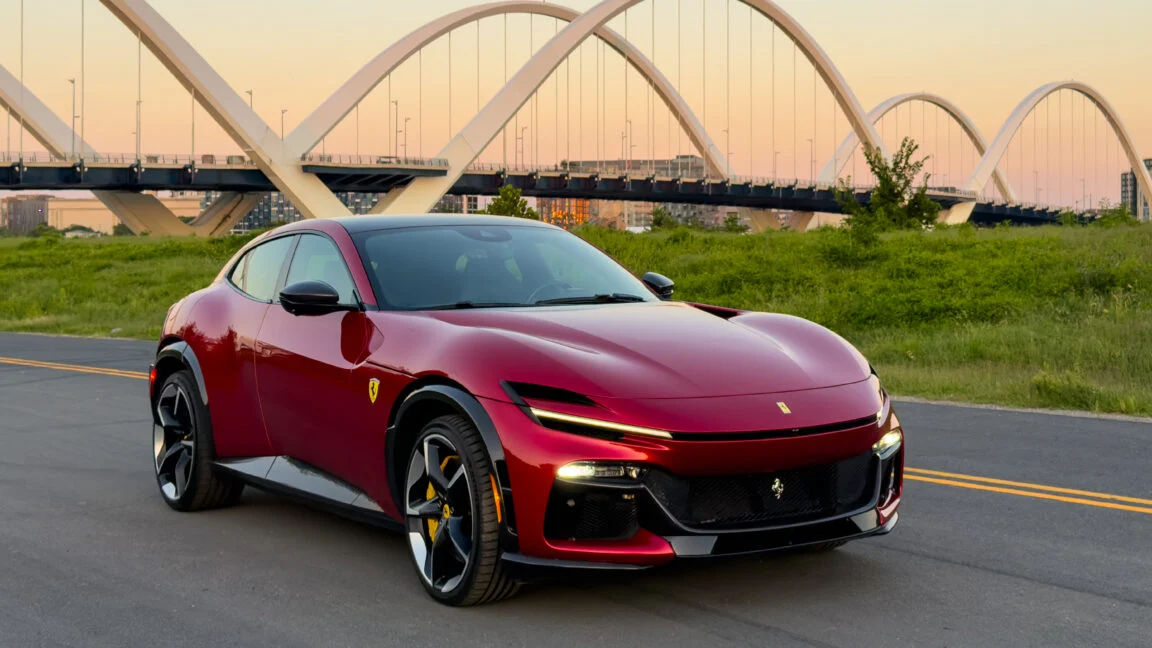
The evolution of the ultra-luxury automotive sector has forced even the most historically rigid sports car manufacturers to rethink their product portfolios, leading to the creation of the Ferrari Purosangue. Starting at a baseline manufacturer’s suggested retail price of $393,350—though quickly escalating to an eye-watering $576,544 as tested with bespoke options—Ferrari’s entry into the high-performance utility vehicle segment stands as an engineering marvel wrapped in controversy and exclusivity. Unlike the frustrating capacitive touch surfaces found on models like the 296, the Purosangue retains physical buttons on its multifunction steering wheel, a welcome ergonomic choice that allows drivers to manage complex systems like Apple CarPlay without diverting their attention from the road. However, cabin ergonomics remain a paradox, blending intuitive physical controls with intricate pop-up touch interfaces that challenge usability while in motion.
Background Context and the Genesis of Maranello’s Four-Door
For decades, the mere suggestion of a four-door, four-seater vehicle bearing the Prancing Horse badge was considered anathema to Enzo Ferrari’s purist philosophy. Traditionalists argued that Maranello’s legacy belonged exclusively to mid-engine berlinettas and front-engine grand tourers. Yet, the seismic shift in global automotive demand toward high-riding luxury utility vehicles made a compelling business and engineering case impossible to ignore. Competitors such as Aston Martin with the DBX and Lamborghini with the Urus proved that affluent buyers desired high-stance versatility paired with supercar performance.
Ferrari’s response was not to build a traditional utility vehicle, but rather to engineer a sports car that happened to offer increased ground clearance and practical rear seating. The development cycle spanned several years, focusing intensely on weight distribution, chassis rigidity, and maintaining the dynamic agility expected of any vehicle leaving the factory gates in Maranello, Italy. The introduction of the Purosangue effectively established a new benchmark for ultra-luxury performance vehicles, blending the spine-tingling acoustic and mechanical theater of a naturally aspirated V12 engine with everyday usability.
Cabin Ergonomics and Human-Machine Interface
Inside the cabin, the Purosangue offers a mixture of brilliant automotive architecture and frustrating modern interface design. The multifunction steering wheel is a notable victory for ergonomics; by utilizing actual physical buttons rather than the near-unusable capacitive touch panels experienced in the Ferrari 296 GTB, drivers can navigate primary functions safely. When managing Apple CarPlay, the interface projects directly onto the main instrument display situated right in front of the driver, seamlessly replacing the digital dashboard’s central tachometer.
Complications arise, however, when occupants attempt to adjust secondary features such as climate control, seat ventilation, or massage functions. These adjustments are governed by a unique rotating controller that physically pops out of the dashboard. Users must swipe or tap its miniature touchscreen to select temperatures, fan speeds, or seat settings. While manageable when parked, executing these precise touches becomes remarkably difficult while navigating rough tarmac at highway speeds, given the small target areas required for finger inputs. A secondary, identical dial is positioned between the rear seats, offering rear passengers the same level of granular control—and presenting the same operational hurdles on the move.
Rear Passenger Experience and Infotainment Architecture
The rear accommodations of the Purosangue are designed to match the front-row experience in both comfort and lateral support. The rear seats are sculpted to hold occupants firmly in place when the driver begins exploiting the chassis’s lateral G-force capabilities on winding backroads.
In keeping with Ferrari’s driver-centric ethos, there is no traditional central infotainment screen dominating the dashboard. Instead, the front-seat passenger is treated to a dedicated, full-width screen. Due to heavy polarization and specialized optical filtering, the driver is entirely blocked from seeing what the front passenger is interacting with. Passengers can access and control native media applications independently, though they are notably restricted from projecting Apple CarPlay onto their side of the cabin. This setup preserves the driver’s focus while offering front-row companions their own digital ecosystem.
Exterior Aesthetics and Customization Possibilities
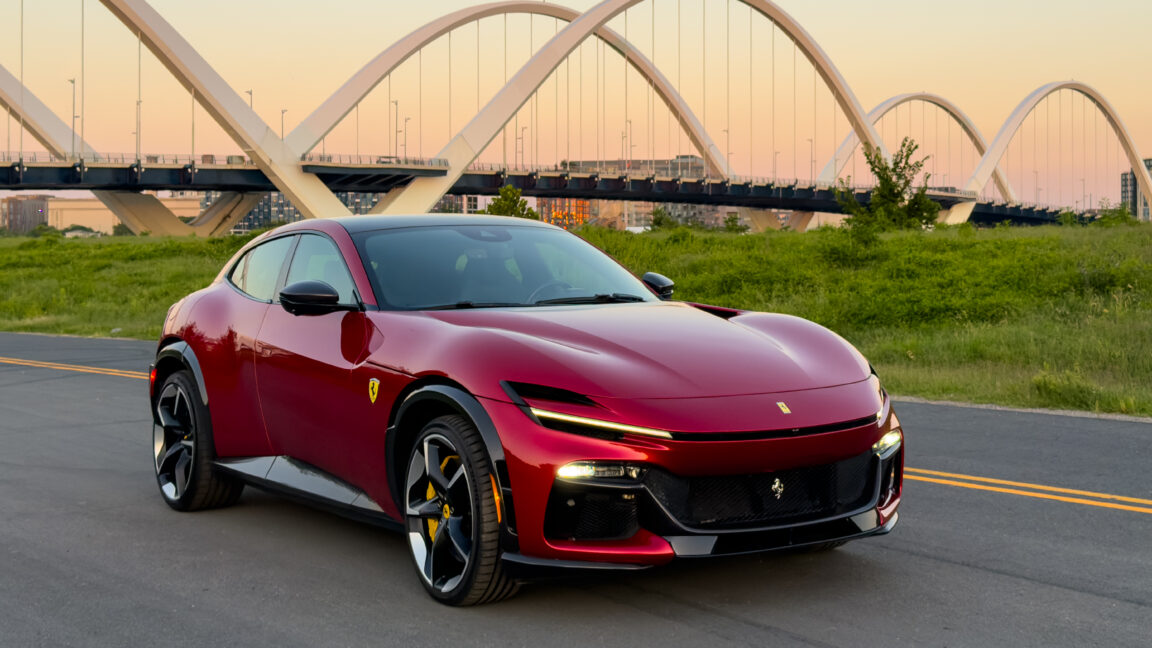
Finished in a lustrous Rosso Portofino paint that dramatically shifts under direct sunlight, the tested Purosangue possesses undeniable road presence. It proves significantly more striking and sophisticated than the yellow-green metallic launch specifications previously showcased around Rome. Yet, exterior aesthetics represent merely the starting point in Ferrari’s universe.
Through elite personalization programs such as Atelier and Tailor Made, buyers face virtually no limits—other than their personal budgets—when customizing exterior hues, interior leathers, carbon-fiber accents, and stitching details. This bespoke capability ensures that no two Purosangue models rolling out of Maranello are identical, reinforcing the exclusivity that high-net-worth collectors demand from the brand.
Drivetrain Efficiency, Daily Usability, and Weather Competence
The beating heart of the Purosangue is its magnificent V12 engine, an endangered species in an era dominated by strict emissions regulations and forced induction. Sharing this powerplant with as many occupants as possible is a core mission of the vehicle, delivering a visceral driving experience that battery-electric alternatives like the upcoming Ferrari Luce cannot replicate.
However, physical laws govern such performance. Fuel economy figures hover around a combined 12 mpg (19.6 L/100 km), meaning daily commuting duties might test the patience of environmentally conscious owners or those adverse to frequent fuel stops. Despite its high fuel consumption, the Purosangue is surprisingly viable as an everyday driver. Equipped with the appropriate winter tires, its sophisticated all-wheel-drive architecture transforms the high-riding Ferrari into an exceptionally capable cold-weather cruiser, proving that supercar performance need not be locked away during inclement months.
Market Positioning and Financial Implications
Priced from $393,350 at its base level, the Purosangue commands a substantial premium over traditional ultra-luxury utility vehicles from established competitors. Models like the Aston Martin DBX and the Lamborghini Urus SE occupy lower pricing tiers, though they target a slightly different segment of the luxury market. When factoring in the extensive option packages fitted to test vehicles—pushing the final tally to $576,544—buyers are paying handsomely for Maranello’s badge, engineering pedigree, and the irreplaceable character of a naturally aspirated V12.
Broader Impact and Industry Implications
The commercial success of the Purosangue signals a permanent shift in how legacy supercar manufacturers must adapt to survive and thrive in the modern automotive landscape. By bridging the gap between high-performance sports cars and practical utility vehicles, Ferrari has secured a lucrative new revenue stream without diluting its core performance credentials. As regulatory pressures mount against internal combustion engines, the Purosangue may well represent one of the final glorious chapters for the front-engine V12 layout, cementing its status as both a polarizing departure from tradition and an engineering triumph for the history books.









Leave a Reply