
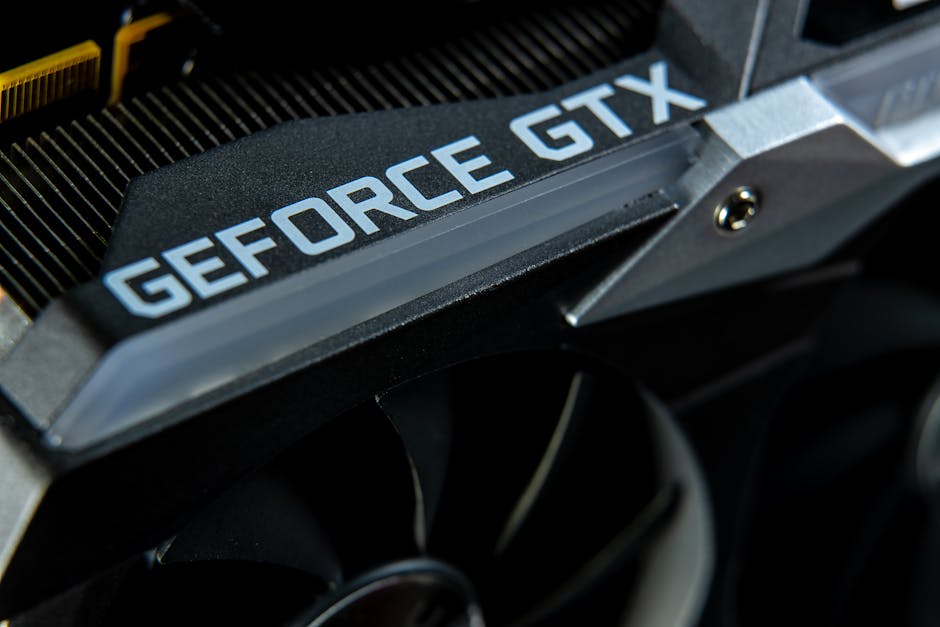
The GTX Legacy: A Deep Dive into NVIDIA’s Iconic Graphics Architecture
The GeForce GTX series, once the undisputed king of gaming performance and a benchmark for visual fidelity, represents a monumental chapter in the history of graphics processing units (GPUs). While NVIDIA has transitioned to newer naming conventions like RTX, the GTX moniker remains etched in the minds of gamers and tech enthusiasts, signifying decades of innovation, performance breakthroughs, and fierce competition. From its inception, the GTX line was designed to push the boundaries of what was graphically possible, catering to the most demanding users and setting new standards for realism and immersion in video games. This article delves deep into the history, technological advancements, and enduring impact of the NVIDIA GeForce GTX graphics cards, exploring their evolution from early pioneers to the powerful GPUs that shaped the modern gaming landscape.
The genesis of the GTX branding can be traced back to NVIDIA’s early efforts to differentiate its high-end offerings. While the GeForce series itself was introduced in 1999 with the GeForce 256, it was the "GTX" suffix that began to signify truly exceptional performance. Initially, the "GTX" designation was not a consistent generational marker as it later became. Instead, it was often applied to flagship models within a specific generation that offered a notable performance leap or a more refined feature set. For instance, the GeForce 2 Ultra, while not explicitly branded "GTX," was in many ways a precursor to the performance aspirations that the GTX suffix would later embody. The GeForce 3 Ti 500, released in 2001, also represented a significant step up in its generation, foreshadowing the performance tiers that GTX would come to define.
The true emergence of "GTX" as a prominent performance identifier gained traction with the GeForce 6 series in 2004. The GeForce 6800 Ultra, a powerhouse for its time, showcased the potential of NVIDIA’s new architectures and set the stage for more explicit performance segmentation. However, it was with the subsequent generations that GTX truly solidified its identity as the pinnacle of consumer graphics. The GeForce 7 series, particularly the 7900 GTX, continued this trend, offering substantial improvements in rendering capabilities and shader performance. These early GTX cards were characterized by their brute force processing power, higher clock speeds, and increased memory bandwidth compared to their lower-tier counterparts. They were the cards that enabled gamers to experience higher resolutions, more complex graphical effects, and smoother frame rates, pushing the envelope of what was considered visually possible.
A pivotal moment in GTX history arrived with the GeForce 8 series, specifically the GeForce 8800 GTX in 2006. This card was not merely an incremental upgrade; it was a revolutionary leap forward, largely due to the introduction of unified shaders. Prior to the 8800 GTX, graphics pipelines used separate fixed-function units for different tasks like vertex processing and pixel shading. The 8800 GTX, built on the G80 architecture, unified these shaders into a more flexible and efficient stream processing model. This architectural shift allowed for much more dynamic and complex visual effects, enabling developers to create richer and more detailed game worlds. The 8800 GTX became a legend, often cited as one of the most impactful GPU releases of all time, and it firmly cemented the GTX name as synonymous with bleeding-edge performance.
Following the groundbreaking 8800 GTX, NVIDIA continued to refine its architecture and push performance boundaries with subsequent GTX releases. The GeForce 9 series saw further advancements, though it was largely an evolution of the 8800’s architecture. The real architectural overhaul came with the GeForce 200 series. The GeForce GTX 280 and GTX 295, for example, were massive cards with incredible processing power for their era, offering significant gains in terms of shader units and memory capacity. These cards were instrumental in enabling the increasingly complex and visually demanding games of the late 2000s, such as Crysis and Grand Theft Auto IV, to be played at their highest settings. The competitive landscape during this period was intense, with AMD (then ATI) constantly vying for the top spot, but NVIDIA’s GTX offerings consistently represented the upper echelon of gaming performance.
The Fermi architecture, introduced with the GeForce 400 series (e.g., GTX 480) in 2010, marked another significant, albeit somewhat controversial, architectural shift. Fermi was designed with compute performance in mind, aiming to be a more general-purpose parallel processing unit. While it delivered substantial computational power, it was also known for its high power consumption and heat generation. Despite these drawbacks, the GTX 480 was still the most powerful consumer GPU available at its release and pushed the boundaries of what was possible in terms of ray tracing and other advanced rendering techniques. This generation also saw the further integration of NVIDIA’s PhysX technology, a physics simulation engine that could be hardware-accelerated by the GPU, adding another layer of realism to games.
The Kepler architecture, arriving with the GeForce 600 series (e.g., GTX 680) in 2012, represented a return to a focus on power efficiency and performance gains without the extreme power draw of Fermi. Kepler delivered significant performance per watt improvements, making high-end gaming more accessible and less demanding on power supplies. This architecture was incredibly successful and formed the foundation for several subsequent generations of GTX cards. The GTX 700 series, building upon Kepler, continued this trend with cards like the GTX 780 Ti, which offered incremental but substantial performance improvements over its predecessors. These cards were the workhorses of the enthusiast gaming community, providing the horsepower needed for high-fidelity gaming at resolutions like 1080p and 1440p.
The Maxwell architecture, introduced with the GeForce 700 series (e.g., GTX 750 Ti) and then fully realized with the GeForce 900 series (e.g., GTX 980, GTX 970) in 2014, was a masterclass in efficiency and performance. Maxwell brought a significant leap in architectural efficiency, delivering more performance at lower power draws. The GTX 980, in particular, was a revelation, offering incredible performance while consuming less power than previous high-end cards. This generation also saw the popularization of technologies like NVIDIA GameWorks, a suite of advanced graphics technologies that provided developers with tools to create more visually stunning games, often with optimized performance on NVIDIA hardware. The 900 series was a golden era for GTX, offering a compelling blend of performance, efficiency, and features.
The Pascal architecture, launched with the GeForce 10 series (e.g., GTX 1080, GTX 1070) in 2016, was another monumental step. Pascal was built on a more advanced manufacturing process (16nm FinFET) and delivered a massive generational performance leap. The GTX 1080, the flagship of this generation, shattered performance expectations, making 4K gaming at high settings a tangible reality for many. This generation also saw the introduction of technologies like variable rate shading and other advancements that further improved rendering efficiency. The GTX 10 series cards, particularly the 1070 and 1080, became immensely popular and remained high-performance options for years, a testament to their raw power and architectural efficiency.
The Turing architecture, introduced with the GeForce RTX 20 series in 2018, marked a significant paradigm shift, not just for GTX, but for the entire graphics industry. While the RTX branding largely replaced GTX for the absolute bleeding edge, the GTX suffix was still utilized for some models within the Turing generation, such as the GTX 1650 and GTX 1660 series. These cards, while not featuring dedicated ray tracing cores, still benefited from the architectural improvements of Turing, offering excellent performance in traditional rasterization. However, the most significant aspect of Turing was the introduction of dedicated RT Cores for real-time ray tracing and Tensor Cores for AI-powered DLSS (Deep Learning Super Sampling). This signaled a move towards a future where real-time ray tracing would become a standard feature, fundamentally altering the landscape of visual fidelity in gaming.
The Ampere architecture, launched with the GeForce RTX 30 series in 2020, further refined the technologies introduced with Turing. While the RTX branding was now firmly established for the high-end, the underlying architectural advancements continued the legacy of GTX in terms of raw rasterization performance. Cards like the RTX 3080 and RTX 3090 delivered astonishing performance gains, pushing the boundaries of 4K gaming and virtual reality. The improvements in DLSS, powered by the Tensor Cores, also made higher resolutions and frame rates more achievable by intelligently upscaling lower-resolution rendered images. The Ampere generation, even with its RTX branding, represented the continuation of the GTX spirit – delivering unparalleled gaming performance and pushing graphical boundaries.
The evolution of GTX cards wasn’t just about raw power; it was also about the accompanying technologies that enhanced the gaming experience. NVIDIA’s development of technologies like CUDA (Compute Unified Device Architecture) allowed GPUs to be used for general-purpose parallel processing, impacting scientific computing, AI, and cryptocurrency mining. PhysX, as mentioned earlier, brought more realistic physics simulations to games. GeForce Experience provided driver updates, game optimizations, and in-game recording/streaming features, making high-end gaming more accessible and user-friendly. The commitment to improving shader models and enabling more complex visual effects like ambient occlusion, volumetric lighting, and detailed textures consistently placed GTX cards at the forefront of graphical innovation.
The competition with AMD, particularly its Radeon series, was a driving force behind the relentless innovation of the GTX line. This rivalry pushed both companies to introduce new architectures, improve performance, and develop groundbreaking features. The fierce competition ensured that gamers consistently benefited from increasingly powerful and feature-rich graphics cards. While AMD often offered competitive pricing or specific technological advantages, NVIDIA’s GTX series consistently held the crown for absolute peak performance and, at times, superior driver support and ecosystem integration.
The legacy of the GTX series is undeniable. It established a benchmark for high-performance gaming for over two decades. The name itself became a shorthand for enthusiast-grade graphics, a symbol of power and visual fidelity. While the RTX branding signifies the current generation of NVIDIA’s focus on ray tracing and AI-enhanced graphics, the technological advancements and architectural foundations laid by the GTX series continue to underpin today’s most powerful GPUs. The GTX era represents a period of rapid evolution, where graphics cards transformed from niche components into the heart of immersive digital experiences, forever changing how we play and interact with virtual worlds. The impact of the GTX series resonates deeply in the gaming industry, setting the stage for the visually stunning and computationally advanced games we enjoy today and will continue to enjoy in the future.





Leave a Reply