
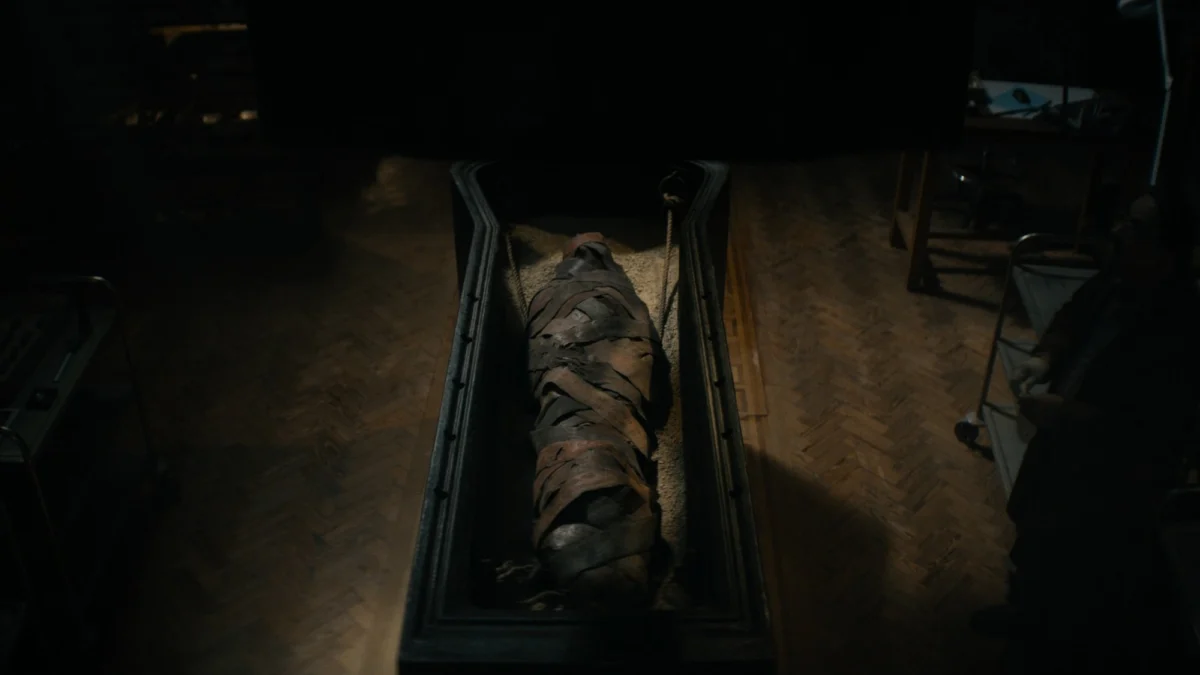
Director Lee Cronin, known for his visceral approach to horror in Evil Dead Rise, returns to the genre with Lee Cronin’s The Mummy, a standalone reimagining that showcases his signature blend of unsettling child characters and extreme gore. Released on April 17, the film presents a mixed bag for horror aficionados, delivering truly spectacular moments of practical effects and stomach-churning horror, but ultimately struggling to weave these elements into a compelling or innovative narrative. The movie is praised for its commitment to explicit, relentless gore, yet critics and audiences alike have noted that these intense sequences are often sandwiched within an otherwise underwhelming storyline that fails to sustain tension or truly unleash its potential.
The Genesis of a New Mummy Tale
Unlike previous cinematic interpretations, Lee Cronin’s The Mummy deliberately distances itself from established lore, offering an entirely new narrative free from the shadow of its predecessors. This creative decision allows Cronin to explore fresh territory, unburdened by the need to adhere to existing mythologies or character arcs. The film forgoes any connection to the iconic 1932 Universal Monsters classic starring Boris Karloff, the commercially successful and beloved Brendan Fraser and Rachel Weisz franchise (which, according to some reports, has a fourth installment in development), or the critically panned 2017 Tom Cruise vehicle that attempted to launch Universal’s "Dark Universe." Instead, Cronin crafts an intimate, family-centric horror story that grounds its supernatural elements in very human grief and psychological trauma.
The core of Cronin’s narrative centers on the Cannon family, whose lives were irrevocably altered by a tragedy in Cairo eight years prior. Charlie (Jack Reynor), a journalist, and his wife Larissa (Laia Costa) were stationed in the Egyptian capital when their young daughter, Katie (Emily Mitchell), vanished. She was reportedly kidnapped by a mysterious woman (Hayat Kamille) who had been observed lurking near their residence. The trauma of Katie’s disappearance left an indelible mark on the family, a wound that never fully healed.
Years later, the Cannons have relocated from the arid landscapes of Egypt to the equally parched deserts of Albuquerque, New Mexico. Here, they strive to rebuild their lives with their younger children, Sebastián (Shylo Molina) and Maud (Billie Roy), alongside Larissa’s mother, Carmen (Verónica Falcón). Despite the geographical shift and the passage of time, Katie’s absence remains a palpable presence. Her childhood bedroom is meticulously preserved, a pink-hued shrine to a lost past, and the family has foregone vacations, haunted by the fear of further misfortune befalling their remaining children. This lingering grief and collective trauma form the emotional bedrock upon which the film’s horror elements are built, aiming to provide a psychological justification for the characters’ often illogical decisions.
The Return and Deterioration: A Family Confronts the Unthinkable
The narrative takes a shocking turn when the Cannons receive miraculous news: Katie, now played by Natalie Grace, has been found alive. Her discovery in an ancient sarcophagus hints at a supernatural ordeal far beyond conventional kidnapping. Katie’s return, however, is not a joyous reunion free of complications. Her physical state is deeply perturbing: her skin is scratched and peeling, her limbs are unnaturally contorted, and her communication is reduced to unsettling clicks of her teeth and labored, wheezing breaths. This grotesque transformation immediately establishes the film’s commitment to body horror and signals that the child who has returned is no longer the one who was lost.

Confronted with their daughter’s deteriorated condition, Charlie and Larissa are driven by an overwhelming desire to help Katie heal and feel safe again. This parental devotion, however, leads them to overlook a series of increasingly disturbing behaviors. Katie is seen cavorting through the house’s crawl space with unnatural agility and, in one particularly jarring scene, headbutts Carmen with alarming force. These actions are textbook manifestations of demonic possession or a similar supernatural affliction, yet Charlie and Larissa’s love, combined with their profound relief at having their daughter back, clouds their judgment. Their emotional state renders them largely impervious to fear, at least for a significant portion of the film.
This protracted period of parental denial, however, stretches the audience’s credulity, particularly across the film’s punishing 135-minute runtime. What begins as understandable grief-fueled blindness gradually devolves into what many viewers perceive as classic horror movie idiocy, with the parents making one ill-advised decision after another until the plot explicitly demands a shift in their perception. While Cronin, who also penned the screenplay, attempts to leverage the parents’ guilt over Katie’s disappearance as a psychological anchor for their actions, their willful ignorance ultimately becomes almost comical. The film effectively explores the initial stages of grief and the desperate efforts to establish normalcy amidst supernatural chaos, but the extended duration of the parents’ obliviousness undermines the dramatic tension and their character believability.
Cronin’s Trademarks: Visceral Horror and Creepy Kids
Lee Cronin has rapidly established a reputation for a distinct directorial style within the horror genre, characterized by a relentless focus on practical effects, extreme gore, and the effective deployment of "creepy kid" tropes. His previous success with Evil Dead Rise showcased his ability to deliver unrelenting, stomach-churning horror, and Lee Cronin’s The Mummy continues this tradition with vigor. The film’s strength lies unequivocally in its execution of visceral horror, pulling no punches in its depiction of physical disintegration and gruesome violence. Every tear of Katie’s skin, every bloody gnash of her teeth, is rendered with painstaking and often nauseating detail, creating a truly visceral nightmare for the audience.
Natalie Grace’s performance as the returned Katie is central to this effectiveness. She embodies the latest addition to Cronin’s arsenal of unsettling child characters, delivering a physically demanding and genuinely disturbing portrayal. Her contorted movements, guttural sounds, and unsettling stare contribute significantly to the film’s atmosphere of dread. The film leans heavily into classic creepy child tropes, incorporating elements reminiscent of The Exorcist, including unnerving backbends and unsettling vocalizations. However, Cronin attempts to infuse these familiar tropes with mummy-specific lore, such as scenes where skin sloughs off in a manner akin to unraveling bandages, adding a unique, albeit relentlessly stomach-churning, visual dimension to the horror.
Despite the technical prowess and the undeniable impact of these gory set pieces, a significant criticism leveled against the film is that this spectacular gore rarely leads to a sustained sense of consequence or escalating dread. Time and again, even after the most upsetting sequences — such as one particularly memorable and disturbing scene involving nail clippers — the narrative seems to reset, returning to a state of mild concern rather than genuine terror or frantic action. A family gathering, for instance, unleashes a torrent of nastiness involving teeth, vomit, and shredded flesh, promising a crescendo of carnage that ultimately fails to materialize. Instead, the scene abruptly cuts to a restrained Katie, leaving the audience without a clear understanding of the broader impact of her rampage. This narrative choice left many viewers, including one audience member in a screening who reportedly exclaimed, "That’s it?", feeling bewildered and unfulfilled. These moments of unfulfilled promise contribute to the film’s perceived pacing issues and its struggle to build a coherent and escalating arc of horror.
Formulaic Narrative and Missed Opportunities
Beyond its visceral horror, Lee Cronin’s The Mummy is described as frustratingly formulaic. Despite being presented as a bold reimagining, it frequently falls back on established horror tropes and conventional mummy story beats. The reliance on an archaeology professor who conveniently unlocks most aspects of the film’s central mystery is a prime example of this predictability, serving as a functional, but uninspired, plot device. This adherence to familiar structures, while perhaps comforting to some, prevents the film from truly breaking new ground or feeling like a genuinely innovative entry in the horror canon.

One of the film’s most significant missed opportunities lies in its subplot involving Detective Zaki (May Calamawy) in Egypt. As Katie’s original missing persons case is revisited eight years later, Detective Zaki’s investigation unfolds in parallel to the Cannon family’s ordeal. Her journey, which delves into the mysterious circumstances surrounding Katie’s disappearance and her subsequent discovery, generates genuinely tense and intriguing sequences. Many critics have suggested that this detective thriller aspect, with its focus on unraveling an ancient mystery through investigative work, held the potential for a far more compelling narrative than the Exorcist-style rehash presented in the main storyline. The underdevelopment of Zaki’s plotline means that a potentially rich avenue for suspense and discovery is largely sidelined, leaving viewers wishing for a more balanced or even a completely different focus for the film.
The collective impact of these narrative choices — the prolonged parental denial, the episodic nature of the gore, and the underdeveloped subplots — means that Lee Cronin’s The Mummy ultimately fails to coalesce into the "bold new horror saga" it aspires to be. Instead, it feels more like a "hodgepodge of better films," borrowing elements from various successful horror movies without forging a distinct identity or delivering a consistently engaging experience.
The Broader Implications for Horror and the Mummy Franchise
The release of Lee Cronin’s The Mummy arrives at a fascinating juncture for the horror genre, which has seen a diverse range of subgenres gain prominence, from "elevated horror" focusing on psychological depth to a resurgence of more extreme, gore-driven films. Cronin’s film firmly plants itself in the latter camp, appealing directly to an audience that craves relentless practical effects and visceral scares. Its technical execution in these areas is undeniable, cementing Cronin’s reputation as a master of explicit horror. However, the film’s struggle with narrative coherence and pacing raises questions about the sustainability of relying solely on shock value without a robust story to underpin it.
For the broader Mummy franchise, this standalone iteration presents an interesting case study. Universal Pictures has historically grappled with how to successfully reintroduce its classic monsters to modern audiences, with the "Dark Universe" attempt largely failing. Cronin’s approach, by divorcing his film from any existing continuity, offered a chance for a truly fresh take. Yet, the mixed reception suggests that simply reinventing the monster isn’t enough; the narrative framework must also be compelling and consistent. The film’s performance, both critically and commercially, will likely inform future decisions regarding the direction of the Mummy property and indeed, other classic monster reboots. It underscores the inherent challenge in taking iconic horror figures and making them feel genuinely terrifying and relevant in a contemporary context without sacrificing narrative depth for spectacle.
For Lee Cronin himself, The Mummy solidifies his distinct visual style and his ability to deliver high-impact gore. However, it also highlights a potential area for growth in his storytelling, particularly in terms of narrative structure, character development, and pacing over a longer runtime. Future projects will likely be scrutinized for how well he balances his undeniable talent for visceral horror with a more tightly constructed and emotionally resonant plot.
In conclusion, Lee Cronin’s The Mummy is a film that delivers on its promise of spectacular, stomach-churning gore, showcasing the director’s unique vision for explicit horror and featuring a wonderfully unsettling performance from Natalie Grace. However, its strengths are often undermined by a frustratingly formulaic storyline, questionable character decisions, and a lack of cumulative narrative impact. The film feels like a series of intense horror sequences connected by a less engaging plot, ultimately leading to a sense of unfulfilled potential. Perhaps, as the film itself implies, some horror franchises, much like a cursed sarcophagus, are indeed meant to stay buried, or at least require a more profound excavation of narrative depth to truly be resurrected for a new generation. Lee Cronin’s The Mummy premiered in theaters on April 17.










Leave a Reply