
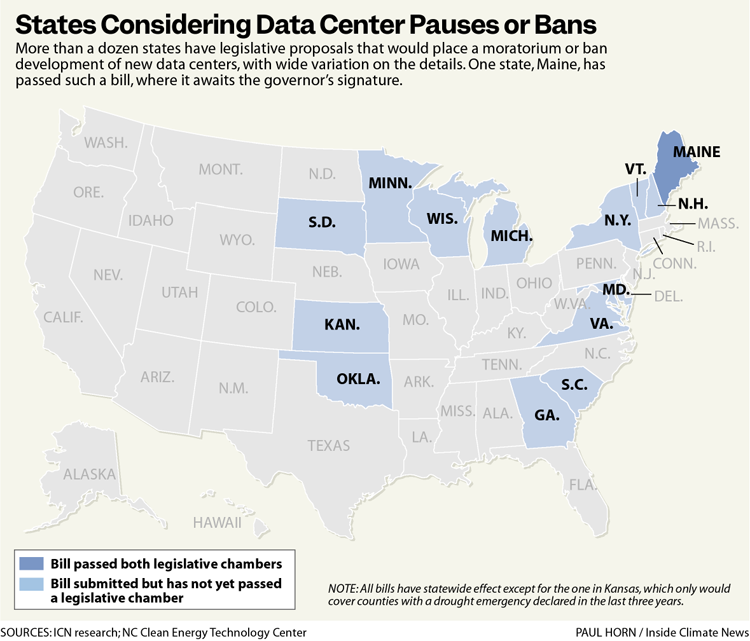
The Maine Legislature has made history by passing a first-of-its-kind moratorium on the development of large-scale data centers, marking a significant pivot in how states manage the rapid expansion of digital infrastructure. This week, the Maine House and Senate approved LD 307, a bill that effectively halts the approval of data centers requiring 20 megawatts or more of electricity until at least October 2027. The legislation now moves to the desk of Governor Janet Mills, whose decision to sign, veto, or allow the bill to become law without her signature remains the final hurdle for this landmark environmental and industrial policy.
The move comes at a time of unprecedented growth for the data industry, fueled by the global transition to cloud computing and the explosive rise of generative artificial intelligence. While data centers have traditionally been viewed as lucrative sources of tax revenue and technological prestige, a growing chorus of lawmakers and environmental advocates is raising alarms regarding their immense consumption of electricity and water, as well as their potential to strain aging power grids.
The Specifics of LD 307 and the Legislative Path
LD 307 passed the Maine House with a vote of 79-62 and the Senate with a 21-13 margin. The bill establishes a temporary freeze on state and local government approvals for any data center project with a demand of at least 20 megawatts. To put that threshold in perspective, 20 megawatts is enough to power roughly 15,000 to 20,000 homes. By targeting these "hyperscale" facilities, Maine is attempting to prevent the kind of runaway development seen in states like Virginia and Texas, where data center clusters have led to concerns over skyrocketing utility rates and environmental degradation.
The primary objective of the moratorium is to provide "breathing room" for the state to develop a comprehensive regulatory framework. During the pause, the bill mandates the convening of a special council tasked with evaluating the long-term impacts of data centers on Maine’s energy grid, water resources, and climate goals. This council will eventually provide recommendations to the legislature to ensure that any future development aligns with the state’s commitment to carbon neutrality and resource conservation.
The legislative debate highlighted a sharp partisan divide. Democratic proponents, led by State Representative Melanie Sachs, argued that the bill is a proactive measure to prevent Maine from becoming a "cautionary tale." Sachs emphasized that the state’s current regulatory tools are ill-equipped to handle the unique demands of modern data infrastructure. Conversely, Republican opponents, such as State Senator Matt Harrington, argued that the moratorium sends a "closed for business" signal to the tech industry, potentially costing the state billions of dollars in private investment and hundreds of high-tech jobs.
The Context: A National Trend Toward Regulation
Maine is not alone in its skepticism. According to data from the NC Clean Energy Technology Center, lawmakers in 13 other states have introduced similar measures this year to pause or restrict data center development. Analysts suggest that Minnesota and Illinois are the most likely candidates to follow Maine’s lead, as both states are currently grappling with the influx of massive data projects that threaten to outpace local energy production.
The national concern is driven by the sheer scale of energy demand. As of late last year, U.S. data centers accounted for more than 50 gigawatts of electricity demand. This figure is roughly double the peak demand of the entire New England power grid, which serves six states combined. With the integration of AI—which requires specialized chips that consume significantly more power than traditional servers—projections suggest that data center energy use could double again by 2030.
The pressure is also being felt at the federal level. U.S. Senator Bernie Sanders (I-Vt.) and Representative Alexandria Ocasio-Cortez (D-N.Y.) have recently proposed a national moratorium on AI-specific data centers, citing the urgent need to assess their impact on the climate crisis and the national power grid.
The Energy and Water Dilemma
The primary driver behind the Maine moratorium is the potential impact on the state’s energy infrastructure. Data centers operate 24/7, creating a "flat" load that requires constant, reliable power. In states with high data center density, utilities have struggled to keep up, often resorting to keeping coal or gas-fired power plants online longer than planned to meet the demand. This creates a direct conflict with state-mandated renewable energy targets.
Furthermore, there is the issue of ratepayer protection. When a utility must build new transmission lines or power plants to accommodate a massive data center, the costs are often shared across the entire customer base. Maine lawmakers are concerned that residential ratepayers could see their electricity bills rise to subsidize the infrastructure needs of multi-billion-dollar tech corporations.
Water consumption is another critical factor. Large data centers utilize evaporative cooling systems to prevent servers from overheating. A single large facility can consume millions of gallons of water per day—often sourced from municipal potable water supplies. In a state like Maine, which prides itself on its natural resources and environmental stewardship, the prospect of diverting vast quantities of water to cool server racks has met with significant community resistance.
Local Impacts: The Case of Jay and Sanford
The moratorium has specific implications for local projects currently in the discussion phase. In the town of Jay, there have been talks about redeveloping a former paper mill site into a data center. Governor Janet Mills had previously expressed a desire for the bill to include an exemption for the Jay project, viewing it as a way to revitalize a community hit hard by the decline of the paper industry. However, the final version of LD 307 did not include this exemption.
In Sanford, local officials have also explored data center development as a means of economic diversification. Critics of the bill, like Senator Harrington, argue that the moratorium will lead developers to abandon these sites in favor of states with more permissive environments. Proponents, however, counter that the redevelopment of old industrial sites should not come at the expense of the state’s long-term energy security.
Sarah Woodbury, legislative director for Maine Conservation Voters, noted that community opposition often arises when residents realize the scale of these projects. "In Maine, every time a community has tried to get a data center, the town has rebelled," Woodbury stated. She argued that the moratorium reflects the will of voters who are wary of "intrusive development" that offers few permanent jobs once construction is complete.
Chronology of the Maine Data Center Debate
- Early 2023: Initial discussions begin regarding the repurposing of defunct paper mills for digital infrastructure.
- Late 2023: Reports emerge of massive energy demand spikes in Virginia and other data center hubs, prompting concern among Maine environmental groups.
- January 2024: LD 307 is introduced by Rep. Melanie Sachs, aiming to establish a regulatory framework before large-scale projects are approved.
- March 2024: Public hearings reveal a deep divide between economic development agencies and environmental advocates.
- April 2024: The Maine House and Senate pass LD 307 after intense debate regarding exemptions for specific mill sites.
- Present: The bill awaits action from Governor Janet Mills. If signed, the moratorium will remain in effect until October 2027.
Analysis of Implications
The passage of LD 307 represents a fundamental shift in the "growth at all costs" mentality that has characterized the tech boom of the last decade. By prioritizing grid stability and environmental oversight over immediate capital investment, Maine is positioning itself as a leader in "responsible technology" policy.
However, the move carries risks. If other states do not follow suit, Maine could lose out on the underlying infrastructure of the digital economy. Data centers are the backbone of everything from healthcare records to financial systems. If a state lacks this infrastructure, it may find itself at a disadvantage in attracting other tech-adjacent industries.
The "breathing room" provided by the moratorium will be crucial. The success of this policy will depend on the effectiveness of the special council. If the council can produce a clear, predictable, and rigorous set of rules for data center development, Maine may eventually attract projects that are more efficient and less burdensome on the public. This could include requirements for on-site renewable energy generation, advanced liquid cooling systems that minimize water use, and "grid-interactive" technologies that allow data centers to reduce their load during times of peak demand.
Conclusion
As Governor Mills weighs her decision, the eyes of the national tech industry and environmental community are on Augusta. The outcome will likely serve as a blueprint for how other states navigate the tension between the insatiable demand for data and the finite resources of the physical world. Whether LD 307 becomes a model for sustainable development or a cautionary tale of missed economic opportunity will depend on the state’s ability to balance innovation with preservation over the next three years. For now, Maine has sent a clear message: the digital gold rush must respect the limits of the power grid and the environment.










Leave a Reply