
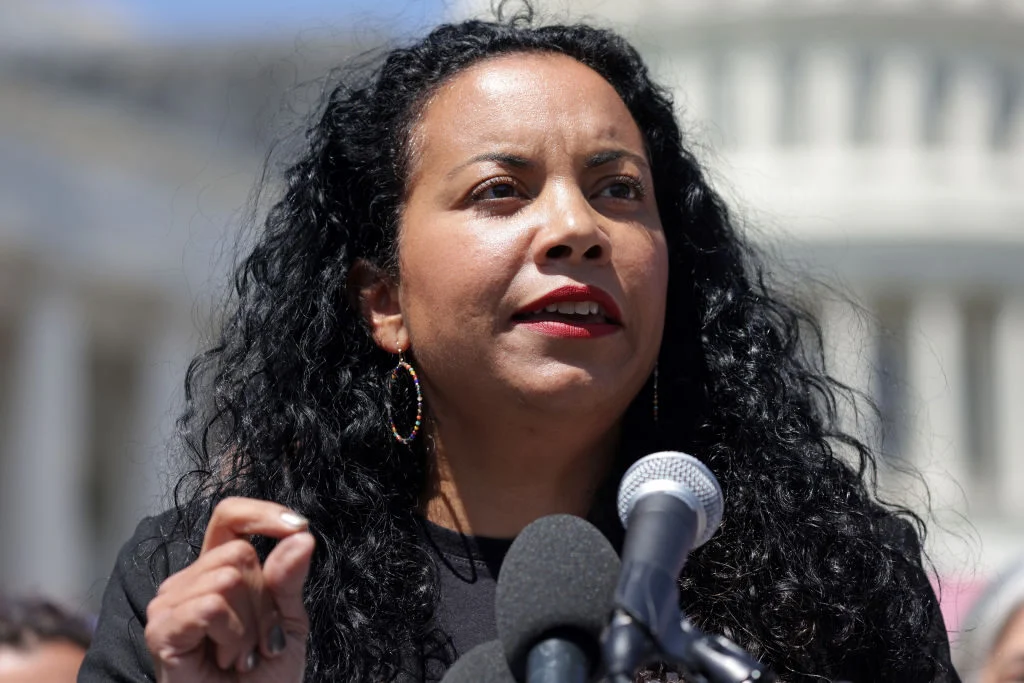
Voters in New Jersey’s 11th Congressional District are poised to select their next representative in a high-stakes special election this Thursday, April 18, to fill the seat vacated by Democratic Governor Mikie Sherrill. Progressive organizer Analilia Mejia, who secured the Democratic nomination in a closely watched and contentious primary, is widely favored to win the reliably blue North Jersey district against Republican nominee Joe Hathaway, the current mayor of Randolph Township, and independent candidate Alan Bond. This election is not merely a local contest but a critical moment for the Democratic Party to maintain its congressional strength and for the progressive wing to assert its influence.
Analilia Mejia: A Progressive Force for Change
Analilia Mejia enters the general election as a formidable candidate with a robust progressive platform and a history of advocacy. The daughter of Colombian and Dominican immigrants, Mejia’s career trajectory reflects a deep commitment to labor rights and social justice. Her early professional life saw her actively involved with the Service Employees International Union (SEIU), a powerful labor organization known for its advocacy on behalf of working families. This experience laid the groundwork for her subsequent role as the executive director of New Jersey’s Working Families Party, an organization dedicated to advancing progressive policies and supporting candidates who champion economic equality and social justice.
Mejia’s national profile rose significantly through her involvement in Senator Bernie Sanders’ 2020 presidential campaign, where she served as a senior advisor, helping to shape and articulate the campaign’s progressive message. Following the election, her expertise in labor issues led her to a position within the Labor Department under President Joe Biden, further cementing her credentials within Democratic circles. Her campaign for the 11th District seat has garnered substantial support from various sectors, particularly from organized labor, which views her as a staunch ally. Prominent progressive figures, including Senator Sanders himself, New York Representative Alexandria Ocasio-Cortez, and Congressional Progressive Caucus Chair Greg Casar, have enthusiastically endorsed her, signaling the broader progressive movement’s investment in her victory. Her policy positions, consistent with her progressive background, are expected to include strong advocacy for workers’ rights, environmental protection, expanded access to affordable healthcare, and addressing systemic inequalities.
The Opposition: Hathaway’s Republican Challenge and Bond’s Independent Bid
Challenging Mejia for the 11th District seat is Republican Joe Hathaway, the mayor of Randolph Township. Hathaway represents the Republican Party’s effort to appeal to suburban voters in a district that has increasingly leaned Democratic. As a municipal leader, his platform is likely to emphasize local governance, fiscal responsibility, and community-focused initiatives. While his mayoral experience suggests an understanding of local needs, translating that into a successful congressional bid in a blue-leaning district presents a significant challenge. Hathaway’s campaign has sought to draw a contrast with Mejia’s progressive stances, likely focusing on more moderate or conservative economic policies and potentially national security issues.
Independent candidate Alan Bond also features on the ballot, offering voters an alternative outside the two major parties. Independent campaigns often struggle to gain significant traction due to limited resources and less party infrastructure, but they can sometimes draw votes from disaffected individuals or those seeking non-partisan solutions to specific local issues. Bond’s platform, while less publicized than his major-party counterparts, is typically geared towards appealing to voters disillusioned with partisan politics.
In terms of campaign finance, Mejia has demonstrated a considerable advantage, reflecting the broader support she has garnered. Federal filings through March 27 indicate that Mejia raised an impressive $1.1 million and concluded the pre-general filing period with $374,000 in cash on hand. In contrast, Hathaway raised $525,000 and had $109,000 banked by the same deadline. This financial disparity underscores the uphill battle Hathaway faces in a district that is not only politically inclined towards Democrats but also heavily invested in Mejia’s candidacy.
The Tumultuous Democratic Primary: An Upset Driven by Outside Spending
Analilia Mejia’s path to the Democratic nomination was anything but straightforward, marked by a crowded and contentious primary that ultimately saw her emerge as a surprise victor. The field included several notable figures, such as former Lieutenant Governor Tahesha Way and Essex County Commissioner Brendan Gill, but the most significant challenger was former Representative Tom Malinowski. Malinowski, who had previously represented the neighboring 7th District for two terms, was initially considered the front-runner, leveraging his prior congressional experience and established fundraising network. Through January 16, Malinowski had outpaced Mejia in fundraising, accumulating $1.2 million compared to her $420,000.
However, the dynamics of the primary were dramatically altered by the intervention of outside spending, specifically from the American Israel Public Affairs Committee (AIPAC) through its super PAC, the United Democracy Project. AIPAC spent a substantial $2.3 million against Malinowski, an unprecedented sum in a New Jersey congressional primary. This significant financial outlay was reportedly triggered by Malinowski’s public statements indicating an openness to discussing limits on funding for Israel, a position that drew the ire of the pro-Israel lobbying group. Malinowski himself later decried the "massive flood of dark money that AIPAC spent on dishonest ads during the last three weeks," suggesting that the negative campaigning had a decisive impact on his standing among voters.
Mejia, who had already established herself as a vocal critic of Israel’s actions in Gaza, going so far as to accuse Israel of committing genocide, became the unintended beneficiary of this intense outside spending. The attacks on Malinowski, while not directly boosting Mejia’s campaign, effectively weakened his front-runner status and created an opening for her to surge. The initial margin between Mejia and Malinowski in the February 5 primary was so narrow that The Associated Press did not call the race for a full week. Malinowski ultimately conceded on February 10, with Mejia being declared the winner by less than a two-point margin, a testament to the unforeseen power of external influence in shaping primary outcomes. This episode has reignited national debates about the role of super PACs and "dark money" in elections, particularly how significant independent expenditures can dramatically alter the landscape of a primary contest, even in local races.
New Jersey’s 11th District: A Strong Democratic Foothold
New Jersey’s 11th Congressional District, encompassing parts of Morris, Essex, and Passaic counties, has solidified its position as a reliably Democratic stronghold in recent election cycles. This shift reflects broader demographic and political trends in suburban areas across the United States, where once-conservative enclaves have increasingly moved towards the Democratic Party. The district’s electoral history provides clear evidence of this lean: Mikie Sherrill, the former incumbent, won her last House term in 2024 by a commanding 15 points. Furthermore, in the 2020 presidential election, Kamala Harris carried the district over Donald Trump by a significant 9 points, according to calculations by Inside Elections with Nathan L. Gonzales. These figures highlight a substantial Democratic voter registration advantage and a consistent pattern of supporting Democratic candidates in both federal and state elections.
The demographic makeup of the 11th District contributes to its Democratic lean. It is characterized by diverse communities, including a growing professional class, significant ethnic minority populations, and suburban residents who prioritize issues such as environmental protection, gun control, and social services. These demographics often align with the Democratic Party’s platform, making it challenging for Republican candidates to gain significant traction without substantial cross-over appeal or a highly localized campaign focused on specific, non-partisan issues. The special election in a district with such a strong partisan lean typically becomes a contest of mobilization and turnout, rather than a genuine toss-up.
Implications for the House and Beyond
The outcome of Thursday’s special election carries several implications, both for the immediate composition of the House of Representatives and for broader political narratives.
Bolstering the Democratic Caucus and Progressive Voices
Should Analilia Mejia win, as expected, she will be swiftly sworn into office, bolstering the Democratic caucus in the House. Her addition comes at a critical time when the House’s partisan balance remains exceptionally narrow, making every seat crucial for legislative strategy and procedural votes. As a self-identified progressive, Mejia’s presence is expected to strengthen the progressive wing of the Democratic Party, potentially influencing policy debates on issues such as climate change, healthcare reform, and economic inequality. Her victory would be seen as a validation of progressive policies and a testament to the power of grassroots organizing, particularly after her primary upset. For Democrats, holding this seat is paramount to maintaining their legislative strength and signaling continued voter confidence in their agenda in key suburban battlegrounds.
A National Snapshot Amidst Congressional Flux
While the NJ-11 election is a local contest, it forms part of a larger national narrative concerning the state of the House of Representatives. Special elections often serve as mini-referendums on the prevailing political climate, even if the strong partisan lean of this district may limit its predictive power for the upcoming general election cycle. However, it does reinforce the Democratic Party’s ability to retain seats in favorable territory. The swift swearing-in of a new member, following Georgia Representative Clay Fuller’s recent addition to the House Republican Caucus, underscores the ongoing churn in Congress. Fuller took the oath of office just this Tuesday, April 16, after winning a special election last week to fill the vacancy left by the January departure of Republican Marjorie Taylor Greene. This rapid succession of new members highlights the dynamic nature of legislative bodies.
A House in Transition: A Flurry of Vacancies
The New Jersey 11th District special election is one of several recent and upcoming contests to fill vacancies in the U.S. House of Representatives, painting a picture of a legislative body in constant flux. The reason for the NJ-11 vacancy itself – Mikie Sherrill’s resignation in November after being elected governor – reflects the career mobility of politicians.
Currently, there are three other vacant seats in the House, in addition to the one being filled in New Jersey. Two of these vacancies opened just this Tuesday, April 16, following the resignations of embattled Representatives. California Democrat Eric Swalwell resigned amidst sexual assault allegations, which he vehemently denied, stating his decision was to protect his family and focus on his legal defense. Texas Republican Tony Gonzales also announced his plans to leave office, though the specific reasons for his departure were less publicly detailed, adding to the GOP’s challenges in maintaining its slim majority. The California seat of the late Republican Representative Doug LaMalfa, who passed away in January, also remains open.
The timelines for filling these remaining vacancies are varied. Special elections in the two California districts, including LaMalfa’s former seat and Swalwell’s, have already been set for this summer by Governor Gavin Newsom, indicating a relatively quick process to restore representation. However, Texas Governor Greg Abbott has yet to announce plans for the Texas vacancy left by Gonzales, leaving that district in a period of uncertainty regarding its representation.
This flurry of resignations, deaths, and special elections underscores the precarious nature of the House’s composition. With a historically thin majority, every seat counts, and each special election, regardless of its partisan lean, carries significance for the overall balance of power and the ability of either party to advance its legislative agenda. The New Jersey 11th District election, while largely anticipated to result in a Democratic hold, is therefore an important piece in the larger, ever-shifting puzzle of congressional representation.
Mary Ellen McIntire contributed to this report.









Leave a Reply