The global wind energy sector is currently confronting a significant physical constraint: as turbines grow in size to capture more consistent, higher-altitude winds, the logistics of transporting and erecting massive components have reached a breaking point. For years, the industry has relied on increasingly gargantuan crawler cranes to assemble turbines that now regularly exceed 150 meters in hub height. However, the costs associated with transporting these cranes—often requiring dozens of heavy-haulage trucks—and the narrow weather windows required for their operation have prompted a shift in engineering philosophy. Spain-based Nabrawind has emerged as a leader in this transition with its Nabralift system, a modular, self-lifting tower design that effectively bypasses the need for traditional heavy-lift cranes.
The Engineering Mechanics of Nabralift
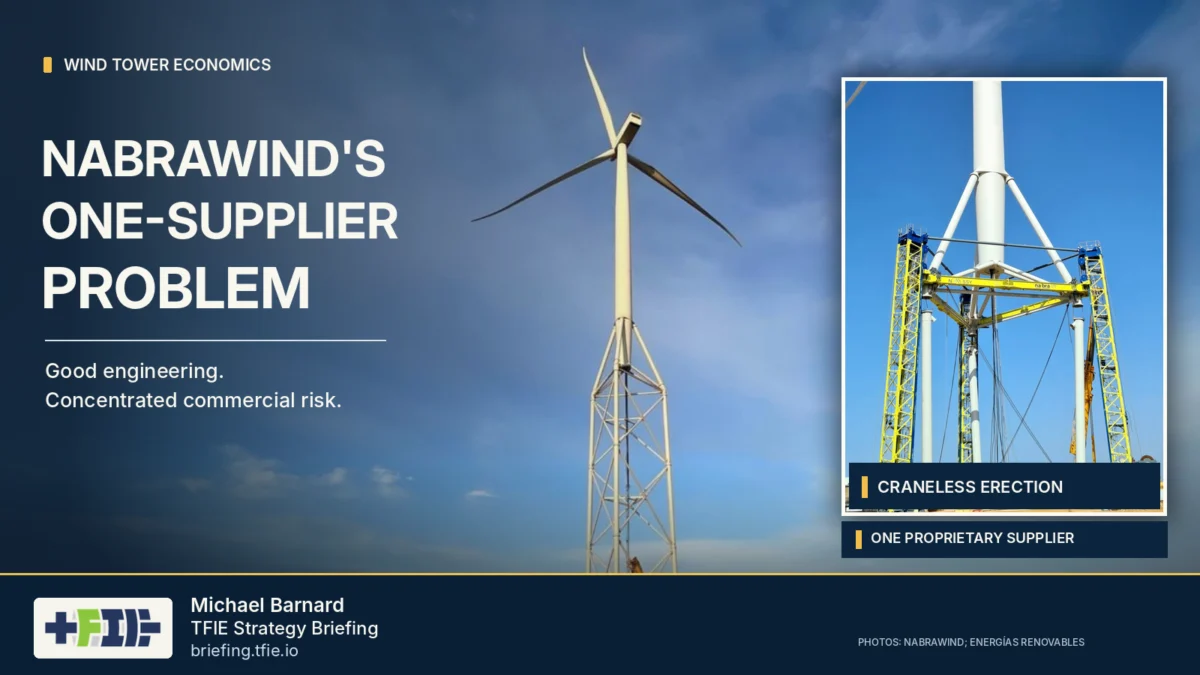
At its core, the Nabralift system replaces the traditional, monolithic steel tower base with a three-legged, lattice-like steel structure. This design provides structural stability while allowing the turbine’s nacelle and upper tower sections to be assembled at ground level. Once the primary components are prepared, a proprietary hydraulic self-lifting frame is attached.
Unlike conventional installations where a crane lifts the entire nacelle—a component that can weigh hundreds of tons—to the top of the tower in one high-risk operation, the Nabralift system operates in increments. The hydraulic equipment raises the nacelle and upper tower, allowing workers to insert modular sections of the tower beneath the existing structure. This process is repeated until the full hub height is reached. Because the center of gravity remains low throughout the assembly, the system is far less susceptible to the wind-speed limitations that typically force work stoppages on conventional crane-based projects.
Chronology of Commercial Scaling
Nabrawind’s trajectory from conceptual design to industrial-scale deployment has been marked by rigorous testing and incremental certification. The following timeline outlines the evolution of this technology:

- Early Development: Nabrawind initiates the design of modular tower segments intended to address the logistical bottleneck of transporting oversized tubular sections on public roads.
- Initial Prototypes: The company successfully erects a 160-meter prototype in Spain, completing the installation in under two weeks. This project served as the primary proof-of-concept for the self-lifting mechanism.
- Commercial Expansion: Smaller-scale commercial projects are successfully completed in Morocco and France, demonstrating the technology’s adaptability to varying terrain and climatic conditions.
- September 2025: Fortescue, the global green energy and metals giant, officially acquires Nabrawind. This move signals a vertical integration strategy, bringing the proprietary technology in-house to support Fortescue’s ambitious decarbonization goals.
- September 2026: A major milestone is achieved when UL Solutions issues a formal type certification for the integration of Envision’s 7.8 MW wind turbine onto a 188-meter Nabralift tower. This certification is a critical prerequisite for bankability and insurance coverage.
- Late 2026 – Present: Construction begins on the 133 MW Nullagine wind project in Western Australia’s Pilbara region, utilizing 17 of the certified 188-meter configurations.
Economic and Logistical Implications
The primary value proposition of the Nabralift system lies in its potential for cost reduction and schedule optimization. According to data provided by the company, the design utilizes approximately 20% less steel compared to traditional tubular tower designs. Furthermore, because the three-legged structure distributes loads differently than a standard base, the required volume of foundation concrete can be reduced by as much as 80% in specific geological conditions.
These savings are not merely anecdotal; they represent a fundamental shift in how wind farm developers might approach remote site construction. In the Pilbara region of Australia, where the Nullagine project is currently situated, the cost of mobilizing a specialized crawler crane can be astronomical. By eliminating the need for such heavy equipment, developers can significantly lower the "Total Cost of Ownership" (TCO) for a wind turbine over its 25-to-30-year operational life.
However, industry analysts note that these efficiencies must be weighed against the challenges of proprietary supply chains. While conventional steel towers are a commodity—sourcing them from multiple manufacturers is common practice—the Nabralift system is currently a singular solution. This creates a dependency on one supplier for the tower structure, the lifting equipment, and the specialized technical support required during the installation phase.
Strategic Integration and the Fortescue Factor
The acquisition of Nabrawind by Fortescue provides a unique case study in vertical integration. By owning the technology, Fortescue mitigates the procurement risks that an independent developer might face. The Nullagine project serves as a "living laboratory" for the system, allowing the company to refine the installation process without the immediate pressure of third-party contract disputes.
For the broader market, however, the "Fortescue model" presents questions regarding scalability. For independent power producers (IPPs), the decision to adopt Nabralift involves a complex risk assessment. Lenders and insurers generally prefer standard, proven technologies with multiple service providers. For Nabralift to achieve widespread market penetration, the company must demonstrate that it can provide the long-term warranties, spare parts availability, and maintenance support that institutional investors require for multi-decade infrastructure projects.

Technical Assurance and Future Outlook
The type certification from UL Solutions for the 188-meter configuration serves as a vital bridge between experimental engineering and commercial reality. It provides a baseline of safety and performance, ensuring that the structural integrity of the lattice tower and its interaction with the Envision 7.8 MW turbine meet international standards.
Looking forward, the success of the Nullagine project will likely serve as the ultimate barometer for the technology. If the 17 units are installed within the projected timeframe and meet their performance metrics, it will provide the empirical data necessary to satisfy the requirements of international project finance.
The industry is currently at a juncture where hub heights are steadily increasing to capture more stable, high-altitude wind currents. While 300-meter towers are being discussed in academic and engineering circles, the physical limitations of current crane technology act as a "glass ceiling" for height. Solutions like Nabralift do not just offer a clever way to save on steel and concrete; they offer a potential path to overcoming the height limitations that have constrained wind energy output for years.
Conclusion: A Market in Transition
The adoption of self-lifting tower technology represents a maturation of the wind energy supply chain. As projects move into more remote, logistically challenging areas, the ability to "build from the ground up" without massive external support becomes an increasingly competitive advantage.
While the technology faces hurdles regarding supplier concentration and the need for standardized commercial terms, its technical merits are becoming increasingly difficult to ignore. The transition from demonstration-scale hardware to a major 133 MW deployment at Nullagine signifies that Nabrawind has moved past the "proof of concept" phase. The next chapter for the company will depend on its ability to transition from a niche, proprietary solution to a trusted, widely accessible standard that can satisfy the rigorous demands of global wind energy financing. For now, the eyes of the industry are focused on Western Australia, where the outcome of the Nullagine installation will determine whether the self-lifting tower becomes a cornerstone of the next generation of wind energy infrastructure.