
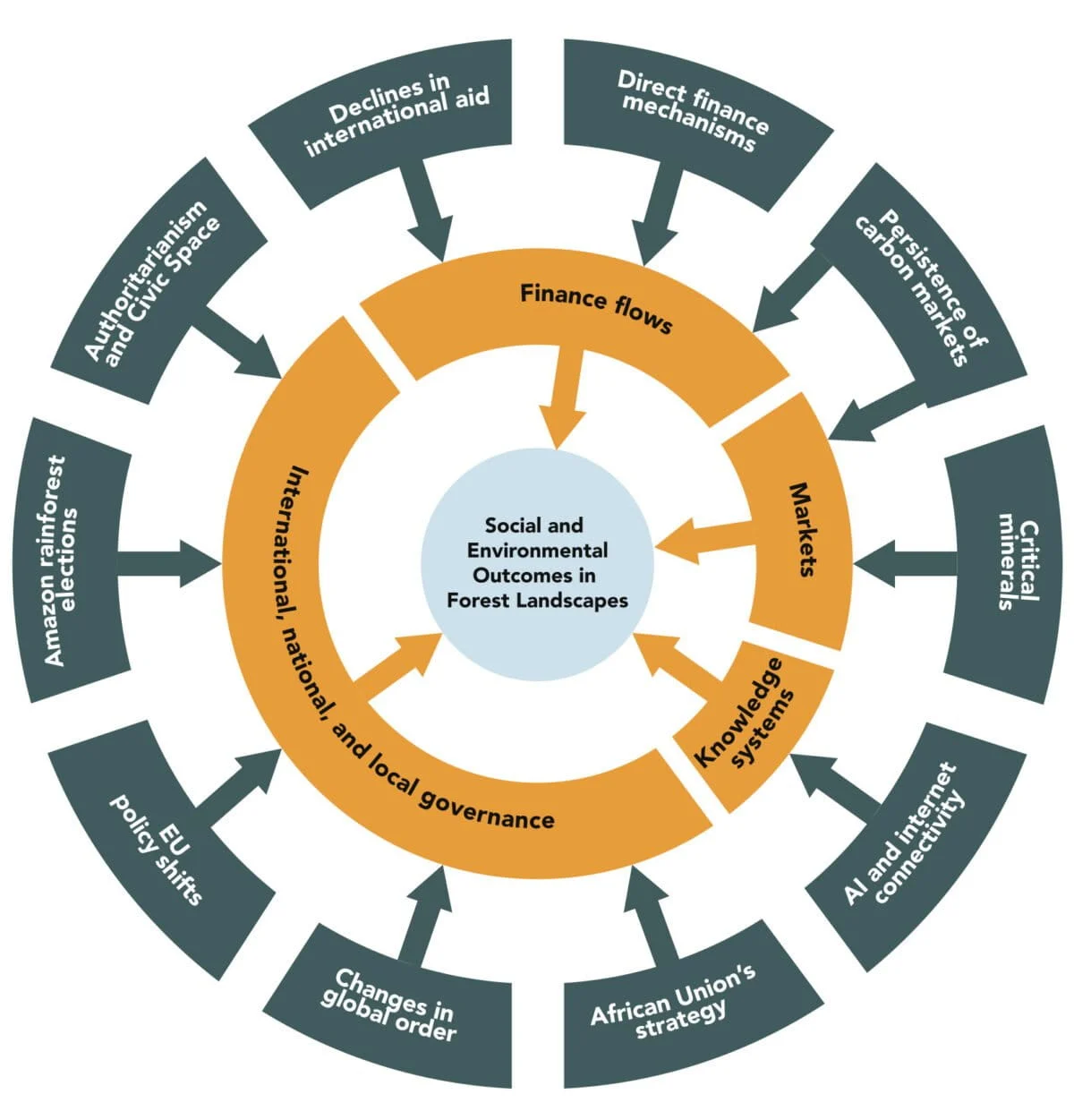
The global landscape of forest conservation is undergoing a seismic shift as a confluence of political, financial, and technological drivers creates a new and increasingly volatile era for ecosystems. According to a comprehensive horizon scan published in the journal Forest Policy and Economics, the systems designed to protect the world’s forests are struggling to keep pace with the speed of modern change. Led by researcher Matilda Kabutey-Ongor, the study identifies ten critical emerging issues that will define the relationship between forests and human society through the early 2030s. The findings suggest that the traditional models of top-down governance and international aid are giving way to a fragmented reality where artificial intelligence, mineral extraction for the green energy transition, and shifting geopolitical alliances dictate the fate of the world’s most vital carbon sinks.
The Horizon Scan: A Methodology for Uncertainty
The research team employed a structured consultation process, engaging a diverse range of practitioners, academics, and policymakers to identify "weak signals"—early indicators of significant change that are often overlooked by traditional monitoring. Unlike standard forecasting, which relies on historical data to predict the future, horizon scanning seeks to map out potential disruptions before they become mainstream. The study emphasizes that the coming decade will not be defined by a single crisis, but by the intersection of several.
For instance, the rapid advancement of digital connectivity in remote areas is occurring at the same time that global trade regulations are tightening and public funding for conservation is drying up. This convergence creates a "perfect storm" of uncertainty for the Amazon, the Congo Basin, and Southeast Asian rainforests. The primary takeaway from the report is a sense of institutional lag; while the threats to forests are evolving at the speed of the digital age, the legal and bureaucratic frameworks intended to mitigate them remain rooted in 20th-century logic.
The Financial Pivot: From Public Aid to Volatile Markets
For over half a century, forest governance in the Global South has been heavily subsidized by Official Development Assistance (ODA) from wealthy nations. However, the report highlights a significant retreat in traditional aid. Economic pressures in donor countries, combined with a pivot toward domestic priorities and security concerns, have led to substantial cuts in research and field project budgets.

This retreat is not merely a loss of capital; it represents a breakdown in the monitoring systems that underpin global conservation. When public funding disappears, so too does the independent oversight required to verify conservation outcomes. To fill this vacuum, new and more complex forms of finance are emerging:
- Forest Carbon Markets: Despite ongoing controversies regarding the "permanence" and "additionality" of carbon credits, the market continues to expand. Driven by corporate net-zero commitments and new regulatory frameworks like Article 6 of the Paris Agreement, these markets are becoming a primary vehicle for forest finance.
- Direct Funding for Indigenous Peoples: A notable positive trend identified is the rise of mechanisms that bypass national governments to provide funds directly to Indigenous and local communities (IPLCs). While this empowers local stewards, it also creates friction with state authorities who may view such funding as a challenge to their sovereignty.
- Philanthropic Volatility: While large-scale philanthropy is stepping in to cover some gaps left by governments, these funds are often less predictable and more prone to the changing whims of individual donors than multi-year government treaties.
Technology as a Double-Edged Sword
The integration of Artificial Intelligence (AI) and high-resolution remote sensing has revolutionized the ability to monitor deforestation. Organizations can now track tree loss in near-real-time, allowing for rapid response to illegal logging. However, the horizon scan warns that these same tools are being co-opted by those they are meant to stop.
In the Amazon and the Congo, improved satellite internet connectivity has enabled illegal mining and logging syndicates to coordinate their activities with unprecedented efficiency. These actors use encrypted communication and real-time mapping to evade law enforcement patrols. Furthermore, the spread of AI-driven data analysis allows large-scale agricultural interests to identify and exploit legal loopholes in land-use regulations more effectively than ever before. The "digital divide" is no longer just about access to information; it is about who has the superior algorithm to control the land.
The Mineral Rush and the Energy Transition Paradox
One of the most significant pressures identified in the report is the global push for "critical minerals" such as lithium, cobalt, and copper. As the world attempts to decarbonize through the adoption of electric vehicles and renewable energy infrastructure, the demand for these materials is skyrocketing. The International Energy Agency (IEA) estimates that mineral demand for clean energy technologies will need to quadruple by 2040 to meet the goals of the Paris Agreement.
Much of this extraction is being pushed deeper into previously intact forest regions. This creates a bitter irony: the efforts to save the climate through a "green transition" are directly contributing to the destruction of the forests that serve as the planet’s primary defense against global warming. In regions where governance is weak and land rights are poorly defined, the arrival of large-scale mining operations often leads to the displacement of local communities and the irreversible loss of biodiversity.

Geopolitical Shifts and the Erosion of Multilateralism
The post-World War II international order, which facilitated global environmental treaties like the Convention on Biological Diversity (CBD), is under extreme strain. The horizon scan notes a visible drift toward more centralized, nationalist, and less accountable governance in many forest-rich nations.
In several countries, new laws are being enacted to restrict the activities of civil society organizations and limit their access to foreign funding. This "shrinking space" for NGOs means there are fewer watchdogs to hold governments and corporations accountable. Environmental defenders are facing record levels of violence; according to data from Global Witness, hundreds of activists are killed every year, the majority of them in forested regions of Latin America and Asia.
The weakening of multilateral institutions makes it harder to enforce international standards. As global norms around sustainability and human rights become more fragmented, "governance gaps" appear, allowing unscrupulous actors to operate with impunity across borders.
Trade Policy and the Smallholder Challenge
New regulatory frontiers are also reshaping global supply chains. The European Union Deforestation Regulation (EUDR), which requires companies to prove that products like coffee, cocoa, and palm oil are not linked to deforestation, represents a bold attempt to use market power for environmental ends.
However, the report identifies a significant risk: the "exclusion effect." Small-scale farmers, who produce a significant portion of these commodities, often lack the digital mapping tools and bureaucratic resources required to prove compliance with EU standards. Without support, these producers may be pushed out of premium markets, potentially driving them toward less regulated markets or more desperate, environmentally damaging survival strategies.

Chronology of Forest Governance Milestones
To understand the current state of uncertainty, it is necessary to look at the timeline of how forest governance has evolved:
- 1992 (The Rio Earth Summit): The establishment of the "Forest Principles" and the launch of the UN Framework Convention on Climate Change (UNFCCC).
- 2005 (The Birth of REDD): The concept of Reducing Emissions from Deforestation and Forest Degradation (REDD) is introduced, aiming to pay developing nations to keep their forests standing.
- 2015 (The Paris Agreement): Forests are formally recognized as a critical component of climate mitigation strategy.
- 2021 (COP26 Glasgow Declaration): Over 140 countries, representing 90% of the world’s forests, pledge to halt and reverse forest loss by 2030.
- 2023-2024 (The Implementation Gap): Data shows that despite pledges, primary forest loss remains high, and new pressures from mining and political instability begin to peak.
Broader Impact and Policy Implications
The fragmentation of forest governance means that the future will likely be characterized by "hybrid" systems. We are moving away from a world where the state is the sole arbiter of forest use. Instead, a complex web of private certifiers, community-led initiatives, and international corporate standards will take the lead.
The implications for the roughly 1.6 billion people who depend on forests for their livelihoods are profound. On one hand, the shift toward direct community funding offers a path to self-determination and the protection of traditional knowledge. On the other hand, the rise of "green-grabbing"—where land is set aside for carbon offsets or mineral extraction without local consent—threatens to marginalize these populations further.
Conclusion: A Call for Adaptive Governance
The horizon scan concludes that the systems built to protect forests were designed for a slower, more predictable world. To survive the next decade, forest policy must become as dynamic as the forces threatening it. This requires a shift from rigid, five-year planning cycles to adaptive management strategies that can respond to real-time data and shifting political realities.
The coming years will be a test of whether the global community can reconcile its hunger for resources with its need for a stable climate. Forests have always been political spaces, but they are now at the center of a global struggle over the definition of progress. Whether the next decade results in the collapse of these ecosystems or a new era of resilient stewardship will depend on how quickly institutions can bridge the gap between their current capabilities and the emerging realities of the 2030s.









Leave a Reply