
The landscape of home appliances has undergone a radical transformation over the last five years, driven by a combination of tightening energy regulations, a shift in urban architectural trends, and a global movement toward more sustainable refrigerants. For homeowners navigating the complexities of modern kitchen design—whether managing the tight quarters of a metropolitan galley kitchen, the specialized needs of a tiny home, or the aesthetic demands of a high-end remodel—the refrigerator remains the most critical and energy-intensive component. In 2026, the market for counter-depth refrigerators has matured, successfully bridging the gap between the sleek, flush-mount look of built-in units and the high-volume capacity once exclusive to bulky, standard-depth models.
The Evolution of the Counter-Depth Market: A Five-Year Retrospective
To understand the 2026 appliance market, one must look at the technological trajectory established since 2021. Five years ago, choosing a counter-depth model—defined as a unit with a cabinet depth of approximately 24 to 30 inches—often meant sacrificing significant internal storage space. The average counter-depth unit offered roughly 20 to 22 cubic feet of volume, while standard-depth models easily exceeded 28 cubic feet.
However, a shift in manufacturing engineering, led primarily by South Korean giants LG and Samsung, has largely neutralized this disadvantage. Through the implementation of advanced vacuum insulation panels (VIPs) and high-density polyurethane foams, manufacturers have thinned the exterior walls of these appliances without compromising thermal efficiency. This "Capacity Revolution" reached a milestone in 2024 and 2025, with the introduction of "Max Capacity" counter-depth units that now offer up to 27 cubic feet of storage, nearly matching their standard-depth counterparts while maintaining a shallow footprint.
Furthermore, the industry has completed a monumental transition in cooling chemistry. As of 2026, R-600a (isobutane) has replaced R-134a as the universal standard for residential refrigeration in the United States. This shift was mandated by Environmental Protection Agency (EPA) regulations aimed at reducing the Global Warming Potential (GWP) of household appliances. While R-134a had a GWP of approximately 1,430, R-600a has a GWP of less than 3, marking a significant victory for environmental sustainability.
The New Standard: R-600a and Maintenance Implications
The adoption of R-600a is not merely a technical footnote; it fundamentally changes the service lifecycle of the modern refrigerator. Isobutane is a highly efficient thermodynamic medium, allowing for smaller, quieter compressors. However, because R-600a is classified as an A3 (flammable) refrigerant, the repair landscape has shifted.

Industry analysts note that while the safety risk to consumers is negligible due to the small volumes used in sealed systems, "sealed-system" repairs—those involving the compressor or evaporator—now require specialized, hydrocarbon-rated recovery equipment. Consumers are increasingly advised to verify that local technicians are certified in hydrocarbon handling before scheduling service, a factor that has bolstered the market share of brands with extensive, factory-authorized service networks like GE and Bosch.
Leading Models for 2026: Analysis of Performance and Value
The current market is divided into several high-performing categories based on configuration and consumer priority. The following models represent the pinnacle of 2026 refrigeration technology, selected for their energy efficiency, reliability data, and spatial innovation.
The Efficiency Leader: Frigidaire FFTR1835VW (Top Freezer)
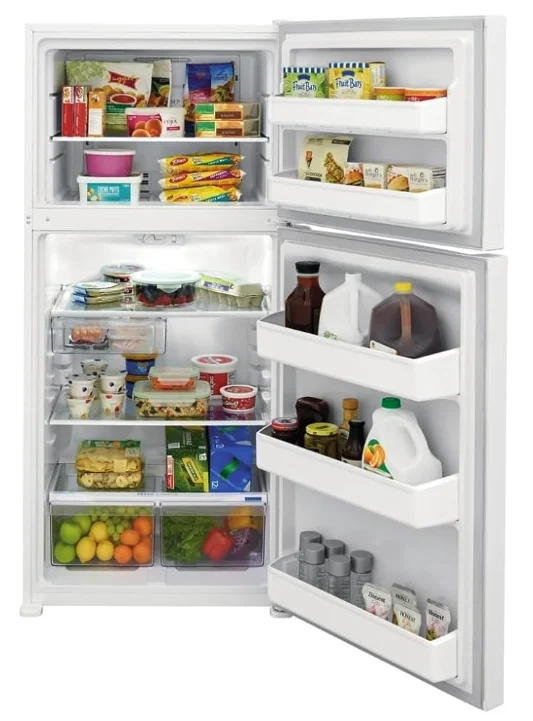
Despite the popularity of bottom-freezer and French-door designs, the top-freezer configuration remains the most thermodynamically efficient layout. The Frigidaire FFTR1835VW continues to dominate the efficiency charts. By eschewing energy-draining features such as through-the-door ice dispensers, this 18.3 cubic foot model maintains a lean energy profile, consuming approximately 369 kWh per year. It is a "garage-ready" unit, engineered to maintain consistent internal temperatures in ambient environments ranging from 38°F to 110°F, making it a primary choice for auxiliary storage or budget-conscious small households.

The Space Optimizer: Samsung RF18A5101SR (33-Inch French Door)
For kitchens with narrow 33-inch openings—a common standard in mid-century American homes—the Samsung RF18A5101SR provides a premium French-door aesthetic without the 36-inch footprint. Its standout feature is the Twin Cooling Plus system, which utilizes independent evaporators for the fridge and freezer. This prevents the dry air of the freezer from dehydrating fresh produce in the refrigerator and eliminates odor transfer between compartments.
The Capacity Pioneer: LG LRFLC2706S (Counter-Depth MAX)
The LG LRFLC2706S represents the successful resolution of the "capacity vs. depth" trade-off. Utilizing LG’s "Counter-Depth MAX" engineering, this unit provides 26.5 cubic feet of storage. Reliability data from Yale Appliance in early 2026 ranks LG’s linear inverter compressors among the most reliable in the high-capacity segment, with low first-year service rates. The inclusion of an internal water dispenser serves a dual purpose: it maintains the sleek exterior lines favored by designers and reduces the mechanical failure points associated with through-the-door dispensers.
The Preservation Specialist: Bosch 800 Series B36CT80SNS
In the luxury freestanding market, Bosch remains the leader in food longevity. The 800 Series employs a dual-compressor, dual-evaporator system—a feature typically reserved for built-in units costing twice as much. By using a dedicated compressor for the freezer and another for the refrigerator, the system maintains precise humidity levels. The "FarmFresh" system uses a combination of four technologies to keep food fresh up to three times longer, significantly reducing household food waste.

The Premium Service Choice: GE Profile PVD28BYNFS
While technically available in both standard and counter-depth versions, the GE Profile series is often selected for its robust smart features and the industry’s most extensive service network. The PVD28BYNFS features a "door-in-door" design, allowing users to access frequently used items without releasing the cold air from the primary cabinet. Its LED light wall provides unparalleled visibility, and the sensor-based AutoFill water dispenser represents the height of convenience for modern "smart" homes.
Comparative Data and Market Trends
| Model | Configuration | Depth (Inches) | Capacity (Cu. Ft.) | Est. Annual Energy (kWh) |
|---|---|---|---|---|
| Frigidaire FFTR1835VW | Top Freezer | 30.0 | 18.3 | 369 |
| Samsung RF18A5101SR | French Door | 28.5 | 17.5 | 448 |
| LG LRFLC2706S | French Door | 29.25 | 26.5 | 632 |
| Bosch 800 Series | French Door | 24.0 (Case) | 21.0 | 530 |
| GE Profile PVD28BYNFS | 4-Door French | 31.25 (CD Ver) | 27.9 | 760 |
Economic and Environmental Implications
The transition to high-efficiency counter-depth units carries broader implications for the residential energy sector. Refrigerators account for approximately 7% to 10% of total household electricity usage. The widespread adoption of Energy Star-certified counter-depth models, which are roughly 9% more efficient than those meeting only the minimum federal standard, is a key component of national carbon reduction goals.
Furthermore, the shift toward "right-sized" appliances reflects a changing demographic. As the average household size in the U.S. continues to hover around 2.5 persons, and the "Tiny House" and ADU (Accessory Dwelling Unit) markets expand, the demand for appliances that maximize volume while minimizing physical footprint has become a permanent market fixture rather than a niche trend.

Best Practices for Longevity and Performance
Regardless of the model chosen, the lifespan and efficiency of a refrigerator are heavily dependent on consumer maintenance. To ensure a modern unit reaches the 10–14 year average lifecycle, experts recommend:
- Coil Maintenance: Dusting the condenser coils every six months to ensure optimal heat exchange.
- Gasket Integrity: Cleaning door seals with warm, soapy water to prevent air leaks that force the compressor to overwork.
- Strategic Loading: Avoiding the obstruction of air vents within the cabinet to maintain uniform temperature distribution.
- Temperature Calibration: Keeping the refrigerator at 37°F and the freezer at 0°F to balance food safety with energy consumption.
Conclusion
The 2026 refrigerator market demonstrates that consumers no longer need to choose between the aesthetic appeal of a counter-depth design and the functional necessity of large-scale storage. Through the integration of R-600a refrigerants, vacuum insulation, and dual-evaporator systems, the modern refrigerator has become a sophisticated piece of environmental technology. As energy costs continue to fluctuate and sustainability remains a primary consumer driver, the shift toward these highly efficient, space-saving units represents the new baseline for the American kitchen.










Leave a Reply