
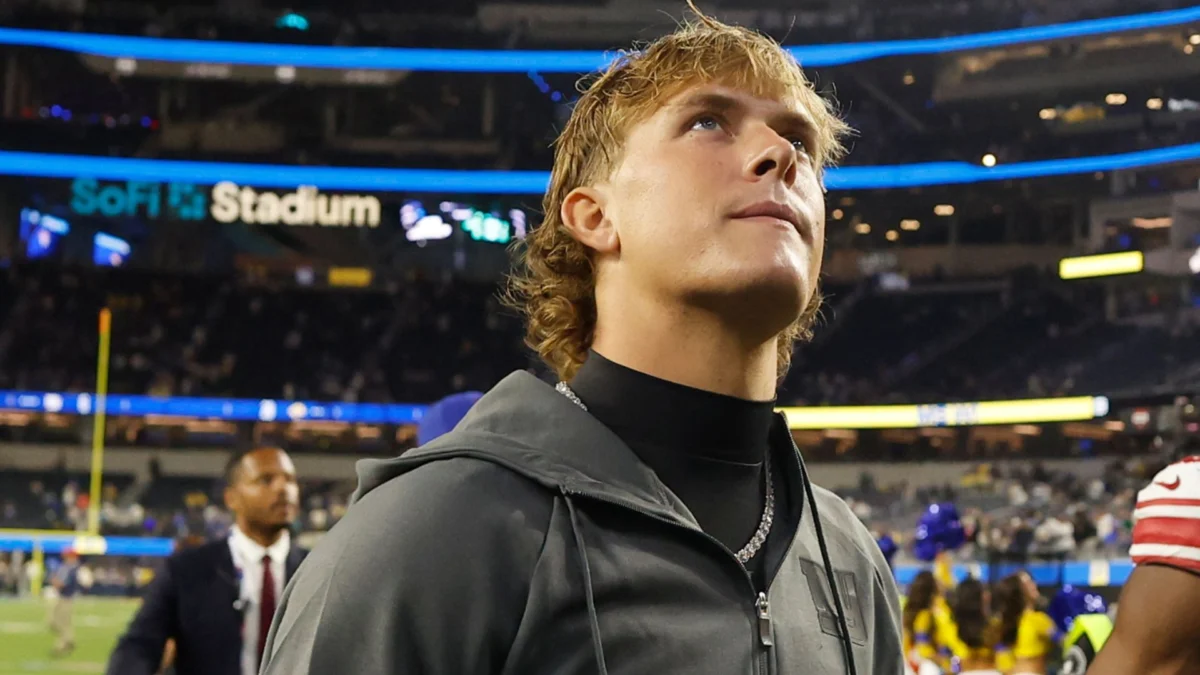
The New York Giants find themselves at a precarious crossroads early in the 2026 NFL season, as starting quarterback Jaxson Dart faces the grim possibility of a season-ending knee surgery. Following a disheartening 28-6 loss to the Los Angeles Rams on Monday night, head coach John Harbaugh confirmed that the medical staff is currently conducting an exhaustive evaluation of Dart’s left knee. While initial sideline reports suggested a medial collateral ligament (MCL) sprain, subsequent medical assessments have raised concerns that the damage may be significantly more severe, necessitating a surgical intervention that would effectively terminate his campaign.
The uncertainty surrounding Dart’s future comes at the worst possible time for the Giants, who are attempting to stabilize their momentum following a lackluster start to their 1-1 season. With a critical matchup against the Tennessee Titans looming on the horizon, the franchise is forced to weigh the immediate physical health of their marquee signal-caller against the long-term strategic viability of their roster.
The Anatomy of the Injury: A High-Stakes Sequence
The injury occurred during the opening minutes of the Monday night clash at SoFi Stadium. Less than four minutes into the first quarter, with the Giants facing a crucial third-and-eight situation, the pocket collapsed. Rams linebacker Byron Young executed a textbook bull-rush from the quarterback’s right side, applying heavy pressure that forced Dart to step up and drift laterally. As Dart attempted to evade the pressure, he collided with Rams linebacker Josaiah Stewart. The subsequent force of the two defenders converging caused an awkward, high-impact fall, during which Dart’s left leg was pinned underneath his body.
Medical personnel immediately rushed to the field, and after a brief examination, it was clear that Dart could not continue. The visual evidence of the hit, combined with the subsequent movement difficulty observed by observers, prompted immediate speculation regarding the structural integrity of his knee. The sequence served as a sobering reminder of the physical volatility of the NFL, where a single snap can fundamentally alter the trajectory of a franchise’s entire season.
Harbaugh’s Response and the Organizational Outlook
In the immediate aftermath of the loss, John Harbaugh navigated the post-game press conference with the measured caution typical of veteran coaches. Refusing to confirm the worst-case scenario while acknowledging the gravity of the situation, Harbaugh emphasized the need for a comprehensive diagnostic process.
"It’s an ongoing conversation about the health of a player, of a person," Harbaugh stated during his media availability. "We’ve got to prepare for the range of possibilities. We are looking at the totality of the medical data, including MRI results and internal orthopedic consultations. When we have a definitive timeline and a clear path forward, we will share those details with the public. Right now, our priority is the health of the individual."
Harbaugh’s refusal to rule out surgery speaks to the internal apprehension within the Giants’ front office. When pressed on the specific nature of the MCL injury, the head coach noted that the situation remains "in the neighbourhood" of his initial assessment, a phrasing that suggests the team is bracing for a recovery period that could extend well beyond the typical return-to-play window for a standard sprain.
The Depth Chart: Jameis Winston’s Moment
Should Dart be sidelined for an extended period, the burden of leadership will fall upon veteran backup Jameis Winston. Known for his resilience and extensive experience in various offensive systems across the league, Winston represents a stable, albeit different, option for the Giants. Harbaugh expressed confidence in the transition, noting that Winston’s preparation has been exemplary throughout the training camp and the early weeks of the season.
However, the transition from a starter like Dart to a veteran backup carries inherent risks. The offensive scheme, which has been tailored to capitalize on Dart’s specific mobility and arm talent, may require adjustments. Analysts suggest that the coaching staff will likely emphasize a more balanced, run-heavy attack to alleviate the pressure on the passing game while Winston acclimates to the starting role.
A Cascade of Physical Setbacks
The injury to Dart was merely the most prominent of a series of setbacks that plagued the Giants during their trip to Los Angeles. The physical toll of the game was extensive, impacting several core players on both sides of the ball.
The Giants’ offensive line suffered a significant blow when starting left tackle Andrew Thomas sustained a lower-body injury in the fourth quarter. Thomas, a cornerstone of the protection unit, was observed struggling to put weight on his leg, casting doubt on his availability for the upcoming week. Simultaneously, star pass rusher Brian Burns suffered a left ankle sprain. While Burns remained optimistic about his recovery, the loss of his defensive presence would be a significant handicap for a team that prides itself on creating pressure in the backfield.
Perhaps most illustrative of the team’s challenging night was the plight of wide receiver Malik Nabers. After suffering a shoulder dislocation during the final minutes of the first quarter, Nabers was treated on the sideline, where trainers successfully popped the joint back into place, allowing him to return to the game. This display of "next man up" mentality, while commendable, highlights the attrition that has become the hallmark of the 2026 season for the New York squad.
Contextualizing the Impact: NFL Attrition Rates
Statistically, the early-season injury rate in the NFL has become a major point of discussion among front offices and player safety committees. According to recent injury surveillance data, teams that experience multiple high-profile injuries within the first three weeks of the season see a statistically significant decrease in win-probability for the remainder of the year. The Giants’ situation is particularly precarious because it affects their most valuable asset: the quarterback.
Historically, teams that lose their primary starting quarterback for more than half a season rarely reach the postseason. The reliance on the backup position—a role often viewed as an insurance policy rather than a tactical pivot—is now being tested under the harsh glare of a playoff-contending mandate. The Giants’ ability to adjust their offensive philosophy in real-time will define the next chapter of their season.
Looking Ahead: The Titans and Beyond
As the organization prepares for the Tennessee Titans, the focus has shifted from the disappointment of the Rams loss to the cold, hard logic of roster management. The coaching staff is reportedly meeting with team physicians and strength coaches to establish a modified practice schedule designed to prevent further injuries while preparing the team for a high-intensity divisional game.
"This is football. This is the NFL. This is what you do," Brian Burns remarked when asked about the team’s morale. "Our task is not to lament it. Guys go down every day, and it’s always the next guy up. We have to develop a culture where we don’t slack off in production regardless of who is on the field."
Harbaugh echoed this sentiment, urging his team to remain focused on the long-term goals of the season. The message from the leadership is clear: while the loss of key personnel is an objective reality, the team’s failure to adapt would be a choice. Whether the Giants can survive this wave of injuries will depend on their depth, their adaptability, and their ability to maintain confidence in the face of what appears to be an increasingly difficult path to the postseason.
Conclusion: A Defining Moment
The coming days will be critical. As the MRI results are finalized and the surgical team reaches a verdict on Jaxson Dart’s knee, the Giants must simultaneously finalize their game plan for the Titans. This is a defining moment for the franchise—not just for the 2026 season, but for the resilience of the team’s current culture.
The fans, the media, and the league at large await the official word on Dart. Until then, the Giants must operate under the assumption that the road ahead will be arduous, requiring every player on the roster to exceed their current production levels. In the NFL, adversity is inevitable; it is the response to that adversity that determines which teams earn a spot in the playoffs and which teams are left wondering what could have been. As the league continues its journey toward Super Bowl LXI, the New York Giants stand at the edge of a significant transformation, with their immediate future resting in the hands of the medical team and the depth of their roster.








Leave a Reply