
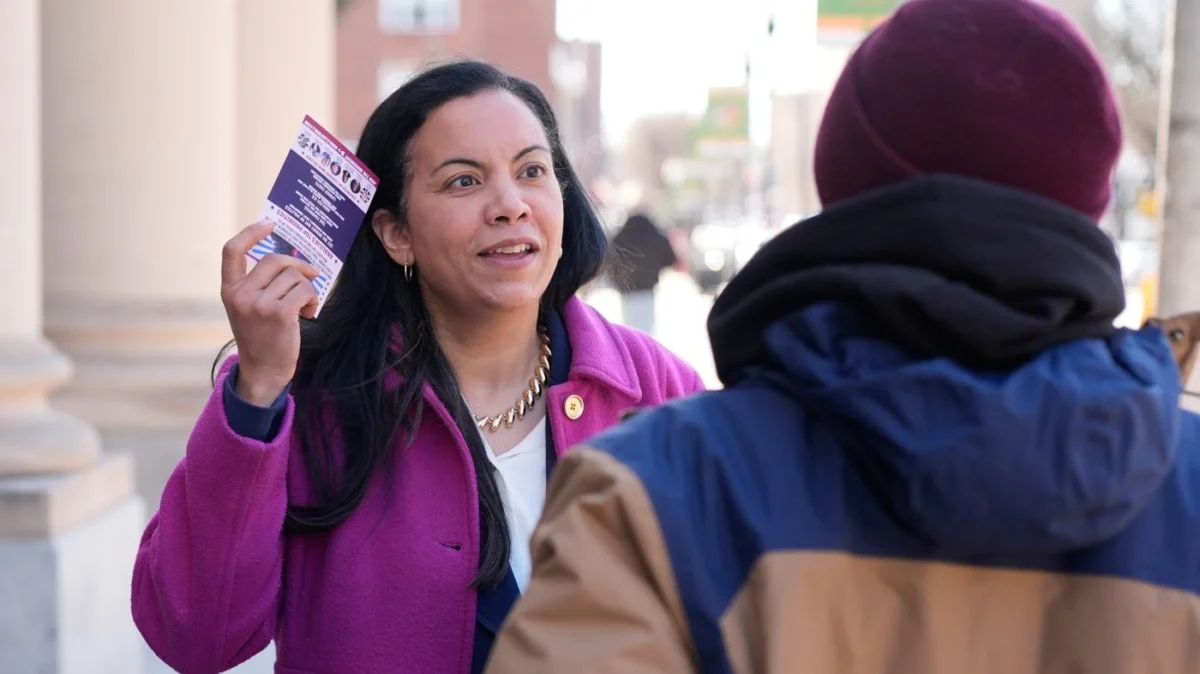
Voters across northern New Jersey are casting their ballots today in a high-stakes special election to determine who will complete the current term for the congressional seat previously held by Congresswoman Mikie Sherrill (D), following her successful bid for the governorship of New Jersey. The outcome of this contest is poised to significantly impact the already razor-thin Republican majority in the U.S. House of Representatives and serve as a critical barometer for Democratic voter engagement as the 2026 midterm election cycle begins to gather momentum.
The race features a diverse field of candidates vying for the vacant seat. Leading the Democratic ticket is Analilia Mejia, a seasoned progressive strategist and former campaign aide to Senator Bernie Sanders (I-Vt.). Her Republican challenger is Joe Hathaway, a current councilman from Randolph, N.J., who has positioned himself as a conservative voice. Rounding out the ballot is independent candidate Alan Bond, whose background includes a career on Wall Street and a past conviction for defrauding clients. The contest has been marked by sharp exchanges and significant national attention, particularly concerning its potential implications for the broader political landscape.
The 11th Congressional District: A Shifting Political Terrain
The 11th Congressional District of New Jersey (NJ-11) encompasses a geographically diverse region, spanning portions of Essex, Passaic, and Morris counties. Historically, this district has been considered a swing district, with a past leaning towards moderate Republicanism. However, recent electoral trends have shown a decisive shift towards the Democratic Party, reflecting broader demographic and political realignments within the state and the nation.
This district, encompassing parts of Essex, Passaic, and Morris counties, has demonstrated a strong Democratic lean in recent cycles. For instance, Vice President Kamala Harris carried the district by nearly 9 percentage points in the 2024 presidential election. Similarly, Governor Mikie Sherrill, in her gubernatorial re-election bid that same year, secured a victory margin of close to 15 points within these boundaries, underscoring the district’s preference for Democratic leadership. These figures paint a clear picture of the district’s current electoral composition, indicating a significant advantage for Democratic candidates in general elections. The special election today is therefore viewed not just as a local contest but as a test of whether this established Democratic preference will hold firm against a determined Republican challenge, especially in an off-cycle, lower-turnout scenario.
Candidates and Their Campaigns: A Clash of Ideologies
The special election has brought into sharp focus the ideological divides within American politics, epitomized by the leading candidates.
Analilia Mejia (Democrat), a prominent figure in progressive circles, entered the race with a strong endorsement from the party’s left wing. Her tenure as a campaign aide to Senator Bernie Sanders provided her with a platform to advocate for policies aimed at economic justice, universal healthcare, and climate action. Mejia’s campaign has consistently emphasized her commitment to progressive values, portraying her as a champion for working families and a vocal advocate for marginalized communities. Her primary victory against former Representative Tom Malinowski, who was initially considered the frontrunner, marked a significant win for the progressive movement, mirroring similar successes in other traditionally moderate Democratic strongholds across the country. Mejia’s platform includes calls for robust social safety nets, increased corporate accountability, and a foreign policy that prioritizes human rights and international law.
Joe Hathaway (Republican), a councilman in Randolph, N.J., presents himself as a pragmatic conservative focused on local issues and fiscal responsibility. Hathaway has launched strong attacks against Mejia, labeling her as "socialist" and "radical" due to her progressive policy views. He has also accused her of holding "extreme antisemitic rhetoric," particularly concerning her stance on the Israeli-Palestinian conflict, an issue he highlights as crucial given the district’s substantial Jewish population. Hathaway’s campaign strategy appears to be rooted in mobilizing conservative voters and appealing to moderate Democrats who may be wary of Mejia’s progressive leanings. He has implicitly aligned himself with former President Donald Trump, with Mejia criticizing him as a potential "yes-man" for the former president. Hathaway’s focus on economic stability, public safety, and a strong national defense aims to resonate with voters seeking a more traditional approach to governance.
Alan Bond (Independent), while less prominent in the race, offers an alternative for voters disillusioned with both major parties. His campaign has largely flown under the radar, but his presence on the ballot underscores the desire among some segments of the electorate for non-partisan representation. Bond’s past legal issues, including a prison sentence for defrauding clients during his career on Wall Street, present a unique challenge to his viability as a mainstream candidate, though he aims to appeal to voters outside the conventional political spectrum.
Early Voting Signals a Democratic Advantage
Preliminary data from absentee and early voting has provided an initial glimpse into the electoral landscape, suggesting a significant lead for the Democratic candidate, Analilia Mejia, heading into election day. As of Monday, figures compiled by the reputable political data firm L2 Data indicated that an overwhelming 65 percent of early or absentee voters were registered Democrats. In contrast, Republicans constituted only 20 percent of this early electorate, with 14 percent identifying as non-partisan.
These trends were further corroborated by anonymous political analyst @umichvoter on the social platform X, a co-founder of Vote Hub, who reported similar findings two days prior to the election. Their analysis showed that nearly 62 percent of voters who had already cast their ballots were Democrats, while 25 percent were Republicans, and 14 percent were unaffiliated. This substantial early Democratic turnout aligns with the district’s recent voting history, which consistently favors Democratic candidates in statewide and national elections.
Despite these encouraging early numbers for Democrats, strategists on both sides are closely monitoring in-person turnout on election day. Republicans traditionally tend to perform better with voters who cast their ballots in person, and a strong showing at the polls could narrow the gap. Nevertheless, the early voting data suggests that Democrats have successfully mobilized their base, providing Mejia with a tangible advantage as the final votes are tallied. The level of Democratic enthusiasm demonstrated in these early returns is a key indicator being watched by political observers nationwide, serving as a potential predictor for voter engagement in the upcoming 2026 midterm elections.
Contentious Debates and Campaign Flashpoints
The campaign for NJ-11 has been anything but cordial, with the sole debate earlier this month between Mejia and Hathaway quickly devolving into sharp accusations and ideological clashes. The April 1 debate, sponsored by the New Jersey Globe and the Rebovich Institute of New Jersey Politics at Rider University, highlighted the deep divisions between the candidates.
Joe Hathaway launched direct attacks against Mejia, accusing her of antisemitism over her critical views on Israel, particularly her assertion that the country has committed genocide in Gaza. Hathaway further characterized Mejia as a "socialist" and "radical," citing her progressive policy stances and what he described as "anti-law enforcement positions." In an interview with The Hill, Hathaway reiterated these concerns, stating, "There are many, many Democrats who are very concerned about Analilia’s positions, whether it’s her socialist economic policies, her anti-law enforcement positions, or probably most starkly highlighted in this race has been her extreme antisemitic rhetoric against the Jewish people and the state of Israel," specifically noting the district’s significant Jewish population as a reason for his emphasis.
Mejia swiftly rebuffed Hathaway’s accusations during the debate, instead redirecting her criticism towards him. She painted Hathaway as a staunch supporter of former President Trump, arguing that he "will vote in lockstep with the very same people who are making your daily life increasingly unaffordable and have thrown us into a reckless war." In a subsequent interview, Mejia reinforced this sentiment, suggesting that Hathaway would merely be a "yes-man" for the former president if elected. Her core message to voters was clear: "The bottom line is that in order to take away another rubber stamp in Congress, or potential rubber stamp in Congress for Donald Trump, we need to show out in full force this upcoming Thursday."
Israel-Gaza Conflict: A Defining Issue
The ongoing conflict in Israel and Gaza has emerged as a central and highly sensitive flashpoint in the special election, particularly intensified by the American Israel Public Affairs Committee’s (AIPAC) super PAC’s early involvement in the Democratic primary during the winter. AIPAC’s significant financial contributions and advocacy efforts typically support candidates who align with its pro-Israel stance, often creating challenges for progressive candidates who express more critical views on Israeli government policies.
Hathaway has consistently leveraged Mejia’s views on Israel as a key line of attack. He specifically highlighted an incident at a party forum earlier this year where Mejia did not raise her hand in affirmation of a question about whether Jewish people have the right to self-determination in their ancestral homeland. This moment became a recurring talking point for Hathaway, who used it to bolster his claims of Mejia’s alleged antisemitism.
Mejia, for her part, has sought to clarify her position, emphasizing the complexities of such issues within the compressed timelines of campaign events. She explained to The Hill, "It’s very hard to unpack the nuance on what are very difficult and complicated questions" during campaign forums. During the April debate, Mejia articulated a distinction between criticizing a country’s leader and condemning the country or its people as a whole, specifically expressing her disapproval of Israeli Prime Minister Benjamin Netanyahu’s leadership.
Responding to Hathaway’s accusations, Mejia stated, "Joe Hathaway can traffic in all of the hatred and fear mongering and tropes that he wishes. But the truth is, do we not want a member of Congress who will uphold international law? Do we not want a member of Congress who is willing to stand up to its own – to our own nation and allies, and say we must uphold the Geneva Convention?" She further vowed that, if elected, she would "use every legislative power at my disposal to protect the rights of Jewish constituents and convene spaces to educate and to fight antisemitism" as a member of Congress, aiming to reassure voters of her commitment to combating hatred while maintaining her critical stance on international policy.
Projections Favor a Progressive Victory
Political strategists from both sides of the aisle widely anticipate an easy victory for Analilia Mejia in today’s special election. This consensus is primarily driven by the district’s strong Democratic leanings, as evidenced by recent electoral outcomes, and a consistent pattern of Democratic overperformances across various ballots in recent months. The district’s inherent "blue tilt" makes it a challenging terrain for any Republican candidate, even in a special election.
Furthermore, the Democratic Party has largely coalesced around Mejia, demonstrating a unified front. Notably, Governor Mikie Sherrill, whose former seat is now being contested, has publicly endorsed Mejia, lending her significant political capital and local support. Even former Representative Tom Malinowski, who was defeated by Mejia in a contentious primary, has thrown his support behind her, signaling party unity despite previous internal competition. This consolidation of support is crucial, as it minimizes internal divisions that could otherwise weaken a candidate’s chances.
Philip Alagia, a veteran Democratic strategist who initially backed Essex County Executive Brendan Gill in the party primary, expressed confidence in Mejia’s prospects. He indicated that he does not expect her progressive leanings to significantly harm her candidacy among more moderate Democrats in the general election. Alagia remarked, "I think this is going to be a generic Democrat versus Republican race," suggesting that in the current political climate, partisan affiliation often outweighs nuanced policy positions in districts with a clear partisan lean. This perspective underscores the idea that even with her strong progressive identity, Mejia is likely to benefit from the district’s overall Democratic majority.
Mejia’s primary victory over Malinowski was already a significant win for the progressive wing of the Democratic Party, building on similar successes seen in other key races in states like New York and Illinois over the past year. A general election victory for Mejia would further solidify the growing influence of progressives within the party and demonstrate their capacity to win in diverse districts.
Implications for the Slim House GOP Majority
A victory for Analilia Mejia today would have immediate and significant repercussions for the composition of the U.S. House of Representatives, directly chipping away at the already precarious Republican majority. If Mejia wins, the Republican Party’s edge would shrink to a razor-thin 219-214, making it even more challenging for the Speaker to govern and pass legislation. This narrow margin amplifies the importance of every single seat, turning special elections like this into critical battles for control.
The margins on Capitol Hill have been particularly volatile in recent weeks, with shifts occurring on both sides. Just this week, Republican Representative Clay Fuller of Georgia was sworn in to fill the remainder of former Representative Marjorie Taylor Greene’s (R-Ga.) seat in Georgia’s 14th Congressional District, slightly bolstering GOP numbers. However, this gain was offset by recent departures, as Democratic Representative Eric Swalwell of California and Republican Representative Tony Gonzales of Texas both resigned on Tuesday following separate allegations of sexual misconduct. These rapid fluctuations underscore the fragility of the current House balance and the constant struggle for numerical advantage.
Beyond the immediate numerical shift, Mejia’s potential victory also holds symbolic weight. It would signal continued Democratic strength in competitive or leaning districts, potentially influencing fundraising and candidate recruitment for the upcoming 2026 midterm elections. For House Republicans, a further reduction in their majority would intensify the internal pressures and challenges of leadership, potentially leading to increased legislative gridlock and difficulties in uniting their caucus on key votes.
Looking ahead, the electoral cycle in New Jersey is far from over. Voters in the state will return to the polls in less than two months, on June 2, to participate in the primary election for the full two-year term for this same House seat. Both Analilia Mejia and Joe Hathaway are expected to run again in that primary, setting the stage for a likely rematch in the general election for the full term. Today’s special election serves as a crucial prelude, offering insights into voter sentiment and campaign strategies that will undoubtedly shape the contests to come. The outcome will be closely watched by political strategists and pundits nationwide, eager to gauge the national mood and the trajectory of American electoral politics.










Leave a Reply