

The rapid integration of artificial intelligence into the modern workplace is triggering an unintended and paradoxical crisis: as machines take over routine tasks, the very human capabilities required to oversee those machines are beginning to atrophy. A comprehensive new report from the IBM Institute for Business Value, titled "Designing the Thinking Organization," reveals a widening disconnect between the expectations of corporate leadership and the lived experiences of the workforce. While executives look to AI to drive efficiency and innovation, employees are reporting a troubling erosion of core cognitive skills, including critical thinking, judgment, and the nuanced oversight required to validate machine-generated output.
The study, conducted in partnership with Oxford Economics between April and June 2026, synthesized data from 1,500 Chief Human Resources Officers (CHROs) and senior executives across 21 geographies and 23 industries, alongside 8,800 full-time employees from 28 countries. The findings suggest that the pace of AI adoption is currently outstripping the organizational capacity to redesign workflows, leaving employees in a state of professional flux that threatens long-term competency.

The Anatomy of a Disconnect
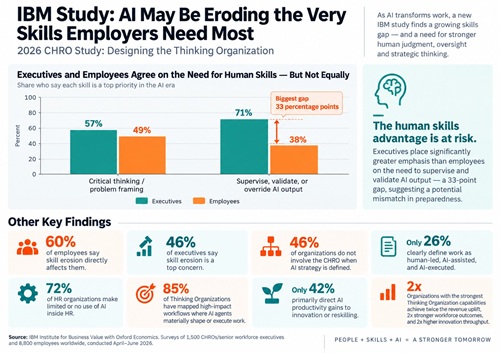
The core of the issue lies in a misalignment regarding what skills are essential in an AI-augmented environment. IBM’s data highlights that while there is broad consensus on the importance of "problem framing" and "critical thinking," the agreement ends abruptly when discussing the practical application of these skills.
Approximately 57% of executives and 49% of employees acknowledge that critical thinking is a top-tier necessity for AI-enabled roles. However, a significant "supervision gap" exists regarding the evaluation of AI outputs. While 71% of executives prioritize the ability to audit, validate, or override AI-generated data, only 38% of the workforce shares this priority. This 33-percentage-point disparity suggests that many employees are either not yet fully aware of the risks associated with unverified AI performance or lack the training necessary to perform such high-level oversight.
Furthermore, the study indicates that judgment—the ability to apply contextual wisdom to AI suggestions—is being undervalued by the workforce. Only 29% of employees identified judgment as a critical skill, a finding that alarms HR leaders who view it as the final line of defense against algorithmic bias and technical error.
Chronology of AI Integration and Skill Atrophy
The current state of the workforce is the culmination of an accelerated timeline of AI adoption that began in earnest following the widespread release of generative AI tools in late 2022.
- 2023: The Adoption Phase. Organizations rushed to implement Large Language Models (LLMs) to handle administrative tasks, drafting, and data summarization. During this period, the primary focus was on cost-saving and speed.
- 2024: The Integration Gap. As AI tools became embedded in daily workflows, the lack of standardized operational protocols became evident. Companies adopted AI as an "add-on" rather than a foundational shift in job design.
- 2025: The First Signs of Erosion. Anecdotal evidence began to surface that employees, relying heavily on AI to draft reports and analyze data, were losing their proficiency in the underlying "manual" versions of these tasks.
- 2026: The Recognition of Systematic Decline. The IBM study confirms that this is now a systemic issue. With 52% of employees reporting that their primary responsibilities have shifted within the last year, the constant adaptation has left little room for deliberate skill building.
The Erosion vs. Gap Problem
A critical distinction drawn by IBM is the difference between a "skills gap" and "skill erosion." Most corporate training programs are designed to address the former: they identify a lack of knowledge and provide a roadmap for reskilling. Indeed, 80% of enterprises now possess a structured reskilling roadmap to help employees collaborate with technology.
However, these programs often fail to account for skill erosion. Unlike a gap—where an employee needs to learn something new—erosion occurs when a previously mastered skill diminishes because the machine now performs the task. When AI takes over the drafting of a document, the employee loses the practice required to maintain high-level writing and editing skills. When AI conducts preliminary data analysis, the employee may lose the ability to spot irregularities that a machine might overlook.
Sixty percent of employees report that they are actively concerned about this erosion, with 75% of those individuals confirming that they have already noticed a decline in their own capabilities. The most frequently cited skill experiencing this decline is critical thinking, which is ironic, given that it is also the most frequently cited skill required for the future.
Organizational Failure in Workflow Design
The IBM report suggests that the blame does not lie solely with the workforce. Only 26% of organizations have clearly defined which tasks are human-led, AI-assisted, or AI-executed. This lack of definition creates a "day-to-day" management style where employees are forced to improvise their interactions with AI.
Without a clear framework, organizations are essentially allowing AI to dictate the nature of work, rather than the other way around. When job descriptions are not redesigned to match the new reality of AI-human collaboration, employees fall back on whatever method feels fastest—which is often accepting the AI’s output without sufficient scrutiny. This leads to a feedback loop where the AI is not corrected, potentially cementing errors or biased outputs into the company’s internal intelligence.

Broader Economic and Institutional Implications
The implications for the labor market are profound. If the workforce loses its ability to think critically about AI outputs, the collective risk to enterprises increases. A company that relies on automated decision-making without a robust layer of human oversight is susceptible to systemic risks, including compliance failures, ethical lapses, and strategic errors.
Furthermore, there is an economic argument to be made regarding productivity. While AI offers immediate productivity gains, those gains may be transitory if they result in a "hollowing out" of the middle-management and professional ranks. If the current generation of employees fails to master the skills needed to lead in an AI environment, the talent pipeline for future leadership will be severely compromised.
Expert Perspectives and Strategic Recommendations
While official statements from individual corporate leaders on this specific report remain limited, industry analysts and HR experts have long warned about the "black box" nature of AI implementation. The consensus among labor economists is that the "AI-human partnership" requires an intentional redesign of the apprenticeship model. Historically, junior employees learned through the repetition of tasks; if those tasks are now performed by AI, companies must find new, accelerated ways to teach foundational thinking.

The IBM report concludes with a subtle warning for leadership: reinvestment of AI productivity gains must be prioritized toward human development. If companies choose to treat the AI-driven labor savings purely as bottom-line profit, they are essentially liquidating their human capital.
To mitigate these risks, the study implies that organizations must shift their focus from "efficiency-first" to "human-centric" design. This includes:
- Defining Workflows: Explicitly categorizing tasks to ensure that human involvement is mandatory in high-stakes decision-making.
- Deliberate Practice: Creating environments where employees are required to perform critical tasks without AI assistance periodically to maintain skill proficiency.
- Supervisory Training: Elevating "AI Oversight" from a niche technical skill to a core competency required of every employee, regardless of department.
Conclusion
As the workforce stands at the crossroads of the AI revolution, the IBM Institute for Business Value study provides a sobering reality check. AI is indeed a powerful engine for progress, but it is not a replacement for human intellect. The risk is not that AI will replace the human worker, but that the human worker will become less capable of providing the essential, high-level oversight that is required to keep an AI-driven organization running safely and effectively.

The path forward requires a fundamental shift in how organizations perceive their role in professional development. It is no longer enough to provide software access and a reskilling handbook. Enterprises must now take responsibility for the cognitive health of their workforce, ensuring that the convenience of automation does not come at the cost of the critical thinking skills that serve as the foundation of modern industry. Without such a shift, the "Thinking Organization" may find itself with plenty of technology, but far less of the human judgment required to guide it.










Leave a Reply