

The rapid integration of artificial intelligence into the modern enterprise is fundamentally altering the human capabilities required for day-to-day operations, introducing a profound operational paradox. While organizations increasingly rely on advanced automation to drive productivity and efficiency, a sweeping global study reveals that the very tools designed to enhance human output may be quietly undermining fundamental cognitive abilities. Chief among these concerns is a growing disconnect between corporate leadership and the workforce regarding who is responsible for validating automated decisions, alongside a palpable anxiety among employees that routine reliance on AI is leading to the gradual atrophy of critical human skills.
This friction sits at the core of new research published by the IBM Institute for Business Value. Titled "Designing the Thinking Organization," the comprehensive report sheds light on the shifting landscape of human-machine collaboration. As algorithms take over administrative tasks, data synthesis, and routine content generation, organizations are navigating an unprecedented structural transition. The findings indicate that while companies are eager to capture the economic dividends of artificial intelligence, they are struggling to adapt their internal workflows, training paradigms, and organizational designs fast enough to keep pace with technological advancement.
Methodology and Research Scope
To capture a holistic view of how artificial intelligence is transforming the global workforce, the IBM Institute for Business Value partnered with Oxford Economics to conduct an extensive empirical investigation. The research initiative, executed between April and June 2026, utilized a dual-survey methodology designed to map the perspectives of corporate decision-makers against those of everyday full-time employees.

The study engaged 1,500 Chief Human Resources Officers (CHROs) and senior executives who bear direct responsibility for workforce strategy, organizational design, and talent development. These leaders represented a broad cross-section of the global economy, spanning 21 distinct geographic regions and 23 industries. To counterbalance executive perspectives, the researchers also surveyed 8,800 full-time employees distributed across 28 countries, capturing frontline insights into how AI is actually altering daily responsibilities, job satisfaction, and professional development.
The resulting data paints a complex picture of a global labor market caught in a state of rapid transformation, where the speed of technological adoption frequently outstrips the deliberate planning required to integrate human workers safely and effectively alongside automated systems.
The Structural Disconnect: Workflow Redesign Lags Behind AI Adoption
One of the most striking revelations of the IBM study is the velocity at which daily responsibilities are shifting without corresponding organizational redesign. More than half of the surveyed employees—precisely 52%—reported that their assigned tasks had changed significantly over the preceding year as artificial intelligence permeated their daily routines.
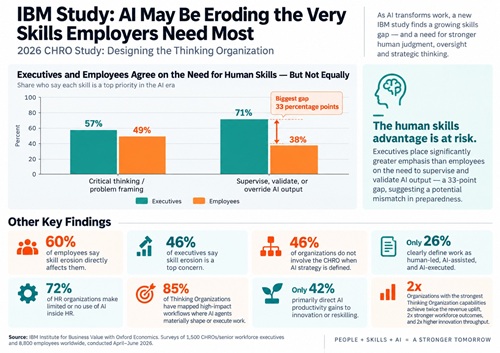
However, this organic evolution of daily work is rarely guided by formal corporate strategy. The study discovered that only 26% of organizations have clearly and formally defined their workflows across human-led, AI-assisted, and AI-executed activities. This leaves the vast majority of companies in a reactive posture. Rather than making deliberate, strategic decisions about how human talent and machine intelligence should complement one another, organizations are relying on ad-hoc, day-to-day adaptation by frontline workers.
Industry analysts note that this lack of structural clarity creates operational vulnerabilities. When tasks morph organically without formal boundaries, accountability can become blurred. Employees may find themselves serving as unwitting editors of automated output without clear guidelines on validation protocols, liability, or quality assurance standards, creating fertile ground for errors, hallucinations, and systemic oversights.
The Critical Thinking Divide: Oversight Versus Execution
As artificial intelligence shoulders the burden of data processing and content generation, the consensus surrounding which human skills remain vital has shifted. Both executives and employees largely agree on the theoretical importance of foundational cognitive capabilities. Fifty-seven percent of executives and 49% of employees place critical thinking and problem framing near the top of the hierarchy of skills required for the modern, AI-enabled workplace.
Yet, a profound perceptual chasm opens when examining the practical application of those skills—specifically, the responsibility of supervising, validating, and overriding machine-generated output.
According to the study, 71% of surveyed executives prioritize the human capability to supervise, validate, or override AI outputs. They view this oversight as an indispensable safeguard against algorithmic bias, factual inaccuracies, and strategic misalignment. In stark contrast, only 38% of employees prioritize this specific oversight function. Furthermore, when isolating the broader concept of professional judgment, only 29% of employees rank it among their top priorities in an AI-driven environment.

This 33-percentage-point gap regarding AI oversight highlights a dangerous misalignment in corporate expectations. While leadership views human workers as the critical last line of defense against algorithmic error, frontline employees frequently view AI as an autonomous or semi-autonomous oracle whose outputs require minimal interrogation. Experts warn that this complacency could lead to dangerous rubber-stamping of automated work, where workers accept machine-generated conclusions without applying the rigorous skepticism necessary to catch critical flaws.
The Looming Threat of Skill Erosion
While conventional workforce discussions have long focused on the "skills gap"—the deficit of new capabilities workers must acquire to keep pace with technology—the IBM study highlights a parallel and potentially more insidious phenomenon: skill erosion.
The data indicates that skill erosion is viewed as a top-tier strategic concern by 46% of corporate executives. For the workforce itself, the anxiety is even more acute. Sixty percent of employees report that skill erosion directly affects them in their current roles. Among the subset of workers who express concern over diminishing capabilities, an overwhelming three out of four respondents state that artificial intelligence has already begun to erode at least some of their core professional skills.
When asked which specific abilities are most vulnerable to degradation, respondents pointed most frequently to critical thinking. As algorithms begin to frame problems, synthesize data, and draft initial strategies, human workers are increasingly relegated to the role of passive reviewers. Over time, this passive posture can cause cognitive muscles to atrophy, reducing the workforce’s ability to solve complex problems independently when systems fail or when creative leaps are required.

Crucially, the study draws a sharp distinction between a traditional skills gap and skill erosion. Corporate readiness for the former is relatively high; the study found that 80% of enterprises have established reskilling roadmaps designed to train workers on how to collaborate with new technologies. However, IBM argues that these traditional training programs are fundamentally misaligned with the nature of skill erosion. While reskilling roadmaps successfully address new capabilities employees must acquire, they do not inherently solve the problem of existing, foundational skills quietly vanishing as machines assume more of the underlying workload.
Economic Reinvestment and the Human Element
Beyond cognitive concerns, the IBM research touches upon the broader economic mechanisms of enterprise AI adoption, including productivity gains and their subsequent reinvestment. As organizations successfully automate routine tasks, they unlock substantial efficiency dividends. However, how these windfalls are utilized remains a critical factor in long-term workforce stability.
The study’s findings suggest that while executive leadership is intensely focused on leveraging AI for margin expansion and operational velocity, the human cost—measured in cognitive fatigue, shifting job definitions, and the fear of obsolescence—requires a more sophisticated management approach. Forward-thinking organizations are beginning to realize that capturing the full value of artificial intelligence cannot be achieved merely by software deployment; it requires a deliberate investment in cognitive infrastructure, continuous learning frameworks, and cultural guardrails that encourage active human engagement rather than passive compliance.
Broader Implications and Future Outlook
The implications of the IBM Institute for Business Value study extend far beyond human resources departments, offering a sobering reality check for an enterprise technology sector often intoxicated by the promise of frictionless automation.

As artificial intelligence continues its rapid integration into the fabric of global commerce, the central challenge for leadership is no longer merely technological implementation, but cognitive governance. Bridging the divide between executive expectations and employee realities will require more than just updated software licenses or generic training modules. Organizations must actively redesign workflows to ensure that human workers remain deeply and actively engaged in the analytical process.
Failure to address the twin threats of workflow ambiguity and skill erosion risks creating a fragile corporate ecosystem—one where businesses are technologically advanced on paper, yet increasingly hollowed out in terms of independent human expertise, critical oversight, and institutional judgment. Moving forward, the most successful enterprises will likely be those that treat human cognitive capability not as a fixed resource to be replaced by algorithms, but as a vital asset that must be intentionally exercised, protected, and refined in the age of intelligent machines.










Leave a Reply