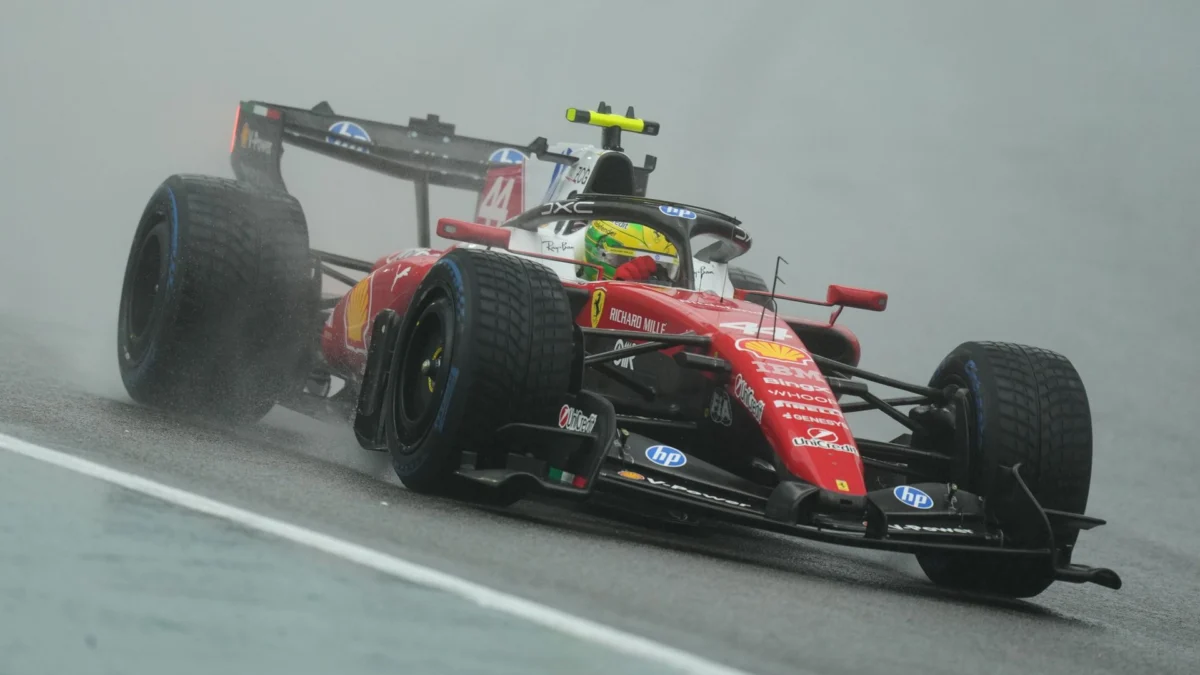
The narrative of Sunday’s race, however, is dominated by the atypical placement of Formula 1’s most decorated drivers. Max Verstappen and Lewis Hamilton—drivers synonymous with the fight for the front—will start from the back of the grid, a consequence of power unit changes that have triggered mandatory penalties. Ferrari’s Charles Leclerc, meanwhile, will start from 14th after incurring a 10-place grid penalty. George Russell, arguably the fastest driver in wet conditions this weekend, finds himself in seventh, nursing the frustration of a team-driven tactical error during qualifying that robbed him of a potential pole position, compounded further by a five-place penalty for an internal combustion engine change.
The Anatomy of a Shuffled Grid
The starting order for the Sao Paulo Grand Prix represents one of the most unpredictable lineups in recent memory. The top ten is a blend of established pace and opportunistic newcomers: Lando Norris (McLaren) leads the field, followed by Kimi Antonelli (Mercedes), Liam Lawson (Racing Bulls), Nico Hulkenberg (Audi), Isack Hadjar (Red Bull), Oliver Bearman (Haas), George Russell (Mercedes), Fernando Alonso (Aston Martin), Alex Albon (Williams), and Oscar Piastri (McLaren).
This inversion of the usual order has prompted Mercedes team principal Toto Wolff to characterize the race as a "reverse grid" scenario. From a tactical standpoint, the race is a high-stakes balancing act for Mercedes. With Antonelli in second and Russell in seventh, the Silver Arrows are within striking distance of securing the Constructors’ Championship. If they outscore Ferrari by a margin of at least three points, their ninth title since 2014 will be mathematically sealed.
Interlagos: A History of Rain and Redemption
Interlagos has long been considered the ultimate crucible for driver skill, particularly when the skies open. The circuit, characterized by its undulations, tight infield, and long, high-speed start-finish straight, is notorious for its microclimates. Rain often hits one sector while leaving the rest of the track bone-dry, creating a strategic nightmare for pit walls.
The legend of the "Interlagos Charge" is well-documented. Max Verstappen’s masterclass in 2024, where he navigated from 17th on the grid to victory in wet conditions, remains the benchmark for modern recovery drives. Similarly, Lewis Hamilton’s 2021 performance—charging from 20th to fifth in the Sprint, and eventually winning the Grand Prix—is etched into the sport’s folklore. However, both drivers face a steeper mountain to climb this year. The current generation of F1 cars, combined with the nuances of the "Overtake Mode" system introduced this season, makes slicing through the field more complex than in previous years.
The Mechanics of Overtaking in 2025
The introduction of "Overtake Mode" as a replacement for the long-standing Drag Reduction System (DRS) has fundamentally altered the geometry of wheel-to-wheel combat. Unlike DRS, which was purely aerodynamic, Overtake Mode is a sophisticated energy-management tool. When a driver is within one second of the car ahead, they are permitted to access higher electric motor deployment and an increased speed tolerance, raising the threshold from 180mph to 209mph.
However, as Verstappen noted during his media briefing, the specific topography of Interlagos limits the effectiveness of this system. "Everyone is draining their battery from the last corner to Turn 1," Verstappen explained. "With everyone having their energy systems fully engaged, the delta between the cars is minimized, making it significantly harder to find the clear speed advantage needed to complete an overtake."
Driver Perspectives and Strategic Outlook
The atmosphere in the paddock is one of calculated tension. Lando Norris, despite his pole position, remains wary of his race pace compared to the Mercedes duo. "I expect a battle no matter what," Norris stated. "If it’s dry, I suspect a tougher challenge because we don’t quite have the raw speed of the Mercedes. I am hoping for a dark, gloomy day, as the rain tends to equalize the machinery and puts more reliance on driver input and risk management."
Kimi Antonelli, displaying the composure that earned him his world title, remains unphased by the weather forecasts. Having excelled in both dry and wet sessions throughout the weekend, the young champion is prepared for any eventuality. His focus remains on a clean start, hoping to avoid the early-race scuffles that often define the first lap at the Senna S corner.
For Lewis Hamilton, the race serves as a final opportunity to experiment with car setups before the season reaches its final stages. "I’m using the race to ensure the engine is performing at its peak," Hamilton noted. "I enjoy the uncertainty of rain, and I feel confident that even from the back, we can make progress."
Charles Leclerc is similarly optimistic about his prospects despite the 14th-place start. The Monegasque driver has been vocal about his desire to rectify his wet-weather form, a persistent challenge during his tenure at Ferrari. "I have learned a lot from the set-up experiments in qualifying," Leclerc said. "If we find the right window for the car, we can certainly fight for more than just the back half of the top ten."
Implications for the Championship and Constructors’ Standings
While the Drivers’ Championship has been decided, the Constructors’ battle remains the focal point for team engineers and management. Ferrari’s struggles this weekend, compounded by the grid penalties for both drivers, have provided Mercedes with a golden opportunity to wrap up the title. The performance of Liam Lawson and Nico Hulkenberg in the top five also signals a shifting hierarchy in the mid-field, as teams look to secure better prize money positions in the final standings.
The data suggests that tire degradation will be the defining variable. Interlagos is notoriously abrasive, and with temperatures expected to fluctuate, the decision of when to switch between intermediate and slick tires will likely decide the podium. A one-stop strategy is the traditional goal, but the threat of rain makes a multi-stop race a high probability.
Chronology of the Weekend
The weekend began with a flurry of technical activity. Friday’s practice sessions allowed teams to evaluate the new aerodynamic packages brought by McLaren, which include a revised front wing and floor geometry. These updates appear to have provided an immediate gain in downforce. However, the wet qualifying session on Saturday effectively reset the field, with the red flag incidents caused by torrential downpours preventing many drivers from setting representative times on optimal track surfaces.
Conclusion: A Race of Strategy and Skill
As the lights go out at 5pm local time, the Sao Paulo Grand Prix will be defined by three critical factors: the start, the management of the Overtake Mode energy, and the timing of pit stops relative to the incoming weather. While the grid may look distorted, the cream of the field—Verstappen, Hamilton, and the McLaren-Mercedes contingent—are expected to converge in the middle stages of the race.
For the spectators at Interlagos and the global audience, the promise of a "reverse grid" spectacle is one of the most anticipated moments of the season. Whether it is a masterclass in wet-weather driving or a tactical chess match in the dry, the Sao Paulo Grand Prix is poised to deliver a high-intensity conclusion to the current triple-header. With build-up coverage starting at 3.30pm on Sky Sports F1, the focus is firmly on who can best manage the chaos of Interlagos to emerge at the front when the checkered flag falls.