For the past several years, secondary and higher education institutions worldwide have been grappling with a deceptively simple yet profoundly divisive question: Should students be permitted to use artificial intelligence for this academic assignment? It is an understandable inquiry for educators attempting to maintain academic integrity and authentic learning. However, as generative artificial intelligence seamlessly embeds itself into the everyday digital tools students utilize for searching, writing, creating, translating, organizing, and receiving constructive feedback, that binary boundary has eroded. Today, distinguishing definitively between "using AI" and "not using AI" has become increasingly difficult, and treating AI adoption as a simple yes-or-no proposition fails to equip students with the nuanced understanding of how technology can appropriately support the learning process.
Recognizing the limitations of a purely restrictive approach, Zion-Benton Township High School District 126 embarked on a multi-year journey to move beyond the simplistic dichotomy of "allowed" versus "prohibited." By shifting the institutional focus toward AI literacy and structured instructional integration, the district has pioneered a shared, transparent vocabulary designed to answer a far more critical educational question: How much artificial intelligence involvement is appropriate for the specific learning objectives students are expected to achieve?

The Evolution of AI Implementation: A Three-Year Timeline
The pedagogical shift at Zion-Benton Township High School District 126 did not happen overnight; it emerged gradually through a deliberate, phased implementation strategy that mirrors the rapid evolution of generative AI tools in the broader consumer and enterprise markets.
The district’s engagement with artificial intelligence began in 2023, coinciding with the global explosion of consumer-facing generative models. During this initial exploratory phase, district leadership, technology specialists, and pioneering educators focused primarily on understanding the underlying capabilities and immediate risks of the technology. Conversations centered around data privacy, equitable access, and the prevention of automated academic dishonesty.
By 2025, the district transitioned from broad exploration to structured pilots. Educators across various departments began testing specific generative AI applications within controlled classroom environments. These pilots were designed to evaluate how AI tools could assist with lesson planning, differentiate instruction for diverse learners, and provide targeted feedback on student drafts. It was during this phase that administrators and teachers alike recognized a significant disconnect: while the technology was evolving rapidly, classroom policies remained trapped in a rigid binary framework. Instructors were struggling to enforce blanket bans in an era where AI features were natively integrated into standard word processors and search engines, yet they lacked the guidance needed to harness the technology safely and productively.
Entering 2026, the district broadened its strategic focus toward comprehensive AI literacy and deep instructional integration. Rather than treating artificial intelligence as an extraneous software tool or a prohibited shortcut, District 126 sought to embed AI literacy across all academic disciplines. This maturation of thought led directly to the realization that teachers needed a standardized framework—something far more sophisticated and practical than a simple "AI allowed" or "AI prohibited" designation on a course syllabus.
The Problem With Binary Policies
To understand the necessity of a nuanced framework, one must examine the vastly different ways artificial intelligence can intersect with student learning. Consider three distinct academic scenarios commonly found in modern high school classrooms.
In the first scenario, an English literature teacher wants to evaluate whether a student can independently construct a persuasive argument from scratch and support it with primary and secondary textual evidence. In this instance, allowing an automated language model to draft the thesis statement and body paragraphs circumvents the core cognitive objective of the assignment.

In the second scenario, students have already brainstormed, researched, and independently developed their own unique arguments. However, to deepen their critical thinking, the instructor invites them to interact with a generative AI tool to produce plausible counterarguments. The students are then tasked with analyzing those automated counter-arguments, identifying logical fallacies, and strengthening their own written defenses. Here, AI acts as a sophisticated intellectual sparring partner rather than a ghostwriter.
In the third scenario, students are enrolled in a specialized course explicitly designed to study generative AI. They are asked to utilize AI extensively throughout a project, critically evaluate its outputs, iteratively revise flawed responses, meticulously document their interactive prompt engineering process, and ultimately defend the methodological decisions they made along the way.
In each of these three educational experiences, artificial intelligence plays a fundamentally different role. Labeling all three scenarios simply under the broad umbrella of "AI allowed" obscures those critical distinctions and leaves students guessing about acceptable boundaries. Conversely, enforcing a blanket prohibition against AI across all three scenarios would eliminate invaluable opportunities for students to develop the practical AI literacy required in higher education and the modern workforce.

The Zion-Benton AI Use Scale
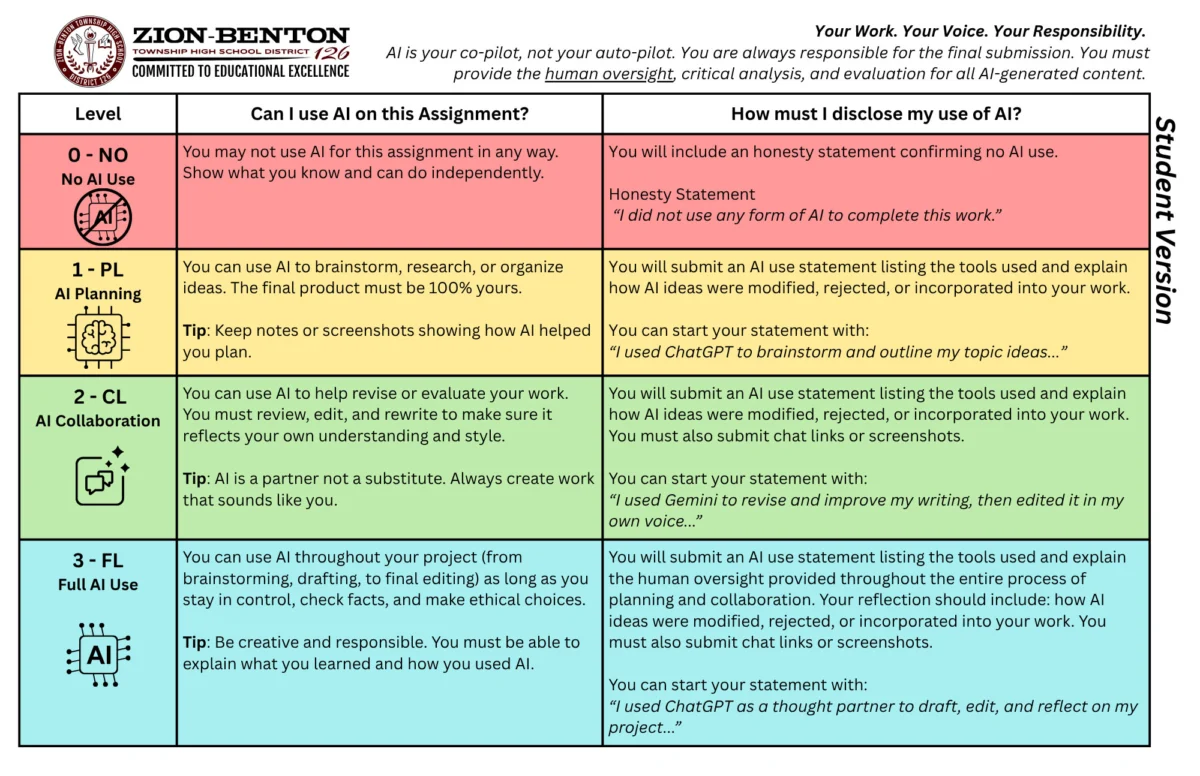
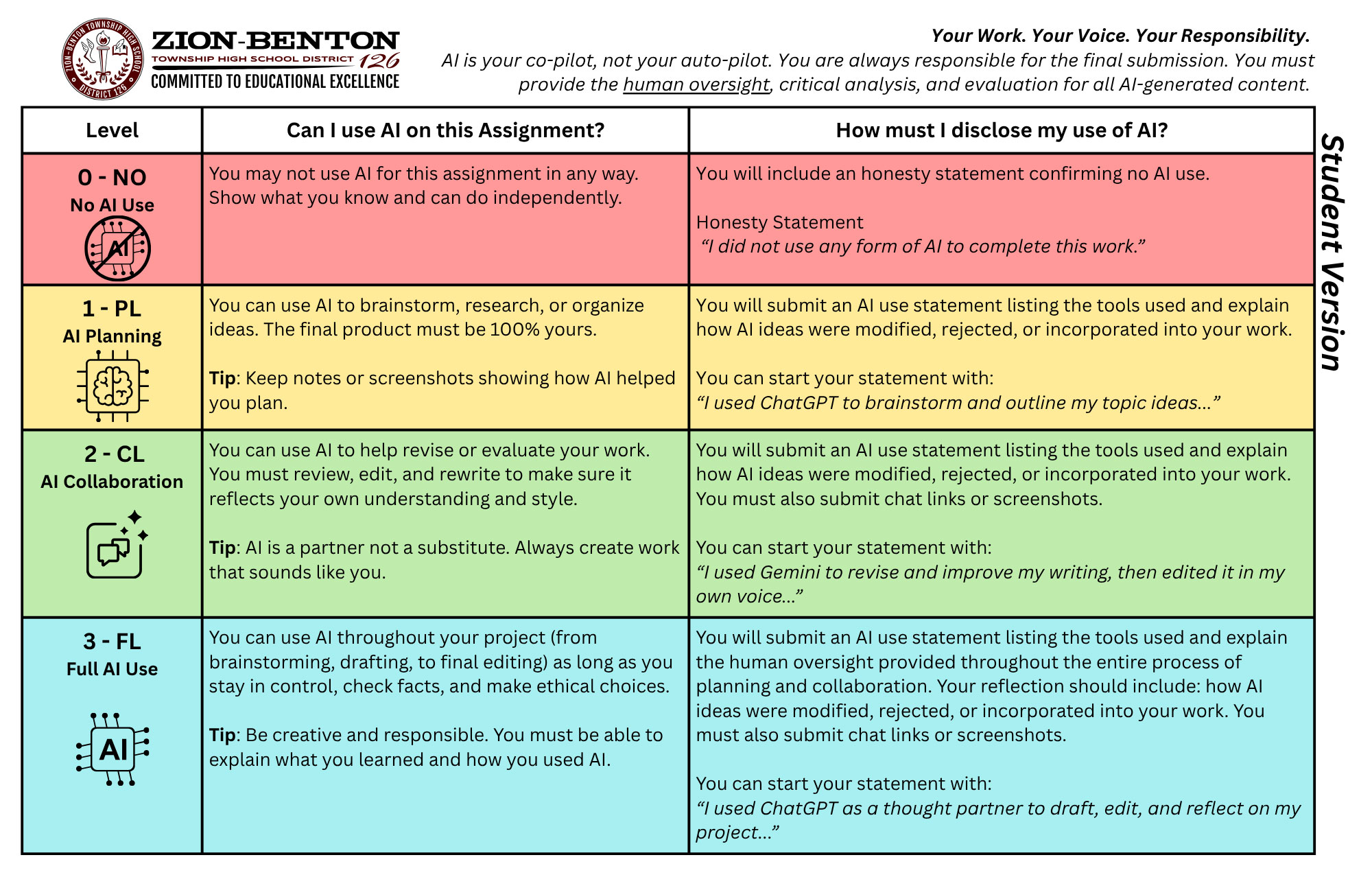
This operational tension prompted the district’s dedicated AI Advisory Committee to develop a comprehensive, districtwide solution: the AI Use Scale.
The scale establishes four distinct, clearly defined tiers of technological integration:
- Level 0: No AI. Artificial intelligence tools are strictly prohibited, as the primary objective is to measure a student’s unassisted cognitive capabilities and foundational skill mastery.
- Level 1: AI Planning. Students may use AI exclusively during the preliminary phases of an assignment—such as brainstorming, outlining, or organizing research—while the execution and final product remain entirely human-generated.
- Level 2: AI Collaboration. Students actively partner with AI throughout the assignment process, using tools for feedback, counterargument generation, translation, or grammar refinement, provided they transparently cite and reflect upon their usage.
- Level 3: Full AI Use. The assignment explicitly requires extensive interaction with generative models, focusing on prompt literacy, critical evaluation of automated outputs, iterative revision, and defense of the final product.
Designed to be prominently displayed in classrooms and systematically referenced by educators across every department, the scale ensures that students encounter consistent, predictable expectations regardless of whether they are sitting in a mathematics, history, science, or language arts classroom. The overarching goal of the initiative is not to make artificial intelligence easier to police or punish, but rather to make academic expectations transparent, teachable, and aligned with real-world competencies.

Broader Implications and Future Outlook
The proactive approach adopted by Zion-Benton Township High School District 126 reflects a broader, urgent paradigm shift occurring across the global educational landscape. As enterprises in every major industry integrate automated intelligence into their daily workflows, educational institutions face mounting pressure to transition from reactive containment strategies to proactive preparation.
Experts note that by shifting the conversation from a punitive compliance model to a literacy-based framework, schools can better prepare students to navigate the ethical, technical, and professional complexities of an AI-driven economy. When students understand how and why technology is integrated into specific learning tasks, they develop metacognitive awareness regarding their own cognitive processes versus automated assistance.
As more districts evaluate their instructional policies in the wake of rapid technological advancement, frameworks like the AI Use Scale offer a practical roadmap. By establishing a shared language that respects both the necessity of foundational skill acquisition and the inevitability of technological evolution, educators can successfully bridge the gap between traditional academic integrity and future-ready instruction.