
The State of Texas is projected to forgo approximately $3.2 billion in sales tax revenue over the next two fiscal years due to a decade-old tax incentive program designed to attract the data center industry. According to the latest figures from the Texas Comptroller’s office, the cost of these exemptions has escalated far beyond original forecasts, transforming what was once a modest incentive into one of the state’s most expensive corporate subsidies. This fiscal shift has sparked a significant debate among state lawmakers, who are now weighing the economic benefits of being a global technology hub against the growing strain on the state’s budget and electrical infrastructure.
The $3.2 billion figure, while substantial, is considered by many fiscal analysts to be a conservative estimate. As the artificial intelligence (AI) boom continues to drive an unprecedented demand for massive computing power, the number of facilities under construction in Texas has surged. What began as a program to lure cloud storage providers has evolved into a multi-billion-dollar giveaway to some of the world’s wealthiest technology companies. With the next legislative session set to convene in January, high-ranking officials have indicated that the current trajectory of the tax break is unsustainable and may face a total repeal or a significant reduction in scope.
The Rapid Escalation of Forgone Revenue
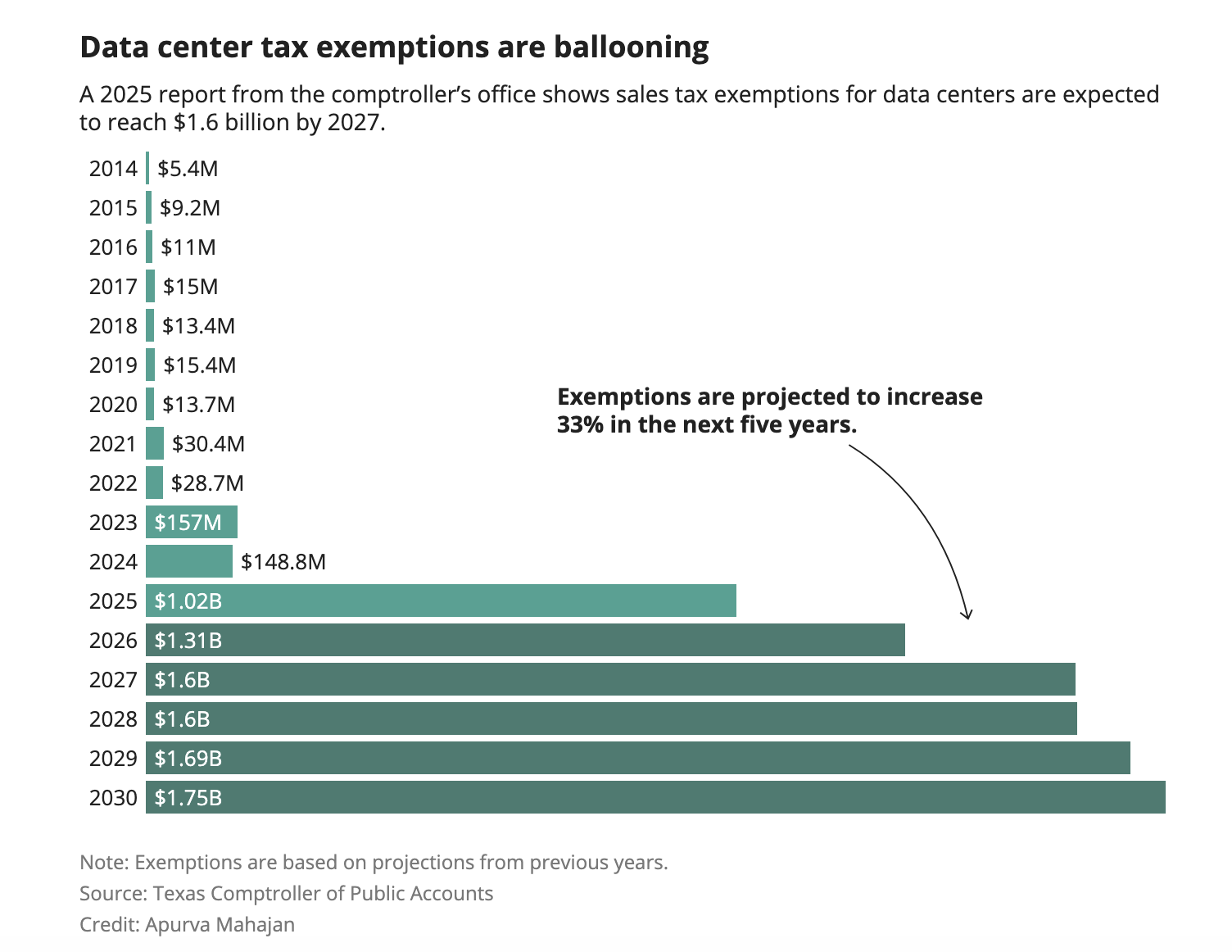
The fiscal impact of the data center sales tax exemption remained relatively stable for nearly a decade after its inception. Between 2014 and 2022, the annual cost to the state treasury fluctuated between $5 million and $30 million. However, the landscape shifted dramatically in 2023, when the cost jumped to $150 million. For the current fiscal year, Texas is on track to lose at least $1.3 billion.
This exponential growth caught state forecasters off guard. Just three years ago, the Comptroller’s office estimated the tax break would cost roughly $180 million for the 2027-2028 biennial budget. Those projections have since been revised upward by more than 1,500 percent, now exceeding $3 billion. By 2030, the annual value of the tax break is expected to reach nearly $1.8 billion. To put these figures into perspective, the annual lost revenue could fully fund the state’s controversial new school voucher program or double the capacity of the state’s disaster relief fund, which assists local communities in the wake of floods and hurricanes.
The rapid rise is also outpacing the cost of the now-defunct Chapter 313 program. That incentive, which allowed manufacturing companies to avoid local school property taxes, was shuttered by lawmakers last year after its annual cost surpassed $1 billion and drew criticism for its lack of transparency and questionable job-creation returns.
A Chronology of the Data Center Incentive
The origins of this tax break date back to 2013, when then-State Representative Harvey Hilderbran authored legislation intended to make Texas competitive with other states seeking to house the burgeoning cloud computing industry. At the time, data centers were significantly smaller and less energy-intensive than today’s facilities. Hilderbran recently noted that while the bill succeeded in attracting investment, the sheer scale of the current industry was unimaginable a decade ago.
To qualify for the exemption today, a facility must meet specific criteria outlined in the state tax code. For data centers larger than 100,000 square feet, owners must agree to create at least 20 full-time jobs that pay at least 120 percent of the area’s median salary. Additionally, they must commit to a $200 million investment over a five-year period.
In 2015, the legislature added a second tier for "mega" data centers. These facilities, exceeding 250,000 square feet, are required to create 40 jobs and invest $500 million. They must also pay the state’s energy grid operator to reserve 20 megawatts of transmission capacity. In exchange, these companies are exempt from the state’s 6.25 percent sales tax on nearly all equipment necessary for the facility’s operation, including servers, storage hardware, software, cooling systems, emergency generators, and even the electricity consumed by the machines.
The AI Boom and the Race for Infrastructure
The primary driver behind the current explosion in data center construction is the global race for artificial intelligence dominance. AI models require exponentially more processing power and data storage than traditional cloud applications. This has led to a building frenzy in Texas, which currently leads the nation in data center development.
According to data from the research firm Aterio, Texas has at least 142 data centers under construction, narrowly beating out Virginia, the long-standing leader in the sector. Texas currently hosts more than 300 operational data centers, with over 100 more in various stages of planning. The state’s appeal lies not only in the tax breaks but also in its relatively cheap land and its independent energy grid, which—until recently—offered an abundance of low-cost power.
However, the scale of these facilities is beginning to test the limits of the Texas power grid. By 2030, some individual data centers are expected to require more than 1 gigawatt of energy—enough to power roughly 700,000 homes. The fact that the electricity used by these facilities is also exempt from state sales tax has become a particular point of contention for critics who argue that the industry is being subsidized to strain a grid that has struggled with reliability during extreme weather events.

Legislative and Public Pushback
The sheer magnitude of the projected revenue loss has unified several key Republican and Democratic leaders in a call for reform. State Senator Joan Huffman, who chairs the Senate Committee on Finance, has been vocal about her concerns, labeling the figures "unsustainable." Huffman has indicated that she plans to file legislation that could either repeal the exemption entirely or drastically narrow its application.
Lieutenant Governor Dan Patrick has also directed the Senate to study the issue during the interim, with a focus on ensuring that Texans receive a tangible benefit from these investments. On the other side of the aisle, State Representative Trey Martinez Fischer, vice chair of the House Ways and Means Committee, emphasized that the state’s relationship with large corporations must be a "two-way street," suggesting that the current "give" from the state far outweighs the "take."
Public sentiment is also shifting. While data centers were once seen as quiet, high-tech neighbors, residents in cities like San Marcos, Amarillo, and College Station have organized to block new projects. Concerns range from the noise generated by massive cooling fans to the immense water consumption required to keep servers from overheating. A recent Quinnipiac poll reflected this growing unease, finding that 65 percent of Americans oppose the construction of data centers in their local communities.
Industry Defense and the National Landscape
The tech industry, represented by groups like the Data Center Coalition, argues that the tax breaks are essential for maintaining Texas’s competitive edge. Dan Diorio, vice president of state policy for the coalition, warned that withdrawing the incentives would send a "hostile message" to global investors. He argues that data centers are the "lifeblood" of the modern economy, facilitating everything from financial transactions to telehealth.
Industry proponents also point to a study commissioned by the association which claims that data centers generated $3.2 billion in other state and local taxes in 2024, including property taxes and franchise taxes. They argue that without the sales tax exemption, these companies would simply move their investments to other states.
Texas is not alone in this struggle. Currently, 37 states offer some form of tax exemption for data centers, creating a "race to the bottom" as states compete to offer the most lucrative packages. However, the tide may be turning. In Virginia, lawmakers are considering phasing out their $1.6 billion annual tax break to balance the state budget. In Illinois, Governor JB Pritzker recently announced a two-year suspension of similar incentives due to concerns over rising energy costs for residential consumers.
Analysis of Economic Implications
The debate in Texas centers on a fundamental question of economic development: would these companies build in Texas without the tax breaks? Critics, including University of Texas professor Nathan Jensen, argue that land and energy costs are far more significant factors in a company’s decision-making process than tax rates. Jensen suggests that if the state were to tax these facilities at their full value, the revenue gained would likely far outweigh the potential loss of a few projects.
Furthermore, the job-creation requirements of the current law are relatively low compared to the size of the tax break. A facility receiving hundreds of millions of dollars in exemptions is only required to create 20 to 40 jobs. This low "return on investment" per job has led some analysts to conclude that the program is an inefficient use of state resources.

As the Senate Committee on Finance prepares for hearings in July, the future of the Texas data center industry hangs in the balance. Lawmakers will have to decide if the prestige of being a global AI leader is worth a $3.2 billion hole in the state budget, or if the time has come for the "21st-century economy" to start paying its own way. The outcome of this legislative battle will likely serve as a blueprint for other states grappling with the fiscal and physical demands of the digital age.