
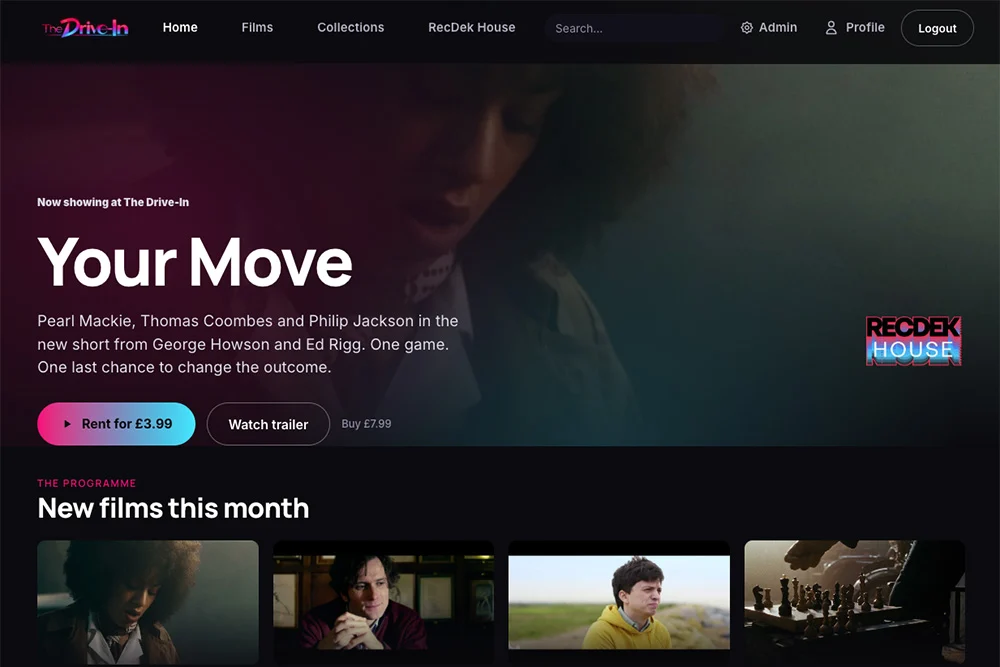
In a significant pivot for the independent cinema landscape, the film discovery platform RecDek has announced the launch of "The Drive-In," a new transactional video-on-demand (TVOD) service designed to bypass traditional distribution bottlenecks. Set to debut on October 17, coinciding with the high-profile London Film Festival, the platform aims to provide a direct-to-audience pipeline for creators who have long struggled with the opaque and often exclusionary practices of major studios and traditional aggregators. By integrating with RecDek’s existing community hub—which boasts a network of 17,000 directors, producers, and financiers—The Drive-In positions itself not merely as a streaming site, but as an infrastructure for professional autonomy.
A Paradigm Shift in Content Ownership
The core value proposition of The Drive-In lies in its radical departure from standard licensing models. Historically, independent filmmakers have been forced to surrender significant portions of their intellectual property (IP), relinquish creative control, and navigate complex revenue-sharing agreements that often leave the original creators with a fraction of the earnings.
Under the new model facilitated by the infrastructure partner Hiway, the power dynamic is flipped. When a filmmaker uploads their work to The Drive-In, they retain full ownership of their IP. The platform functions as a conduit rather than a gatekeeper; films stream directly from the creator’s library, ensuring that the content is never "locked away" or re-uploaded into a proprietary digital prison. Producers are empowered to set their own pricing, access real-time audience analytics, and receive direct payment from the first sale. Perhaps most importantly, the platform offers unprecedented flexibility: if a filmmaker secures a distribution deal for a specific territory via a traditional distributor, they can instantly remove that territory from The Drive-In’s reach, allowing for a hybrid approach that reconciles indie freedom with commercial ambition.
The Evolution of RecDek: From Discovery to Distribution
To understand the emergence of The Drive-In, one must trace the development of RecDek. Initially conceived as a recommendation engine—a digital space where film and television preferences were curated by a network of friends, critics, and festival programmers—the app evolved rapidly. The creators realized that discovery was only half the battle; the missing link was a sustainable pathway for the films being discovered to actually reach a paying audience.
The creation of the "RecDek House" served as the catalyst for this transition. By aggregating a diverse cohort of industry stakeholders—from financiers to talent—the platform transitioned from a consumer-facing app into a professional ecosystem. This evolution mirrors a broader industry trend where creators are increasingly seeking to disintermediate the process. As the festival circuit continues to act as a primary launching ground for prestige independent cinema, the decision to launch The Drive-In during the London Film Festival is a calculated strategic move. It places the platform at the nexus of the industry’s focus, capturing the attention of stakeholders while they are actively evaluating new content.
Supporting Data and Industry Context
The independent film sector has faced a turbulent decade. According to industry reports from organizations such as the Independent Filmmaker Project (IFP), the cost of producing independent films has remained steady while the cost of traditional marketing and distribution has skyrocketed. For many, the "middle class" of independent cinema—films with budgets between $500,000 and $5 million—has been largely hollowed out by the dominance of streaming giants, which prioritize high-volume content over the niche, auteur-driven narratives that define independent art.
Data suggests that while audience appetite for independent film remains high, the accessibility of such content is at an all-time low. Many films that receive critical acclaim at festivals struggle to find a home on major streamers, which often require exclusive, long-term rights that are unfavorable to the filmmaker. By providing a streamlined, low-friction entry point, The Drive-In addresses the "long tail" of cinema—works that have artistic merit but lack the marketing budget to compete with tentpole studio releases. By leveraging Hiway’s direct-to-fan infrastructure, the service mitigates the technical hurdles that often prevent smaller production houses from launching their own digital storefronts.
Official Perspectives on the New Venture
Ed Rigg, the founder of RecDek and a working writer/director, frames the launch as a reclamation of agency. "We champion the voices studios drown out," Rigg noted in a recent statement regarding the platform’s mission. "For too long, it has been unclear exactly how filmmakers get their movies distributed. Sure, you can pitch, screen your work, and hustle—and so you should. Go after wherever you think your movie will be looked after best. But The Drive-In exists for when filmmakers decide to take their film’s future into their own hands."
This sentiment is echoed by David Orman, CEO of Hiway, who views the partnership as the final piece of a structural puzzle. "The missing piece was a screen of their own," Orman explained. "The Drive-In gives them that, on terms the industry rarely offers. RecDek owns the brand and the relationship, and we provide the rails. The tools now exist for them to run their own show."
Implications for the Independent Ecosystem
The launch of The Drive-In has significant implications for how independent film will be financed and marketed in the coming years. By providing real-time audience data, the platform allows filmmakers to identify exactly who is watching their work, where they are located, and how they engage with the film. This data is invaluable for future fundraising, as it allows creators to approach investors with proof of concept and a demonstrated audience base, rather than speculative projections.
Furthermore, the platform’s flexible territorial rights model serves as a direct challenge to the "all-or-nothing" contracts that have defined independent distribution for decades. If successful, The Drive-In could trigger a shift in leverage, forcing traditional distributors to offer more competitive terms to filmmakers who now have a viable alternative for self-distribution.
However, the platform also faces significant challenges. In a crowded streaming market, visibility is the primary hurdle. While RecDek’s community of 17,000 members provides a solid initial audience, the long-term success of The Drive-In will depend on its ability to scale beyond this core group. The platform must effectively bridge the gap between "industry interest" and "consumer consumption." If the marketing efforts of individual filmmakers are not supported by a broader, platform-wide discoverability strategy, even the best films risk being lost in the digital ether.
Timeline and Next Steps
- October 17: Official launch of The Drive-In at the London Film Festival.
- Ongoing: RecDek House continues to accept submissions from independent filmmakers via RecDekHouse.com.
- Post-Launch: The platform will initiate its first phase of rolling out content from its founding cohort of filmmakers, with a focus on high-engagement titles that have already gained traction within the RecDek community.
As the industry moves toward October, all eyes will be on the London Film Festival to see which titles anchor the launch of this new service. The Drive-In represents a bold experiment in creator-led distribution, one that recognizes that the future of independent film may not lie in the hands of the largest platforms, but in the hands of the communities that create the work in the first place. Whether it succeeds in disrupting the status quo or remains a specialized niche for the indie elite, it is a development that signals a growing dissatisfaction with the traditional gatekeeper model and a clear intent to prioritize the artist’s relationship with their audience above all else.










Leave a Reply