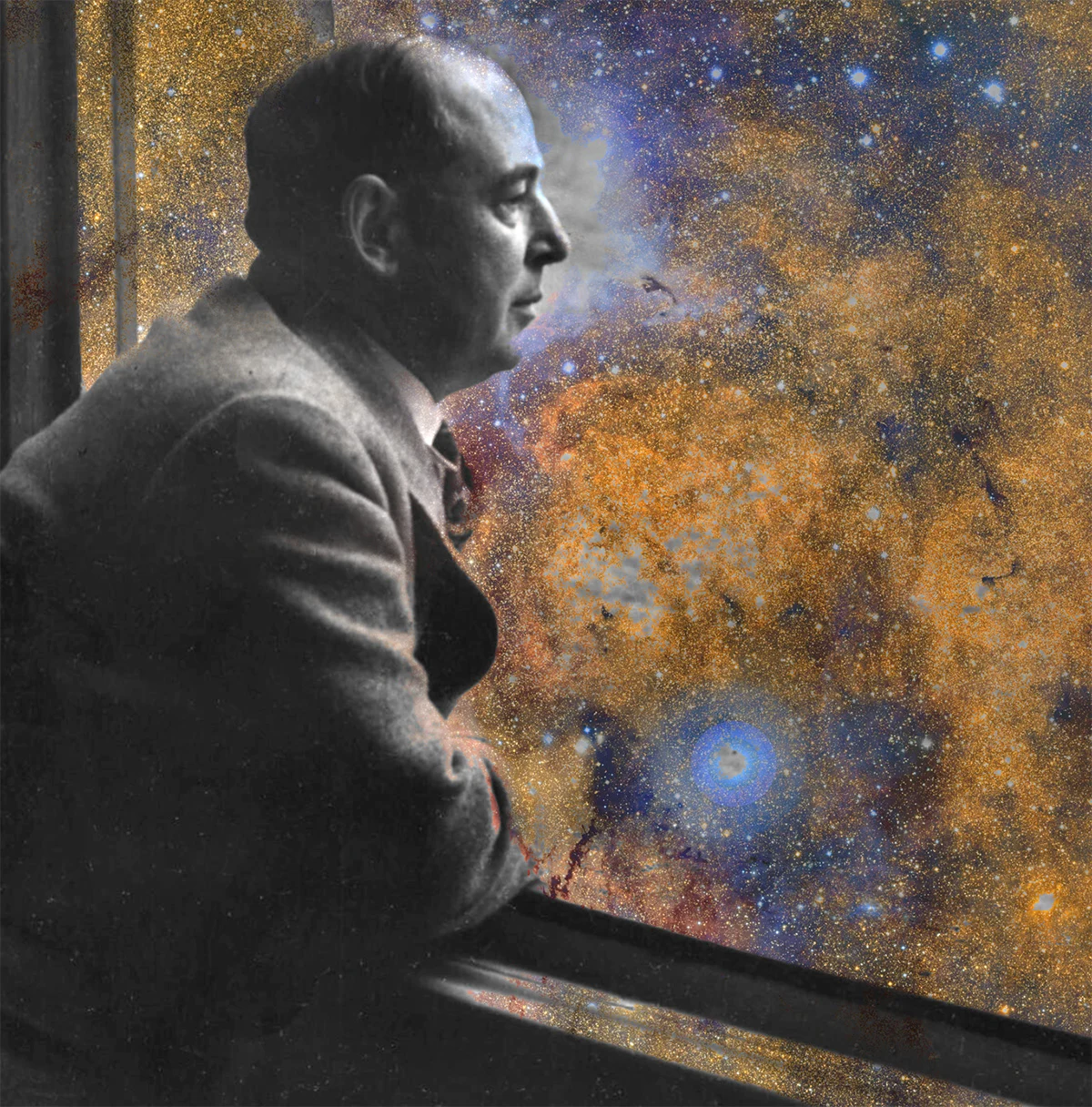
The nature of human interaction and the definition of a well-lived life have long been subjects of philosophical inquiry, but few thinkers have approached the topic with the precise, counterintuitive lens of C.S. Lewis. In his seminal memoir Surprised by Joy, published in 1955, Lewis posits a provocative thesis: that the key to being a fascinating and generous individual lies not in the performative act of self-sacrifice, but in a form of disciplined, outward-facing “selfishness.” This perspective challenges the conventional wisdom that links morality exclusively to altruism, suggesting instead that the quality of one’s contribution to the world is dictated by the direction of one’s attention.
Contextualizing the Philosophical Framework
Clive Staples Lewis (1898–1963), a renowned British academic and author of the Oxford and Cambridge tradition, occupies a unique space in 20th-century literature. Surprised by Joy serves as both an autobiography of his early life and a theological-philosophical treatise on the nature of desire and intellectual growth. The work was written during a period of transition in Lewis’s career, as he moved from being a purely academic figure to a globally recognized public intellectual.
The central paradox presented by Lewis—that one must be “interested” to be “interesting”—aligns with contemporary psychological research into the state of “flow.” In the context of his work, Lewis suggests that the human soul remains vibrant only when it is occupied by external stimuli—be it nature, history, or mythology—rather than the stagnant internal loop of self-reflection.
Chronology and Intellectual Development
Lewis’s journey toward these insights was not sudden; it was the result of a lifetime of academic rigor and personal introspection. Born in Belfast, his intellectual development was marked by the loss of his mother at a young age and a subsequent immersion in books as a means of processing the world.

- 1917–1925: Lewis serves in the British Army during World War I and subsequently completes his studies at Oxford, becoming a Fellow of Magdalen College. This period established his reputation for intense, objective inquiry.
- 1930s: Lewis begins his transition from atheism to Christianity, a period characterized by his debates with fellow scholars such as J.R.R. Tolkien. It was during these years that he began to refine his theories on “self-forgetfulness.”
- 1955: The publication of Surprised by Joy crystallizes his views on how the creative mind functions. By this time, Lewis had already authored major works like The Screwtape Letters and The Chronicles of Narnia, cementing his status as a master of narrative and analysis.
- 1963: Lewis passes away in Oxford. His writings continue to serve as foundational texts for the study of 20th-century ethics and literary theory.
The Dynamics of Selfishness vs. Self-Centeredness
In his analysis, Lewis makes a sharp distinction between being “selfish” and being “self-centered.” In his taxonomy, the “selfish” person—as he defines the term—is one who pursues their interests with such intensity that they are frequently occupied by external objects, people, or ideas. Because their mind is directed outward, they become conduits for new information, perspectives, and beauty.
Conversely, the “self-centered” individual is defined by a preoccupation with the internal state. Even if this person performs acts of sacrifice, the act is often tainted by a demand for validation, pity, or recognition. Lewis argues that this latter category is far more destructive, as it transforms the act of giving into a transaction. Data from modern behavioral studies on altruism support a similar nuance; studies on “burnout” in charitable work often show that those who give from a place of genuine external interest—rather than a sense of moral obligation or self-pity—sustain their output longer and with higher levels of efficacy.
Supporting Data and Psychological Implications
The psychological phenomenon of “self-forgetfulness,” which Lewis champions, mirrors the contemporary concept of “ego-dissolution” found in studies of high-performance athletes, artists, and scientists. According to Mihaly Csikszentmihalyi’s research on flow states, the most productive moments in human endeavor occur when the ego recedes and the subject is entirely lost in the task at hand.
When Lewis writes, “Shut your mouth; open your eyes and ears. Take in what is there,” he is effectively describing the cognitive state necessary for deep learning and empathetic engagement. By removing the ego from the equation, the individual creates space for genuine discovery. This is not merely a moral imperative but a functional necessity for the creative process.
Reactions and Critical Reception
Historically, critics of Lewis have occasionally misinterpreted his remarks on “selfishness” as an endorsement of narcissism. However, a closer reading of his broader body of work reveals that he is advocating for a radical form of humility. By focusing on the “distant mountain” or the “gods of Asgard,” the individual acknowledges that there are truths greater than their own immediate anxieties.

Reactions from theologians and literary critics have noted that Lewis’s arguments are rooted in the classical tradition of contemplation. Philosophers like Aristotle held similar views on the importance of theoria—the contemplation of truth—as a prerequisite for a meaningful life. In this sense, Lewis was not proposing a new ideology, but rather reclaiming an ancient one, adapted for the anxieties of the post-war industrial age.
The Broader Impact on Modern Productivity
The implications of Lewis’s thesis for the 21st-century workforce and social life are significant. We live in an era of unprecedented self-curation, where digital platforms encourage the constant presentation of the self. Lewis’s critique suggests that this trend is fundamentally antithetical to the state of being “interesting.” If one’s energy is spent entirely on managing the internal narrative or the public persona, there is no “mental fuel” left to absorb the world.
Furthermore, his observation that the “thrill” of discovery is rooted in the moment of self-forgetfulness provides a blueprint for overcoming creative blockages. By shifting the focus from the output (how one is perceived) to the input (what is being observed), individuals can regain the vitality required to create work that resonates with others.
Conclusion: A Legacy of External Engagement
The wisdom offered by C.S. Lewis in Surprised by Joy remains a vital corrective to the modern emphasis on internal validation. By advocating for a life directed toward a “thousand things” rather than the narrow confines of the self, he provides a framework for both personal satisfaction and genuine contribution. The “generosity of selfishness” is, ultimately, the generosity of the empty vessel—one that is constantly being filled by the world, and thus, always has something substantial to pour back out.
As we continue to navigate a landscape defined by increasing distraction and self-referential media, Lewis’s call to “open your eyes and ears” serves as an enduring reminder that the most interesting person in the room is usually the one who is least concerned with themselves. Through this discipline of outward-facing curiosity, the individual does not just survive the pressures of daily life; they transform their existence into a repository of meaning, ultimately serving the greater good by simply being, and remaining, deeply engaged with the world.