
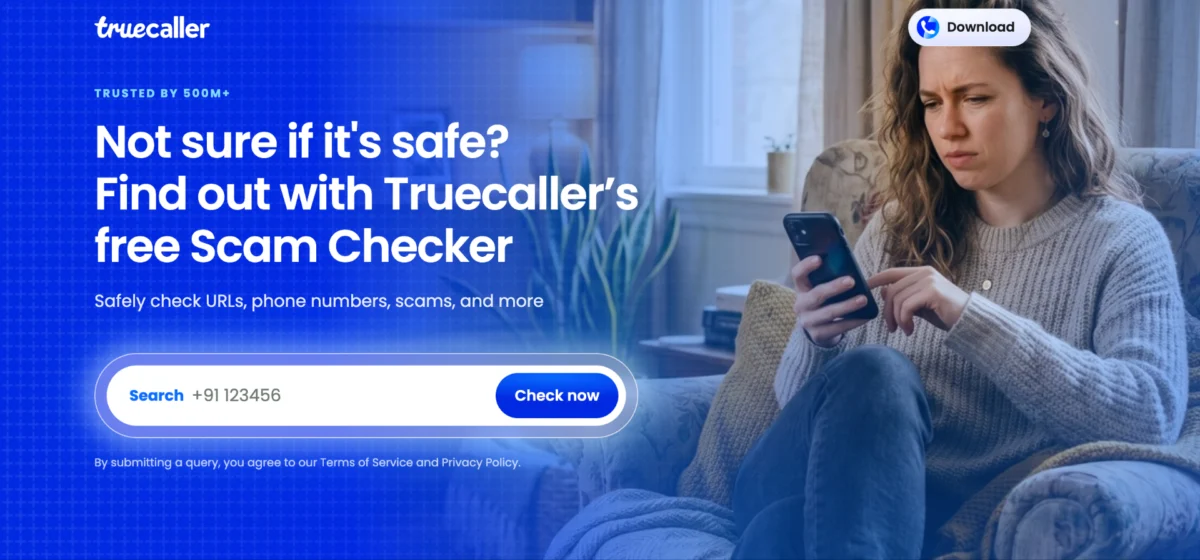
After more than a decade of establishing itself as the global leader in caller identification, Truecaller is fundamentally shifting its strategic focus to combat a modern, multi-channel threat landscape. On Sunday, the Swedish technology firm launched Scam Checker, a web and Android-based service that allows users to verify the legitimacy of suspicious phone numbers, links, and text messages without the need for an application download or a user account. This move marks a significant departure from the company’s traditional reliance on its core app, signaling an effort to capture a broader audience and address the evolving nature of digital fraud.
The Evolution of Digital Fraud
The rise of sophisticated phishing and smishing (SMS-based phishing) campaigns has forced security companies to rethink their defensive postures. According to a 2025 GSMA survey of Indian consumers, the nature of fraud has shifted dramatically from traditional voice calls to digital messaging platforms. The study found that 46% of individuals who reported being victims of scams were targeted via messaging apps, while 37% were approached through SMS. Only 32% of reported scams originated from traditional voice calls.
Recognizing that users often encounter suspicious links in messaging apps like WhatsApp or via SMS, Truecaller designed its new tool to be frictionless. By allowing users to copy and paste a URL or message into a browser, the tool automatically expands shortened links, follows redirects, and checks the final destination against a proprietary, AI-driven risk database. If a link or number is flagged by the community, the tool displays associated reports from ScamFeed, the company’s crowdsourced intelligence platform.
Data-Driven Development
The development of the Scam Checker was not merely a reaction to external pressures but a response to clear consumer behavior. Truecaller’s internal analytics indicate that approximately 14 million web searches are performed monthly by individuals attempting to verify the authenticity of unknown links and numbers.
"When you need it, you’re usually somewhere else," said Rishit Jhunjhunwala, CEO of Truecaller, in an interview. "The link shows up on WhatsApp. Your mother gets a message about a traffic fine. A friend forwards you a screenshot and asks, ‘Is this real?’ What people do in that moment is search."
By positioning the tool on the open web, Truecaller is capturing this "search intent," effectively turning a passive security check into a potential gateway for its broader ecosystem. While the tool is free, it acts as a lead-generation funnel, demonstrating the value of the platform’s deep, community-verified data to users who may not yet be part of the 500-million-strong Truecaller user base.
The Power of Community Intelligence
The effectiveness of the Scam Checker relies heavily on the "wisdom of the crowd." In India alone, Truecaller hosts approximately 20,000 live scam reports on its platform, with the community contributing roughly 1,300 new reports every week. The scale of the company’s data collection is immense; between September 14 and September 20 of this year, the company processed 12.9 billion messages globally, successfully identifying and flagging 20.3 million of them as fraudulent.
This massive volume of data serves as the backbone of the company’s risk products, which are sold to enterprises through the "Truecaller for Business" vertical. While the new Scam Checker is designed for the individual consumer, the intelligence gathered from these public interactions will undoubtedly strengthen the company’s enterprise-grade fraud and risk mitigation services, providing a competitive advantage in a crowded security market.

Strategic Realignment in a Competitive Market
The launch of Scam Checker comes at a critical juncture for Truecaller. Its core business, which thrives on its massive user base in India—the company’s largest market with over 350 million active users—is facing unprecedented challenges. The "moat" that once protected Truecaller is being eroded by both government initiatives and the hardware manufacturers themselves.
In India, the federal government has begun implementing the "Calling Name Presentation" (CNAP) service, a state-backed caller identification system that aims to standardize caller data at the telecom provider level. Simultaneously, smartphone giants Apple and Google have integrated native caller ID and spam-detection features into their operating systems, effectively turning a "feature" that once required a third-party app into a standard utility.
Furthermore, the regulatory environment is becoming increasingly complex. Last week, the Telecom Regulatory Authority of India (TRAI) issued a mandate requiring caller-ID apps to share user-submitted spam reports directly with telecom operators. Truecaller, while cooperating, has been vocal in its criticism, labeling the requirement a "one-way exchange." The company argues that while they are forced to provide valuable, crowdsourced data to telcos, the reciprocal flow of information—which would improve the accuracy of spam filtering—is not being prioritized by the regulators.
Looking Toward the Future
In light of these pressures, Truecaller’s pivot is clear: the company is moving beyond the "caller ID" label. "Caller ID was the first problem we solved, and it’s still how most people find us," Jhunjhunwala noted. "But scams moved to a more multi-channel approach with links and messages, and increasingly to voice and video. Our protection has to follow the scammer."
The company has outlined an aggressive expansion strategy for the Scam Checker. Following its initial rollout in India, the service is scheduled to launch in Latin America, the Middle East, Africa, and Southeast Asia—all regions where digital adoption is growing rapidly, often outpacing the public’s ability to identify and mitigate cyber threats.
The immediate roadmap for the tool involves expanding its detection capabilities to cover a wider variety of fraud patterns, including complex social engineering tactics. Additionally, the company is working on an update that will allow users to upload screenshots of suspicious messages, enabling the platform’s computer vision and text-analysis algorithms to flag scams that are currently difficult to parse through simple text input.
Implications for the Digital Security Landscape
The shift from a "gatekeeper" app model to an "open-access" security utility represents a broader trend in the cybersecurity industry. As fraud becomes more decentralized, protection must also become more accessible. By providing a free, no-login-required service, Truecaller is effectively commoditizing its data to remain relevant in a landscape where its original USP (Unique Selling Proposition) is being cannibalized by OS-level integration.
If successful, the move could solidify Truecaller as an essential security layer for the internet, rather than just an app for the dialer. However, the company must balance this expansion with the challenges of data privacy and the ongoing friction with regulators. As it moves into new global markets, the company will need to navigate diverse legal frameworks regarding data sovereignty and consumer protection, all while maintaining the trust of the community that provides the very data it relies upon.
The next few quarters will be telling for Truecaller. Whether the Scam Checker can effectively convert casual users into long-term subscribers or enterprise partners remains to be seen. What is certain, however, is that the company is no longer content to wait for the phone to ring; it is actively hunting the threats that have moved from the voice line to the digital ether.










Leave a Reply