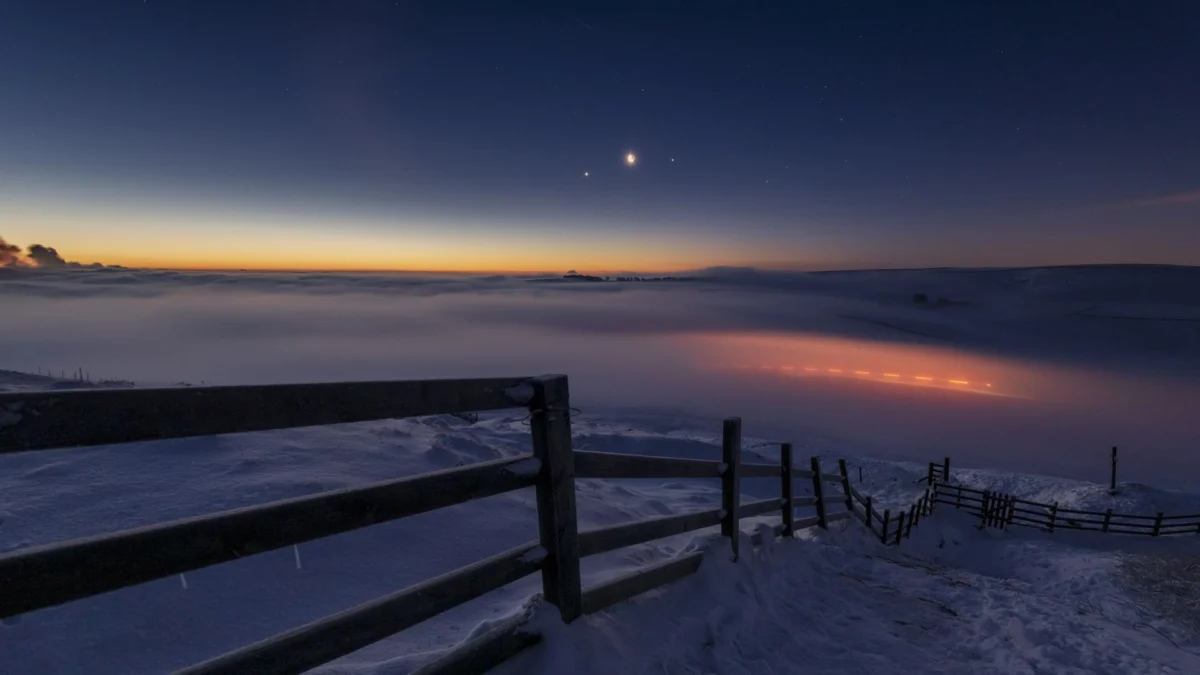
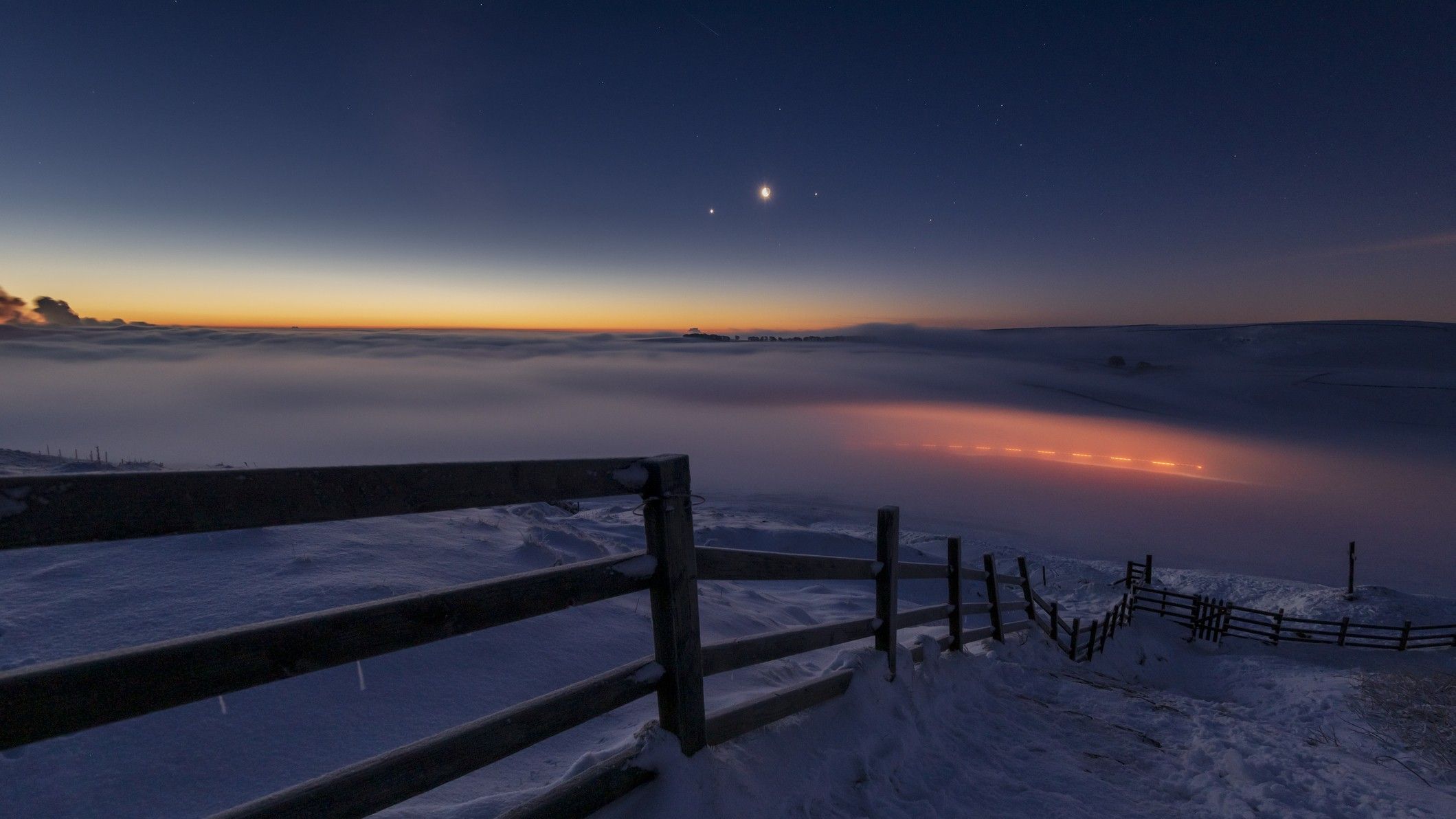
Early morning commuters and skywatchers across the globe are currently witnessing a celestial display of remarkable brilliance as the planet Venus makes a triumphant return to the predawn firmament. After passing through inferior conjunction on October 24—a position where the planet sits directly between the Earth and the sun—Venus has emerged from the solar glare to dominate the eastern horizon before sunrise. This transition, which effectively shifted the planet from an evening object to a morning beacon, marks the beginning of a prolonged and highly visible apparition that will persist through the coming months, providing a reliable and breathtaking sight for those looking skyward before their daily routines begin.
The Mechanics of the Inferior Conjunction
To understand why Venus seems to have appeared so suddenly, one must look at the orbital mechanics governing our inner solar system. Venus orbits the sun at a distance of approximately 67 million miles, compared to Earth’s average of 93 million miles. Because Venus moves faster in its orbit than Earth, it frequently "laps" our planet. When Venus passes between the Earth and the sun, it reaches what astronomers term an inferior conjunction.
During this period, the planet is effectively lost in the sun’s overwhelming radiance. However, as it moves past this point, its elongation from the sun increases daily. As of late October and early November, this separation has reached a point where the planet is clearly visible against the dark backdrop of the predawn sky. Unlike distant outer planets that move slowly across the constellations, Venus exhibits a dynamic and rapid ascent in the morning sky due to its proximity to Earth and its high orbital velocity, creating the "vaulting" effect noted by observers this week.
A Timeline of Visibility and Peak Brilliance
The progression of Venus during this cycle is highly predictable, offering a structured window for both casual observers and serious amateur astronomers to track its movement. Currently rising more than 90 minutes before the sun, the planet is steadily gaining altitude. This lead time will increase incrementally as the weeks progress.
By mid-December, specifically around December 17, Venus will rise nearly four hours before the sun. This duration provides a significant window of time for viewing the planet in a completely dark sky, away from the encroaching light of the dawn. This specific period is particularly valuable for astrophotographers and those interested in celestial mechanics, as the planet will be positioned high enough to avoid the atmospheric turbulence often associated with the horizon.
The crescendo of this apparition will occur on November 29, when Venus reaches its maximum magnitude of -4.9. In the astronomical magnitude scale—where lower numbers indicate greater brightness—this figure is extraordinary. To put this into perspective, Venus will be roughly 12 times brighter than Jupiter, the next most luminous planetary body currently visible. When compared to Sirius, the brightest star in the night sky, Venus will outshine it by a factor of 25. This level of brilliance is sufficient for the planet to cast faint, distinct shadows on the ground in environments free from artificial light pollution. Furthermore, as the planet reaches its peak, it may even be visible to the unaided human eye during the day, appearing as a singular, intense white point against the blue expanse of the morning sky, provided the observer knows exactly where to look.
The Christmas Star Phenomenon
The timing of this apparition has drawn inevitable comparisons to historical and cultural markers. The term "Christmas Star" is often applied to various celestial events that occur near the end of the calendar year. While the biblical account of the Star of Bethlehem remains a subject of historical and theological debate, the phenomenon of a bright object appearing in the eastern sky is a recurring natural event.
Astronomers note that while Venus is not an astronomical "star," its position and extreme radiance fulfill the layman’s expectation of such an event. The planet’s presence during the holiday season provides a natural focal point for public interest in astronomy. Public observatories and planetariums often report a surge in inquiries during these periods, as the general public seeks to identify the "strange, bright light" seen on their morning commutes. Educators, such as those at the Hayden Planetarium in New York, frequently use these moments to distinguish between planetary bodies and the phenomenon of Unidentified Aerial Phenomena (UAPs) or "UFOs," noting that the planet’s steady, non-twinkling light is a hallmark of its planetary nature.
Long-Term Orbital Trends and Eventual Departure
While the current display is impressive, it is transient. Following its peak in late December, the orbital geometry will begin to shift once more. Starting in early January, the planet will begin a slow descent back toward the solar horizon. The lead time before sunrise will begin to shrink, decreasing by approximately 90 seconds each morning throughout the early months of the new year.
By the time the spring equinox approaches, Venus will be rising much closer to the dawn, roughly 100 minutes before sunrise. This trend of rising progressively later will continue through the spring, until by late June, the planet will appear less than an hour before the sun breaks the horizon. By July, Venus will once again be swallowed by the morning twilight, entering a "summer sabbatical." During this time, the planet will be positioned on the far side of the sun from Earth, rendering it invisible to terrestrial observers until it begins its next cycle in the evening sky approximately one year from now.
Scientific and Educational Implications
The prominence of Venus provides a valuable opportunity for public science engagement. Because the planet is so easily identified without the need for telescopes or binoculars, it serves as an accessible entry point for STEM education. Educational institutions often leverage this visibility to teach the public about planetary phases. Much like the moon, Venus exhibits phases because it is an inner planet; through a telescope, observers can currently see it as a thin, brilliant crescent. As the weeks move forward, the planet will move toward a "gibbous" phase, becoming more illuminated as its position relative to the Earth and sun changes.
Furthermore, the study of Venus’s atmospheric brightness—driven by its highly reflective, sulfuric-acid-laden clouds—continues to be a subject of interest for planetary scientists. While the view from Earth is limited to a brilliant point of light, the data gathered by space agencies regarding the planet’s climate and surface conditions provide context to the light we see.
For the average citizen, however, the primary impact is aesthetic and observational. In an era where light pollution frequently masks the cosmos, the sheer luminosity of Venus allows it to pierce through the glow of urban centers. It remains one of the few celestial objects that can be enjoyed by urban dwellers without the need for specialized equipment or dark-sky travel. As Venus continues its ascent, it serves as a reminder of the dynamic and predictable nature of our solar system, acting as a beacon that bridges the gap between scientific observation and the human experience of the natural world. Those looking to the east-southeast in the hours before dawn over the coming weeks are witnessing one of the most reliable and spectacular shows in the sky, a spectacle that will not be repeated with such clarity until the next cycle begins in the following year.