The United States Department of Defense has officially unveiled the "Fortress America" program, a sweeping strategic initiative aimed at modernizing domestic military installations. While the project is framed through the lens of national security, military readiness, and energy autonomy, its core architectural and logistical philosophy mirrors the "15-minute city" urban planning model. This transition represents a significant shift in how the Pentagon views the relationship between base infrastructure, personnel retention, and operational resilience.
Defining the Fortress America Initiative
Announced by Secretary of Defense Pete Hegseth on September 30, the Fortress America program—formally titled "Federal Operations for Resilience, Troop Resources, Energy, Supply, and Survivability"—is designed to create self-sustaining military enclaves. The primary objective is to decouple these facilities from their reliance on regional civilian infrastructure. By fostering internal ecosystems that provide housing, medical care, education, and essential services within walking distance of work centers, the Department of Defense aims to ensure that bases remain functional during extreme weather events, cybersecurity threats, or large-scale grid failures.
The program addresses long-standing critiques regarding the quality of life on domestic installations. For decades, military housing and base infrastructure have been plagued by reports of deferred maintenance, including mold, failing plumbing, and inadequate public amenities. The Fortress America initiative seeks to rectify these issues by treating the military base as a "compact, walkable" entity.
Chronology and Policy Development
The roots of this initiative can be traced back to a growing consensus within the Pentagon that modern threats require a more localized approach to sustainment. Following the global disruptions caused by the 2020 pandemic, the vulnerabilities of centralized, car-dependent supply chains became a focal point for defense analysts.
- 2020–2022: The COVID-19 pandemic highlights the fragility of large-scale infrastructure, prompting internal military reviews of "base resilience."
- September 30, 2026: Secretary of Defense Pete Hegseth officially releases the directives for the Fortress America program, emphasizing the need for energy independence and troop welfare.
- October 29, 2026: Assistant Secretary for Energy, Installations, and Environment, Dale Marks, provides a detailed technical briefing outlining the "Next Great American Base" concept.
- Late 2026: The Department begins identifying pilot locations, with regional governors and state stakeholders engaging in early-stage competition to host the initial infrastructure upgrades.
The 15-Minute City Model: A Technical Perspective
The "15-minute city," a concept popularized by urbanist Carlos Moreno in 2016, posits that all urban residents should be able to access their essential needs—work, school, healthcare, and groceries—within a 15-minute walk or bike ride from their home. Critics of the model, often found in the political sphere, have frequently characterized the concept as a mechanism for government overreach and the restriction of movement.

However, from an urban planning and military logistics standpoint, the model is essentially a strategy for efficiency. By concentrating services, the military reduces the "commuter burden" on personnel. Data consistently demonstrates that when residents are less dependent on private vehicle transit, their health outcomes improve, carbon footprints decrease, and time spent in unproductive commuting is reclaimed for training or personal recovery.
In the context of Fortress America, the application of this model is pragmatic. If a base must be capable of operating in isolation, the density of services is not a matter of social planning, but a matter of survivability. A walkable base is a resilient base, as it remains operational even if fuel supplies for private vehicles are interrupted.
Official Responses and Strategic Rationale
The Pentagon’s pivot has been characterized by an emphasis on "warfighter retention." Assistant Secretary Dale Marks has been vocal about the link between infrastructure quality and professional performance. In his October presentation, Marks stated, "The nation shouldn’t expect warfighters to focus on high-stakes, multi-domain operations when they come home to base housing with black mold, failing plumbing, and leaky roofs."
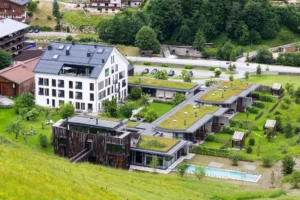
This statement highlights a shift toward viewing the base as a high-functioning campus rather than a collection of disparate, poorly maintained facilities. The "Next Great American Base" is expected to include centralized town centers, advanced healthcare clinics, and modern education facilities, all interconnected by pedestrian-friendly pathways.
While the program has faced some skepticism regarding its budget and implementation timeline, the Department of Defense is moving with urgency. The procurement process for these upgrades is being fast-tracked, with a focus on integrating renewable energy microgrids—such as solar and battery storage—to ensure that these "15-minute" hubs remain powered even if the main regional grid goes offline.
Data-Driven Implications for Infrastructure
The implementation of the Fortress America program is expected to have broad implications for domestic construction and energy policy. By focusing on decentralized power, the Pentagon is effectively creating a testbed for grid-independent technology.

- Energy Resilience: By integrating solar-enabled microgrids, the military reduces its reliance on external energy providers, a major vulnerability in the event of a national grid failure.
- Economic Impact: The construction and maintenance of these new facilities represent a massive injection of capital into the regions where these bases are located.
- Urban Planning Precedent: As the Department of Defense is one of the largest property owners in the United States, its adoption of the "15-minute" model provides a tangible, high-profile example of the benefits of compact, mixed-use design. This may influence local municipal planning as surrounding civilian communities seek to align their own infrastructure with the revamped military hubs.
Analysis of the Operational Shift
The irony of the military adopting a model that has become a flashpoint for political polarization is not lost on analysts. However, the Pentagon’s approach is notably apolitical. By framing the 15-minute concept as "Fortress America," the Department of Defense has successfully re-branded the principles of sustainable, walkable urbanism as a cornerstone of national defense strategy.
The shift signifies that the military recognizes the "modern threat landscape" is not just about external adversaries, but about the stability of the home front. If a military base is not self-contained, its ability to deploy and sustain operations is perpetually at risk. By creating neighborhoods where soldiers and their families can live, work, and thrive without relying on external civilian networks for daily survival, the DoD is essentially insulating its human capital from broader economic or infrastructure volatility.
Future Outlook
The success of the Fortress America initiative will likely hinge on the speed of implementation and the degree of integration between the new energy systems and existing base layouts. With the directive to see results within months rather than years, the pressure on acquisition teams to deliver is immense.
As the program moves forward, observers will be watching to see if the "Next Great American Base" model effectively improves retention rates and operational readiness. If the model proves successful in a high-stakes environment like the military, it will provide compelling, evidence-based data that may reshape the broader national conversation on urban planning, land use, and the importance of localized, walkable, and resilient community infrastructure. The Department of Defense has essentially initiated a massive, large-scale experiment in urban design, the results of which will have lasting effects on both military culture and the future of American development.