
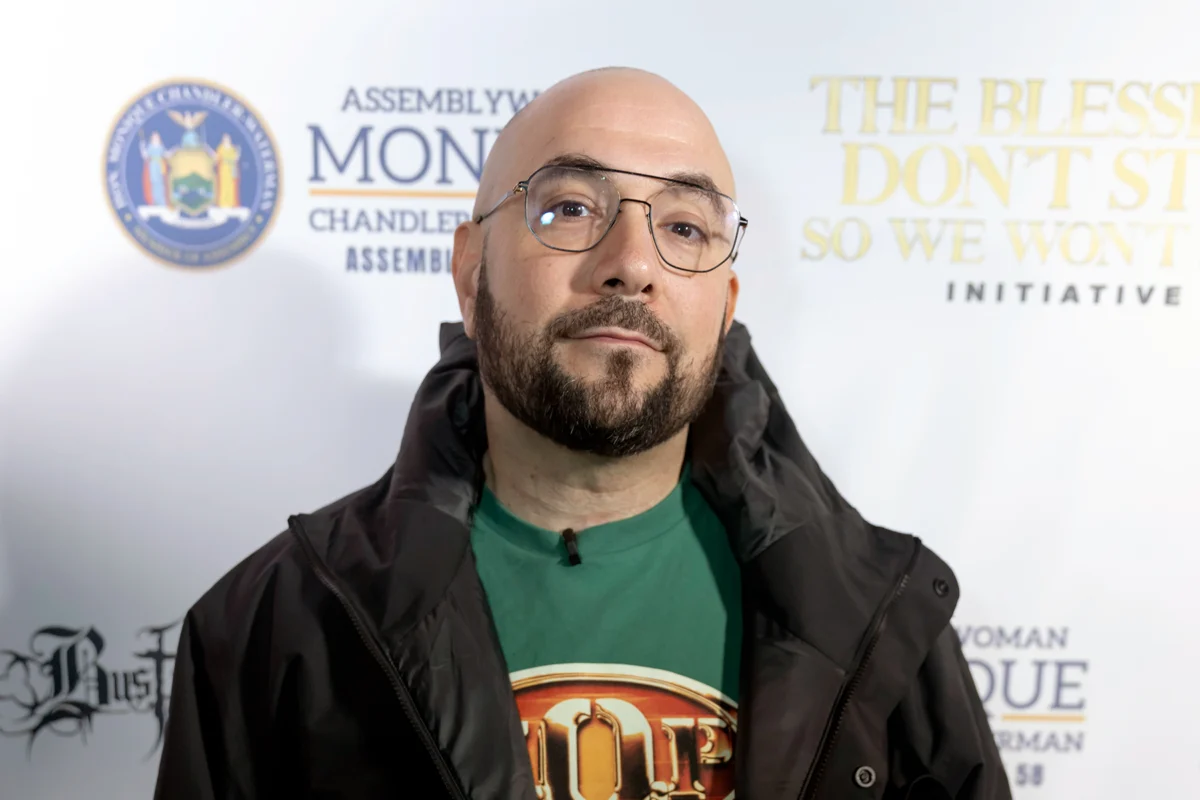
In the complex ecosystem of modern hip-hop, few family names carry the weight and historical resonance of the Rosenbergs. While Paul Rosenberg has long commanded respect behind the scenes as the architect and manager of Eminem’s historic career, Peter Rosenberg has spent decades defining the cultural and critical landscape of radio. From his formative years on New York’s Hot 97 to his current role co-hosting the Ebro Laura Rosenberg Show, Peter has built a career grounded in credibility within a notoriously insular and unforgiving industry. Yet, in an era defined by hyper-polarized digital discourse, navigating the intersection of identity, music, and global politics has become increasingly perilous, particularly for Jewish figures working in entertainment.
The fragility of this cultural tightrope was thrown into sharp relief during a tumultuous week in the music business, triggered by a geopolitical flashpoint that spilled directly onto the concert stage. Superstar pop artist Ed Sheeran found himself ensnared in a widening controversy during his global Loop Tour when his opening act, Macklemore, used the platform to advocate for the Palestinian cause. Following two consecutive performances in New Jersey—both featuring Macklemore—the immediate future of the North American leg of Sheeran’s tour was thrown into sudden jeopardy. The incident quickly transcended a standard backstage dispute, metastasizing into a high-stakes cultural battle involving venue owners, corporate stakeholders, and polarized fanbases.
Roots of the Conflict and the Catalyst of October 7
The collision of pop music and Middle Eastern politics does not occur in a vacuum; it is underpinned by decades of historical grievances, contested narratives, and generational trauma. However, contemporary discourse was irrevocably altered by the events of October 7, an unprovoked assault on southern Israel that resulted in the mass casualties of civilians, peace activists, and attendees at the Nova music festival. The scale of the violence, followed by the subsequent large-scale military campaign in Gaza by the Israeli government, created an environment where the demand for immediate ideological alignment routinely eclipsed the capacity for nuanced discussion.
In the wake of October 7, the cultural atmosphere within the entertainment and media sectors shifted dramatically. For many Jewish artists, executives, and media personalities, the initial silence or muted response from progressive allies regarding the atrocities committed against Israeli civilians felt deeply alienating. Conversely, Palestinian advocates and their supporters argued that decades of military occupation, blockades, and rising civilian casualties in Gaza demanded immediate and vocal condemnation. Within this fractured landscape, artists who attempted to straddle the divide or speak out faced immediate retribution from opposing ideological camps, rendering public discourse volatile and unforgiving.
The Fallout of the Ed Sheeran and Macklemore Tour Dispute

The tension surrounding Sheeran’s tour reached a boiling point when Robert Kraft, the billionaire owner of the New England Patriots and proprietor of Gillette Stadium, intervened. Kraft publicly characterized Macklemore’s onstage political commentary as hate speech, prompting questions about the operational viability of hosting the tour at major venues. Rather than stepping back, Macklemore held firm to his position, emphasizing the staggering loss of young lives in Gaza. The standoff intensified when several other supporting acts and members of Sheeran’s backing band withdrew from the tour in solidarity with Macklemore.
Industry observers and media critics immediately pointed out the ironies inherent in the situation. Critics noted the stark contrast between the swift, punitive measures enacted against Macklemore for expressing pro-Palestinian sentiments and the relatively muted industry-wide accountability faced by other artists. Among the most vocal critics was Peter Rosenberg, who took to social media to express profound disappointment with cultural figures who offered forgiveness or rehabilitation to public figures who had recently engaged in blatant antisemitic rhetoric, drawing a direct comparison to the return of Kanye West following his public praise of Adolf Hitler and dissemination of antisemitic tropes.
The Rising Tide of Antisemitism in Digital Spaces
The polarization within the music industry mirrors a broader, more alarming surge in antisemitism across digital and public spaces. Long before the events of October 7, the cultural landscape had already been conditioned by high-profile normalization of hate speech. Peter Rosenberg notes that the vitriol directed at him on social media shifted palpably following Kanye West’s sustained public campaign against Jewish people. The normalization of these tropes created an open season for online harassment, where everyday discourse frequently collapsed into weaponized identity politics.
This digital hostility has fundamentally altered the lived experience of Jewish figures in the public eye. Casual antisemitism—historically dismissed as background noise or ignorant stereotyping—has been supercharged by algorithmic amplification and political radicalization. According to Rosenberg, the internet’s architecture actively discourages moderation, refusing to accommodate the cognitive dissonance required to hold two concurrent truths: that rising antisemitism is a clear and present danger, and that state-sanctioned military actions executed by the Israeli government can and should be subjected to rigorous moral critique.
A House Divided: Zionism, Identity, and Political Evolution
Peter Rosenberg’s personal history offers a compelling lens through which to examine the generational evolution of Jewish and Zionist identity in America. Growing up in a politically progressive, heavily Jewish suburb of Washington, D.C., Rosenberg was shaped by a family history deeply marked by the Holocaust; his mother was born in a post-World War II displaced persons camp in Germany after her Polish family fled Nazi persecution. Simultaneously, his household maintained a complex relationship with Zionism through his father, MJ Rosenberg, a writer and former policy analyst who spent years working inside pro-Israel political organizations before becoming disillusioned by what he perceived as a systemic resistance to a peaceful, two-state resolution.

This familial trajectory reflects a broader ideological schism within the diaspora. For decades, institutional support for the Israeli government was treated as a monolithic pillar of Jewish identity in the West. However, the assassination of Israeli Prime Minister Yitzhak Rabin in 1995 by a right-wing extremist served as a profound turning point for many dovish Zionists, signaling the derailment of the peace process and sparking a long-term reassessment of Israeli state policy. Today, younger generations of Jewish Americans increasingly separate their cultural and religious heritage from uncritical support of current Israeli governance, fighting to carve out a space where criticizing right-wing nationalism is not conflated with self-hate or antisemitism.
The Failure of Leadership and Public Relations
As the controversy surrounding the Sheeran-Macklemore tour demonstrated, institutional leadership frequently misjudges the current cultural climate. Figures like Robert Kraft possessed the unique leverage required to de-escalate the situation through direct, earnest dialogue rather than punitive ultimatums. Instead, the reliance on top-down censorship and swift corporate cancellation mirrored the exact Hollywood power dynamics that bad-faith actors weaponize to validate conspiracy theories about Jewish control of the media.
By failing to engage with dissenting viewpoints or allow for transparent, good-faith conversations, institutional stakeholders inadvertently corroborated the narratives peddled by extremists. Rosenberg argues that the old playbook of silencing controversial speech through corporate muscle no longer functions in an interconnected, decentralized digital age. Attempts to suppress public discussion only serve to amplify the underlying tensions, cementing an unhelpful association between American Jews and the military actions of a foreign government.
The Path Forward for Rational Discourse
The overarching tragedy of the current cultural moment lies in the systematic silencing of the rational middle. On both extremes of the political spectrum, ideological gatekeepers demand absolute conformity, treating empathy as a zero-sum game. To acknowledge the horror of civilian casualties in southern Israel on October 7 is seen by some as an endorsement of military retaliation in Gaza; conversely, expressing anguish over the destruction of Palestinian infrastructure is frequently dismissed by hardliners as a minimization of Jewish suffering.
Breaking this cycle requires a deliberate rejection of tribalism and an embrace of complex, multi-layered truths. As Peter Rosenberg observes, true moral clarity demands the capacity to stand simultaneously against all forms of bigotry—combating the resurgence of traditional antisemitism while refusing to excuse state-sanctioned violence against Palestinian civilians. Until cultural and political leaders recognize that nuance is not a weakness, the music industry and the broader public square will remain trapped in an endless, destructive shouting match, drowning out the voices striving for sustainable peace and mutual recognition.







Leave a Reply